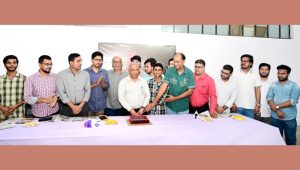
Pahari Chattra Parishad (PCP), also known Hill Students Council, has called upon the BNP government to accept full autonomy for Chittagong Hill Tracts (CHT) and ensure constitutional recognition for all minority ethnic groups under their respective identities.
The demand was voiced during a student rally held at the anti-terrorism Raju Memorial Sculpture of Dhaka University on Friday, following the organisation’s 28th central council.
Earlier, the council session took place from 9am to 5pm, where a new 25-member central committee was formed. Samar Chakma was elected as President, Sohel Chakma as General Secretary, and Ronald Chakma as Organising Secretary.
Addressing the rally, PCP leaders stated that even 55 years after independence, minority ethnic groups have not received constitutional recognition. They argued that being labelled as “tribal” or “small ethnic groups” is degrading and threatens their ethnic existence.

Dilip Roy, coordinator of the student alliance and president of Biplobi Chhatra Maitri, highlighted the plight of the Bawm community, noting they have been imprisoned and labelled as terrorists.
He compared the current treatment of hill people to the oppression faced by Bengalis during the West Pakistan era, adding that military deployment in the hills began under Sheikh Mujib and settler rehabilitation occurred during Ziaur Rahman’s tenure.
The PCP leaders demanded the withdrawal of military rule from the CHT to establish “genuine democratic governance.”



They questioned the disparity where democracy exists in the plains while the hills remain under military administration, asserting that the ’24 mass uprising did not happen to support such discrimination.
They further urged the BNP government not to betray the anti-discrimination spirit of martyrs like Abu Sayed and Mir Mahfujur Rahman Mugdho.
The organisation also strongly criticised a statement made by Home Minister Salahuddin Ahmed on 11 March at a seminar organised by the “Citizen’s Platform for SDGs, Bangladesh.”
The minister reportedly stated that 100% human rights cannot be ensured in the CHT due to threats to regional integrity and sovereignty, and that the Bangladesh Army should remain outside the jurisdiction of the National Human Rights Commission.
The PCP condemned these remarks as an incitement for the army and settlers to violate human rights and demanded their immediate withdrawal.
Reflecting on the organisation’s history, outgoing president Amal Tripura noted that the PCP was born in 1989 in protest against the Longadu massacre.
He claimed the ruling class has consistently used money and resource allocations to create divisions among students, but that the movement has resisted such “conspiracies and tactics.”
On the issue of security, women’s leader Rita Chakma highlighted the ongoing violence against women. Citing a report by the Bangladesh Mahila Parishad, she noted that 47 women and children were killed and 57 raped across the country in March alone.
She described the situation in the hills as even more dire, with women facing abduction and torture without proper investigation or justice.