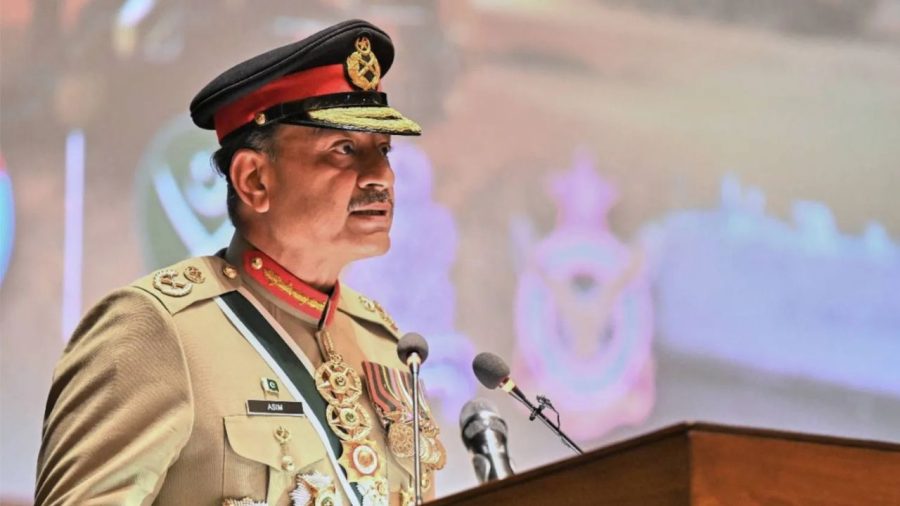

Pakistan’s parliament has enacted landmark legislation establishing the statutory powers of country’s top military office, cementing a major structural overhaul that consolidates operational control under the newly created office of the Chief of Defence Forces (CDF).
The National Assembly approved the Defence Forces of Pakistan Act, 2026, alongside an amendment to the National Command Authority Act, 2010, on 20 August.
Passed within hours of cabinet clearance, these laws formalise the CDF role, which was originally established through the 27th constitutional amendment in November last year, reports Al Jazeera.
Operational command and strategic reorganisation
The legislative changes represent the most significant restructuring of Pakistan’s higher military command since 1976.
The reform abolishes the post of chairman of the Joint Chiefs of Staff Committee (CJCSC), which previously functioned as a limited coordinating body with no operational command over individual service branches.
In its place, the newly formed Defence Forces Headquarters (DFHQ) is headed by the CDF, a post currently occupied by Field Marshal Asim Munir, who concurrently serves as the Chief of Army Staff. Munir was promoted to the rank of Field Marshal in May last year following a four-day military conflict with India.

Unlike the advisory CJCSC role, the CDF has been granted full statutory operational command and control over the army, navy, and air force, making the office directly responsible to the federal government for all military operations.
Moreover, the CDF is expected to serve as the deputy chairman of the National Command Authority (NCA), the prime minister-led body overseeing the country’s nuclear arsenal.
Consolidation of nuclear and conventional missile authority
The overhaul also modifies Pakistan’s strategic command structure. The Commander of the National Strategic Command (CNSC), which oversees nuclear-capable forces, must now come exclusively from the army and is appointed on the recommendation of the CDF.
In July, General Syed Aamer Raza, the former Chief of General Staff, was promoted and appointed as the inaugural CNSC. This strategic shift formally excludes the navy and air force from holding this critical post.




Additionally, conventional missile systems have been separated from the strategic nuclear chain of command through the establishment of the Army Rocket Force Command last year.
While the military’s Strategic Plans Division (SPD) is expected to continue running the nuclear and missile programmes under the CNSC, the CDF is anticipated to hold substantial influence in nuclear decision-making, even though formal control remains with the prime minister.
Debate over army-centrism and service balance
The consolidation of authority has exposed deep divisions within the country’s defence establishment.
Historically, the CJCSC post could rotate among the three services, although the last non-army officer to hold the position was Air Chief Marshal Farooq Feroze Khan, who retired in 1997. The permanent abolition of the CJCSC means navy or air force officers are now legally blocked from reaching the strategic command apex.
Former military officials and analysts have warned that the army-centric system could erode the distinct identities and promotional autonomy of the other services.
Ahmed Saeed, a retired vice admiral and former president of the National Institute of Maritime Affairs, expressed concern that a land-centric doctrine could subordinate sea-based deterrence requirements, which require specialised naval expertise.
However, Naeem Khalid Lodhi, a retired three-star general and former defence secretary, suggested that future operational rules might require the CDF to act only upon the recommendations of the respective naval and air chiefs.
Erosion of civilian control
The legislation has also sparked criticism regarding its impact on civilian oversight. Under the previous system, the retirement or dismissal of a military officer required a summary submitted to the prime minister and cabinet.
The new law grants the CDF sole authority to dismiss, retire, or reduce the service of any officer via a direct letter, completely bypassing the civilian executive.
Critics, including former military officer and lawyer Colonel Inam Raheim, argue that this concentration of power significantly weakens elected civilian leadership.
Defence analysts have also suggested that granting operational command to the CDF violates Article 243 of the Constitution, which vests overall control of the armed forces in the federal government.
Karachi-based lawyer Abdul Moiz Jaferii noted that while service chiefs remain structurally equal to one another and subordinate to civilian authority under the constitution, the lack of an independent judiciary prevents any formal legal challenge to the army’s hegemony.
Defending the legal transition
In contrast, supporters of the legislation argue it represents standard constitutional implementation.
Hafiz Ahsaan Ahmad Khokhar, a Supreme Court advocate, stated that parliament has not bypassed the constitution, but has merely given legislative effect to a structure already enacted by the 27th amendment.
However, analysts point out that while Khokhar compared the CDF post to similar top defence roles in Canada, the United Kingdom, and Australia, those nations maintain separate, rotational command posts that are never concurrently held by the active chief of a single service.
In Pakistan, the CDF remains permanently and concurrently tied to the chief of the army.