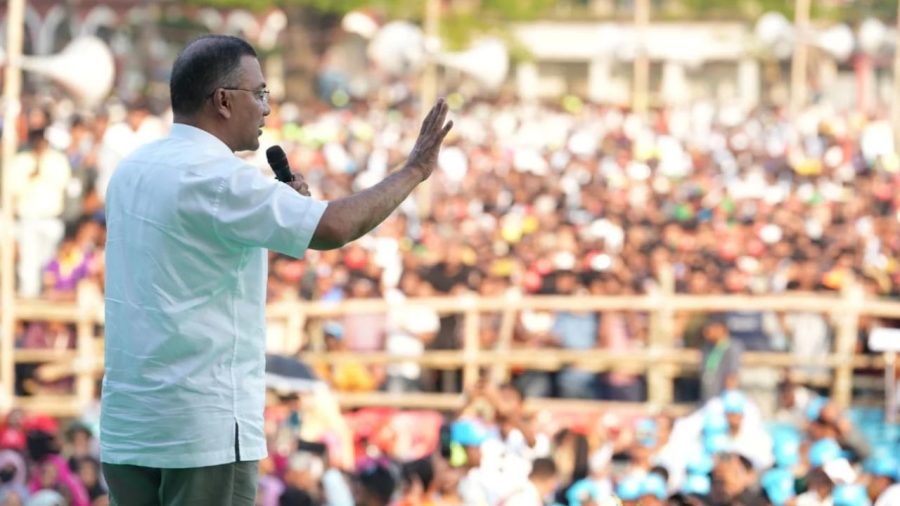



Prime Minister Tarique Rahman on Tuesday announced a series of major development plans focusing on employment creation, agricultural advancement, water scarcity resolution, and healthcare expansion.
Speaking as the chief guest at a grand public rally held at the historic Madrasa Maidan in Rajshahi, Tarique outlined government initiatives to reopen 46 closed factories nationwide between January and December 2027 to generate jobs, highlighting the importance of encouraging both local and foreign investment.
At the rally, the prime minister also inaugurated the disbursement of a Tk12 crore incentive for 38,970 sugarcane farmers across 15 sugar mill zones in the country by pressing a computer button to instantly transfer the funds to their mobile accounts.
Tarique said the financial assistance would reach the mobile accounts of sugarcane farmers within a few minutes of pressing the button, before personally handing over incentive cheques to 15 sugarcane farmers.
The 15 farmers who received the cheques are Abu Sayeed Chan, Abdul Awal Malek, Abdul Mannan Mondal, Emaj Uddin, Md Kahar, Golam Rabbani, Sabita Rani, Jalal Uddin Mridha, Ziaul Haq, Mohidul Islam, Abdul Majed, Nirand Kumar Ghosh, Shamimur Rahman, Rima Khatun, and Rafiqul Islam.
Welfare cards and healthcare expansion
Unveiling key agricultural welfare schemes, the prime minister announced plans to introduce a “Farmer Card” to assist farmers with agricultural inputs such as fertiliser, seeds, and pesticides, while also providing crop insurance, bank loans, and weather updates to boost production and farmer capacity.
To enhance family financial security, Tarique outlined plans to launch a “Family Card” programme aimed at providing financial support to households and creating opportunities for self-reliance under women’s leadership.

On healthcare, the prime minister said the government plans to increase the bed capacity of every upazila hospital across the country from 50 to 150 within the next five years, incorporating separate beds for women and children as well as dialysis facilities to expand healthcare at the upazila level.
Padma Barrage and water security
Addressing the water crisis in Rajshahi and the northern region, Tarique spoke of initiatives to construct barrages on the Padma and Teesta rivers.
He expressed optimism that implementing the Padma Barrage would benefit Rajshahi, its surrounding areas, and nearly 14 districts, adding that discussions are ongoing to secure Bangladesh’s fair share of water.
Although Tarique highlighted government efforts to initiate construction swiftly, specific details regarding funding, technical plans, and a fixed timeline were not disclosed at the rally.




During the address, he alleged that a certain group in the country was receiving foreign funding in an attempt to create instability in some factories, though further details or the identity of the group were not specified.
Recalling the 1971 Liberation War and the 2024 movement, Tarique highlighted government initiatives to provide employment for the families of martyrs, ensure medical treatment for those injured in the July movement, and construct memorials.
Revitalising closed factories
Ruhul Kabir Rizvi, acting secretary general of Bangladesh Nationalist Party (BNP), presided over the rally and highlighted plans to reopen closed sugar mills, textile mills, jute mills, and silk factories in Rajshahi to increase employment and revitalise the local economy.
Describing the current state of the Padma River in Rajshahi, the acting secretary general noted that the river now lacks water flow and is no longer what it used to be.
He pointed out that Rajshahi is rich in agricultural land producing sugarcane and vegetables, with vast potential in sugar, textile, jute, and silk industries that have long remained closed.
He added that since taking responsibility, the BNP government has been working to reopen these closed industrial units to generate new employment opportunities and accelerate economic activity in Rajshahi.
Regional development demands
Land Minister Mizanur Rahman Minu welcomed the Padma Barrage initiative, noting its vital role in countering the adverse effects of Farakka, boosting agricultural production, and maintaining environmental balance.
Raising a set of development demands for the region, the land minister urged Tarique to establish an agricultural university, upgrade healthcare services at Rajshahi Medical University, establish a child hospital, and modernise Shah Makhdum Airport with cargo flight facilities to enable direct export of local agricultural produce.
He also called for special priority for the agriculture-dependent region, alongside advancing the Rajshahi Bypass Road project and other ongoing and proposed development initiatives.
Recalling the deep historical ties of former president Ziaur Rahman and former prime minister Begum Khaleda Zia with Rajshahi, the land minister noted that both leaders had addressed rallies at the Madrasa Maidan multiple times, adding that Khaleda Zia’s administration had taken initiatives to develop Rajshahi as a “Green City.”
Praising the leadership of Prime Minister Tarique Rahman, the land minister said democracy has been restored under his stewardship as the nation moves forward under new leadership.
He pointed out that Rajshahi was once known as the country’s granary, but its agricultural and economic potential suffered under the previous government.
Paying tribute to the martyrs of the 2024 movement and acknowledging sacrifices from the independence struggle to recent movements, the land minister wished Tarique long life and good health.
Mahfuzur Rahman Riton, administrator of Rajshahi City Corporation and general secretary of Rajshahi City BNP, conducted the rally.
Other speakers at the event included Gayeshwar Chandra Roy, member of the BNP National Standing Committee; Cultural Affairs Minister Nitai Roy Chowdhury; Land Minister Mizanur Rahman Minu; Industry Minister Khandaker Abdul Muktadir; and central and local leaders.
Also present at the rally were Women and Children Affairs Minister AZM Zahid Hossain; Disaster Management and Relief Minister Asadul Habib Dulu; State Minister for Water Resources Forhad Hossain Azad; State Minister for Local Government Mir Shahe Alam; and Rehan Asif Asad, adviser to the prime minister.
The implementation of these announced plans – including factory reopenings, farmer incentives, healthcare expansion, and the Padma Barrage project – will depend on specific timelines, funding allocation, and operational progress, which remain key areas of observation for local residents expecting tangible results.