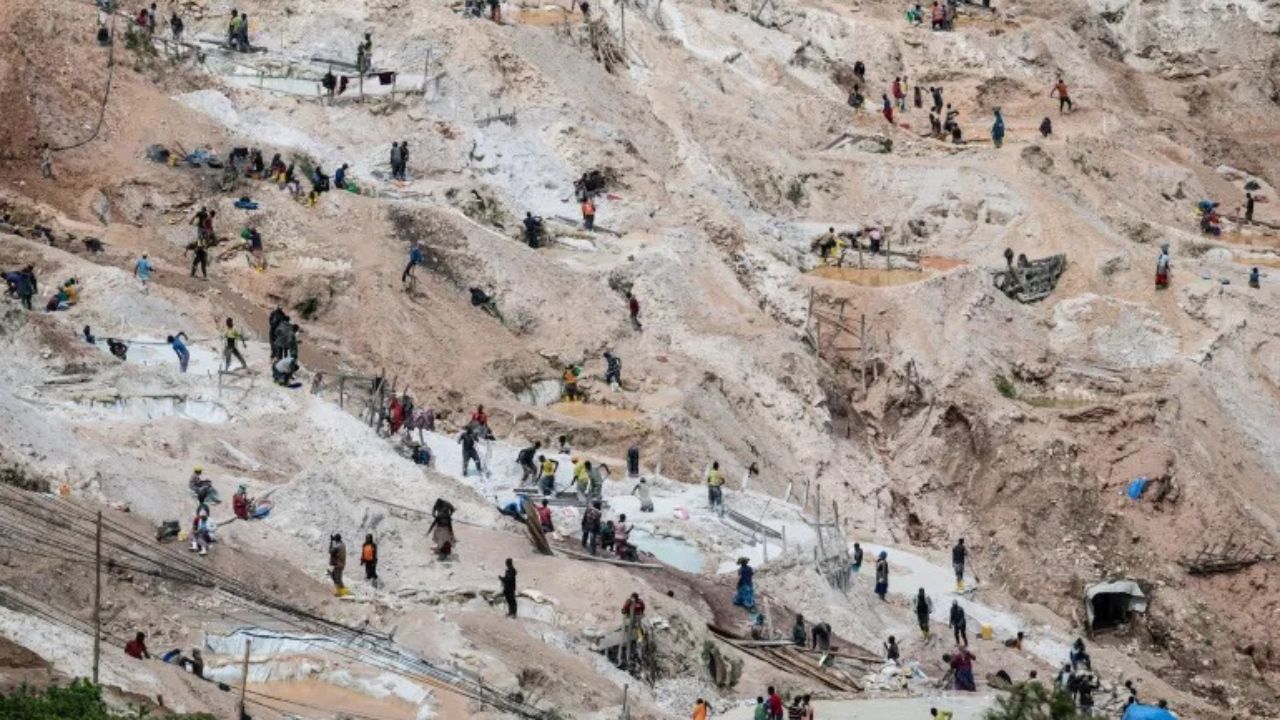



A landslide triggered by heavy rainfall has killed more than 200 people at the Rubaya coltan mine in eastern Democratic Republic of Congo (DRC), authorities said, highlighting the persistent dangers surrounding mineral extraction in one of the world’s most resource-rich yet unstable regions, says Al Jazeera.
The DRC Ministry of Mines said on Wednesday that around 70 children were among those killed in the collapse. Several injured miners and workers were evacuated to medical facilities in Goma, the capital of North Kivu province.
Rubaya, one of the region’s most important mining areas, is a major global source of coltan, a mineral processed into tantalum that is widely used in electronic devices and industrial components.
Government officials said the disaster occurred after heavy rainfall destabilised the soil around mining pits, causing large sections of earth to collapse.
However, a senior official linked to the M23 rebel group, which controls the mining area, disputed the government’s account of the incident.
Fanny Kaj, a senior official in the rebel administration, said the fatalities were caused by bombings rather than a landslide and rejected reports that hundreds had died.

“I can confirm that what people are publishing is not true. There was no landslide; there were bombings, and the death toll isn’t what people are saying. It’s simply about five people who died,” Kaj said.
The Rubaya mining zone has been under the control of the M23 rebel group since 2024. The group is part of the AFC (Congo River Alliance) coalition and has been accused by Congolese authorities of allowing mining operations to continue without proper safety regulations.
Miners working in the area described a far more devastating scene than that suggested by rebel officials.
Ibrahim Taluseke, a miner who took part in rescue efforts, said workers recovered more than 200 bodies from the site after the collapse.




“We are afraid, but these are lives that are in danger,” Taluseke told The Associated Press news agency.
He added that some pit owners were reluctant to disclose the true scale of the disaster.
“The owners of the pits do not accept that the exact number of deaths be revealed,” he said.
A senior official from the AFC/M23 alliance acknowledged that operations at the site had already been considered unsafe before the disaster.
Speaking to Reuters, the official said mining activity had been discouraged at the site following recent rainfall.
“Continued operation had been discouraged,” the official said.
“Pending the securing of the area and the implementation of protective measures for miners. The incident is due to the heavy rains of the last few days.”
The latest tragedy is not the first deadly accident at the Rubaya mine.
In late January, another collapse triggered by heavy rainfall killed more than 200 people at the same site. Congolese authorities blamed that incident on the M23 rebels, accusing them of allowing uncontrolled mining operations to continue without enforcing safety standards.
Mining accidents are common in eastern Congo, where thousands of miners work in informal or poorly regulated pits to extract minerals vital to global technology supply chains.
Coltan mined in the region is refined into tantalum, a metal used in the production of mobile phones, computers, aerospace components and gas turbines.
Rubaya alone is estimated to produce about 15 per cent of the world’s coltan supply, making it one of the most strategically important mining areas in the global electronics industry.
The site’s significance has recently extended beyond commercial mining.
Rubaya was included on a shortlist of mining assets that the Congolese government is offering to the United States under a proposed minerals cooperation framework aimed at strengthening supply chains for critical resources.
The disaster has renewed attention on safety conditions at mining operations in eastern Congo, where armed groups, weak regulation and hazardous working environments have long contributed to deadly accidents.
Authorities have not yet provided a final confirmed death toll as recovery operations continue in the area.