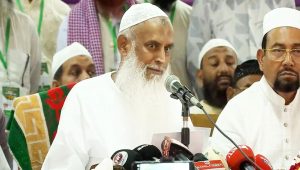
Leader of the Opposition in Parliament and Jamaat-e-Islami Ameer Shafiqur Rahman has alleged that the opposition is being “largely” deprived of its rightful role inside parliament.
He made the remarks on Tuesday evening during a courtesy visit to the central office of the National Citizen Party (NCP) at Rupayan Tower in Banglamotor, Dhaka, where he spoke after a meeting with the party’s leaders.
“A government has two organs — one is the ruling party and the other is the opposition. A country cannot run without both. Without an opposition, democracy has no value,” he said.
Shafiqur said conscious journalists have already noticed how the opposition is being deprived of its rights in parliament. He alleged that discrimination is also increasing outside parliament.
“It now seems to us that discrimination is becoming more deep-rooted,” he said.
The Jamaat chief alleged that opposition lawmakers were receiving far fewer development allocations compared with ruling party lawmakers.
“This is a country with 300 parliamentary seats, from where ruling party members have been elected. The allocations provided so far do not come anywhere close to what has been given to opposition members,” he said.
Shafiqur said development was not a matter of seeking favours from any political party but a fundamental right of citizens.

“Whenever discrimination is created within a country and divisions emerge among regions and communities, social unrest follows,” he said, adding that the government has the primary responsibility to build a stable society.
He also alleged discrimination against lawmakers elected to the 50 reserved women’s seats, saying they were only recently receiving limited allocations in some sectors despite raising issues strongly in parliament.
“Why should this happen? It should be equal,” he said.
The opposition leader also questioned the practice of placing reserved-seat women MPs on opposition benches with additional responsibilities, calling it unconstitutional.
“There is no such provision in the Constitution,” he claimed.




On the referendum, Shafiqur accused the government of refusing to implement the public mandate.
He said 70 per cent of people voted ‘Yes’ in the referendum hoping for meaningful change, but the government was unwilling to implement the verdict after winning a major election victory.
“They will not implement the referendum mandate, and forming the reform council, which was supposed to be done, is basically the responsibility of the prime minister,” he said.
He rejected arguments that there were no constitutional provisions for forming a reform council, saying many issues are not explicitly mentioned in the Constitution but are accepted under the Doctrine of Necessity based on public interest.
Shafiqur said the alliance was forced to take its demands to the streets as they were not accepted in parliament.
“When discussions failed, we naturally took the people’s demands back to the people,” he said, adding that the 11-party alliance had united to press for public demands.
He said “no new fascism will be allowed to be established in Bangladesh” and praised the media’s role in highlighting social injustices and rights violations, saying it was essential for a healthy democratic culture.
Regarding the alliance’s future, he said the parties had come together for an election and were continuing their movement in the interest of the people.
He dismissed concerns over whether the alliance would remain an 11-party platform, saying the number of parties was not the main issue.
“This has been called a 20-party alliance. It is a brand. There can be differences of opinion from time to time,” he said, adding that every party has the right to choose its political platform in a democracy.
Asked about forming a shadow cabinet, Shafiqur said “homework” had already begun.
He said the alliance would utilise the capabilities of its partner parties and involve skilled individuals from Bangladesh and abroad wherever necessary.
NCP Convener and Opposition Whip Nahid Islam said the alliance viewed the national election and referendum as separate issues.
He said while there were questions over the outcome of the referendum, the alliance had accepted the result.
Nahid claimed that 70 per cent of voters supported the ‘Yes’ campaign backed by the 11-party alliance but said the objectives of the movement, including the NCP’s one-point demand to abolish the previous political system and establish a new arrangement, had not yet been achieved.
“We are unitedly present inside parliament and outside parliament,” he said.
He highlighted public concerns over gas, electricity and fuel shortages as well as rising fertiliser prices, saying they would continue raising people’s issues both inside and outside parliament. Nahid also called on democratic, pro-Bangladesh and pro-Islamic political and social forces to unite against aggression, hegemony and authoritarianism.
He said Shafiqur’s visit was a courtesy call rather than a political initiative, but praised his leadership.
“We believe that in the ongoing struggle to establish democracy, his leadership — his strong leadership — is highly needed in Bangladesh,” Nahid said.
He said they would continue working together for people’s rights in parliament and on the streets and would not allow any new form of authoritarianism to emerge in Bangladesh.
NCP Chief Coordinator Nasiruddin Patwary and other central leaders of the party were also present at the meeting.