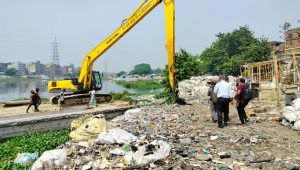
Nipa Akter works every day amid piles of rubbish two kilometres inside the Matuail dumping zone in Dhaka. She has no gloves, no mask, and no protective footwear. She eats her lunch sitting among the waste, with no access even to water for washing hands.
Workers responsible for managing the city’s waste operate without any protective equipment. Authorities appear indifferent, while workers themselves show little awareness of the risks.
As a result, they face constant health problems, often without understanding the causes.
A study titled “Occupational Health Impacts on the Child Waste-pickers of Dhaka City,” published by international scientific publisher WIT Press, found workers suffer from skin diseases, respiratory problems, stomach illnesses, eye conditions, fever, and injuries from sharp waste.
Around 30 per cent suffer from skin diseases, nearly 40 per cent from eye and respiratory issues, 47 per cent from body pain, and 20 per cent from stomach problems. Fever rates are also 62 per cent higher among them than in the general population.
Bleak conditions at landfills
Thousands of tonnes of household waste generated daily in the capital are dumped at two landfill sites on the capital’s outskirts.

At Matuail, Nipa Akter has been collecting waste for 20 years. She brings dry food and water from home, as there is no water supply or toilet facility within two kilometres.
Around 15 to 20 women and several children work at the landfill every day. Some build makeshift tents with cloth to rest in the sun or rain.
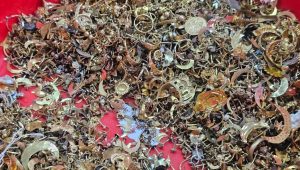
Nearby, plastic is burned to separate metal. The same conditions prevail at the Amin Bazar landfill, where workers handle waste with bare hands, without masks or shoes.
“I have been doing this since childhood, I do not face any problems,” said Rehana Akter. “There are not many issues, only occasional breathing problems,” said Rokeya Begum.




Even an Ansar member on duty, Iqbal Hossain, was seen without protective gear. “It was difficult at first, but I got used to it. Masks feel too hot, so I do not wear them,” he said.
Fires are often set to reduce the volume of waste. Excavators cut through the piles like hills. Crane operators also work without protection.
Babul Mia, who has worked for 15 years at a Secondary Transfer Station in Mohammadpur, said workers were last given masks, gloves, and shoes during the COVID-19 lockdown. “The protection gear did not last long and was ruined in the waste,” he said.
Workers start at dawn and sometimes continue until evening or even late at night. Their wages are Tk12,000 a month, or Tk10,000 for new workers. There is no structured policy.
“Gloves make hands sweaty and cause sores between fingers in the heat. The work is always physically demanding,” Babul said.
Asked about health issues, he said, “Cuts on hands and feet happen often. There is itching if not cleaned properly, and body pain.”
Authorities evade responsibility
Under the Bangladesh Labour Act, 2006 and Labour Rules, 2015, employers must provide personal protective equipment, training, risk assessments, compensation for accidents, and healthcare.
The City Corporation Act, 2009 and Local Government (Amendment) Act, 2010 also assign responsibility for waste management and worker supervision.
The Ministry of Labour and Employment and the Department of Inspection for Factories and Establishments are responsible for enforcing these provisions.
Yet officials avoided accountability when asked why nothing is being done for workers who keep a city of nearly 36 million clean.
Dhaka South City Corporation Additional Chief Waste Management Officer Md Arifur Rahman said, “Not all workers are ours. Some are employed by contractors.”
Asked whether oversight is also their responsibility, he said, “There are adequate safety arrangements from the city corporation, but workers are not comfortable using them during work.”
Cleanliness inspectors’ supervisor Md Sohag Hossain said, “I have told the contractors several times, but nothing happens.”
Matuail Extension Project Director Mohammad Safiullah Siddique Bhuiyan asked for a call later and did not respond afterwards.
Repeated attempts to contact officials at the Ministry of Labour and Employment also went unanswered.