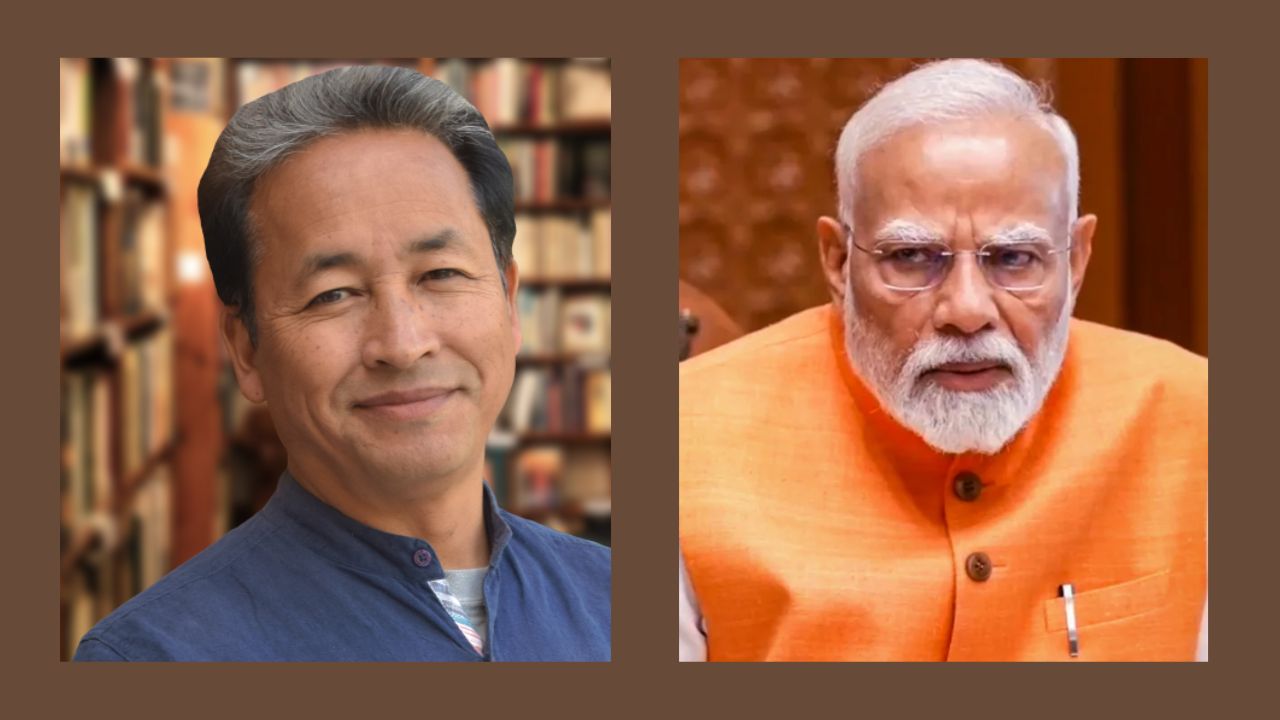



India’s Prime Minister Narendra Modi has been “terribly” weakened by a major wave of youth-led demonstrations, according to leading education activist Sonam Wangchuk.
The 59-year-old engineer and education reformer, whose recent 26-day fast became a rallying cry for the movement, believes the political landscape across the nation has undergone a significant shift, reports BBC.
The unrest, which originated from intense public fury over leaked examination papers, rapidly grew into some of the most significant anti-government demonstrations India has witnessed in recent years.
The pressure culminated in the resignation of education minister Dharmendra Pradhan on 25 July. Speaking 12 days after ending his hunger strike from his Himalayan hometown of Leh in Ladakh, Wangchuk observed that India’s younger generation has gained a newfound belief in their collective power.
“They feel they don’t have to take everything lying down,” Wangchuk remarked, noting that young citizens now possess the confidence to demand and enact meaningful change.
Known as the “Cockroach” movement, the campaign represents one of the largest public challenges to the Modi administration since it took office in 2014.

The movement adopted its unusual name in response to a highly criticised metaphor used by India’s chief justice, who likened groups of unemployed youth to “cockroaches” during a legal proceeding.
During his protest in the severe summer heat of the capital, New Delhi, Wangchuk survived solely on water and salt, losing 11kg in the process, of which he has since recovered 6kg.
For the final six days of his fast, authorities relocated him against his will to hospital facilities that he described as resembling prisons.
The day after Wangchuk concluded his fast, education minister Pradhan stepped down from his post. In response to the growing public outcry, the prime minister has since introduced fast-track courts to prosecute individuals implicated in the exam leaks.




He also appointed a prominent tech billionaire to spearhead structural reforms of the country’s national testing system and announced financial compensation for the families of students who took their own lives following the leaks.
According to Wangchuk, however, these measures do not address the root of the crisis. He highlighted that the rate of graduate unemployment in India has remained stubbornly high, hovering between 35 per cent and 40 per cent for a quarter of a century.
Wangchuk argues that a complete overhaul of the education sector is essential, as the current evaluation system fails to prepare students for the contemporary job market.
The activist pointed out that modern exams rely heavily on multiple-choice formats designed for administrative convenience rather than the evaluation of actual skills or deep understanding. This testing regime subsequently forces schools to orient their curricula around rote test preparation.
“There needs to be some planning of what the world and the country are likely to look like in 15 years,” Wangchuk said.
He suggested that shifting the focus of education toward hands-on learning and practical aptitude would better equip young people, helping resolve the job shortage and preventing underemployment in critical sectors.
The Indian government has previously dismissed such criticisms of its economic stewardship, asserting that the scale of the unemployment crisis is overstated and that its broader macroeconomic policies are fundamentally sound.
Even as the protests have forced some policy changes, many demonstrators associated with the “Cockroach Janta Party” (CJP) continue to endure severe pushback.
Reports indicate that activists are facing ongoing police harassment, social media targeting, and active legal prosecutions. This retaliation continues despite an explicit directive from the Supreme Court instructing regional authorities to refrain from taking coercive actions against protesters who do not have prior criminal records.
Nonetheless, Wangchuk remains optimistic, stating that “good progress” has been achieved in recent days. He contended that the government’s delay in accepting Pradhan’s resignation severely damaged its standing, as the hesitation gave the youth movement valuable time to consolidate its unity and build momentum.
He cautioned that if the state fails to address the underlying public grievances, demonstrations could easily resume and widen in scope beyond academic reform.
The governing Bharatiya Janata Party (BJP) appears already to be experiencing political fallout, having lost two out of three by-elections held this week, including a constituency in Bihar state that the party had successfully defended for more than three decades.
Reflecting on his campaign, Wangchuk expressed a deepened belief in the efficacy of hunger strikes, citing Mahatma Gandhi’s principles of non-violent resistance.
While his previous fasts, which campaigned for increased local autonomy in Ladakh and opposed ecologically destructive development projects, did not achieve their immediate targets, he maintained that self-inflicted suffering is a powerful tool.
“Inflicting pain on ourselves makes the government feel differently, compared to us using sticks and stones,” Wangchuk explained.
When asked if he had any intentions of transitioning into mainstream politics by running for public office, Wangchuk ruled it out, stating he prefers to empower and support others in that pursuit.