






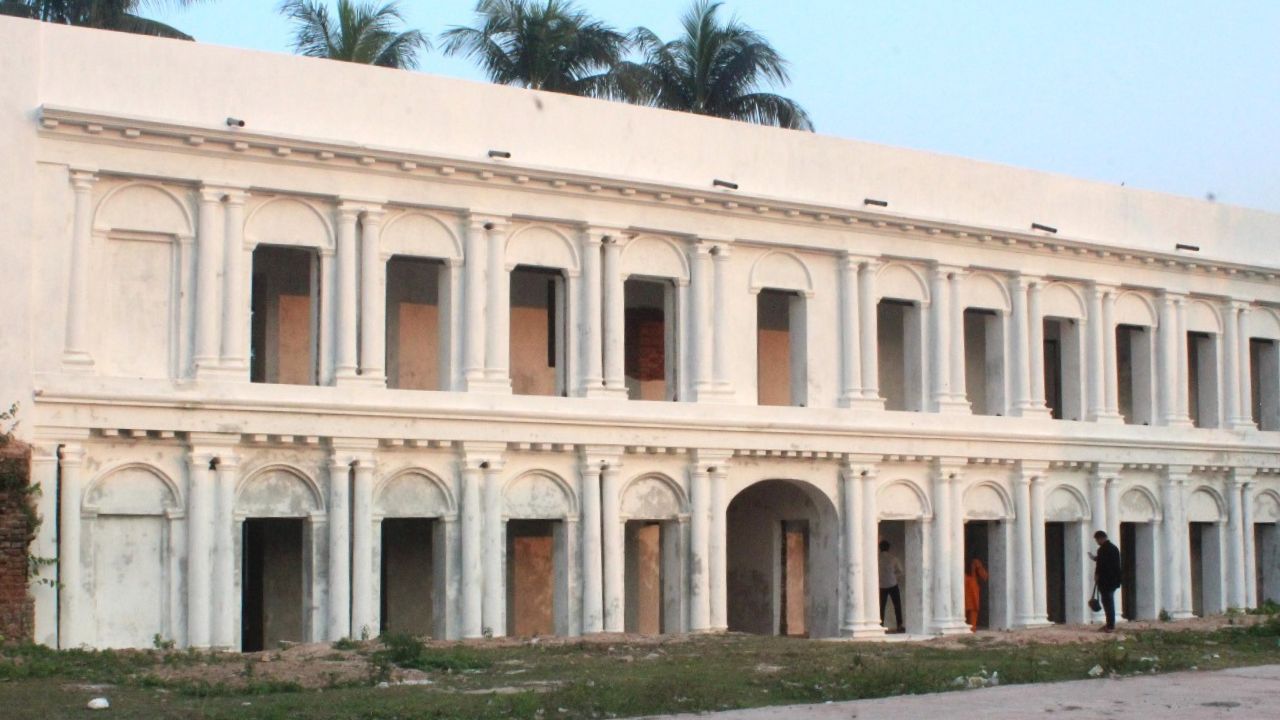
Lakutia Zamindar Bari palace, once a symbol of heritage and grandeur in Barishal’s Babuganj Upazila, is undergoing an impressive restoration, returning it to its original glory after years of neglect.
The mansion, which had fallen into disrepair with crumbling walls, fallen roof tiles, and an overgrown porch, has now begun to regain its former magnificence following the completion of its first-phase renovation.
The Department of Archaeology started the restoration project on May 4, 2025, with an investment of approximately Tk60 lakh aimed at revamping the building’s foundation, brickwork, and roof. New roof tiles sourced from Satkhira have been laid, and new circular brick pillars have been installed to reinforce the structure.
Arifur Rahman, assistant curator at the Barishal Divisional Museum, confirmed that the first phase of the restoration is complete. The second phase will focus on restoring key historical features such as doors, windows, and floors. The building’s exterior has been painted white to protect it from weather damage.
Rahman noted that the restoration efforts have focused on preserving the original structure, with metallic supports added to stabilise the walls.
Inside, damaged wooden beams have been replaced, and varnished wooden props have been introduced to maintain the building’s historical integrity.
Lovely Yasmin, the Khulna-Barishal Regional Director of the Department of Archaeology, emphasised the importance of utilising historical photographs, documents, and local accounts in the restoration process.
“Our goal is to restore the building as closely as possible to its original form,” she said.
The Lakutia Zamindar Bari palace was originally built by Roop Chandra Roy, patriarch of the Lakutia Zamindar family. During the tenure of his grandson, Raj Chandra Roy, the family’s estate expanded, and the mansion was constructed on a 50-acre plot.
The Roy family was known for their connections to the Brahmo religion, with notable family members such as aviator Indralal Roy and boxer Paresh Lal Roy.
The mansion also had ties to prominent figures in Bengali history, including the family of poet Rabindranath Tagore.
The two-story mansion, measuring 8.2 meters in height, 25.4 meters in length, and 9.2 meters in width, contains nine rooms and features three ponds, locally known as “Babu’s ponds.”
Lincoln Bayen, Barishal Divisional Coordinator for the Bangladesh Environment Lawyers Association (BELA), stressed the need to remove a nearby warehouse to fully preserve the building’s archaeological value.
In 2018, Alpana Roy, a descendant of the family now residing in Australia, called for the preservation of the zamindar bari . She fondly recalled stories of the mansion passed down from her father, Pankaj Roy Chowdhury, and expressed her satisfaction with the completion of the first phase of restoration.
Cultural activist Sushant Ghosh, who has witnessed the mansion’s decline over the years, commended the restoration efforts. “We’ve been advocating for the preservation of this historical site, and we are hopeful that the entire structure will be fully restored and protected for future generations,” he said.


