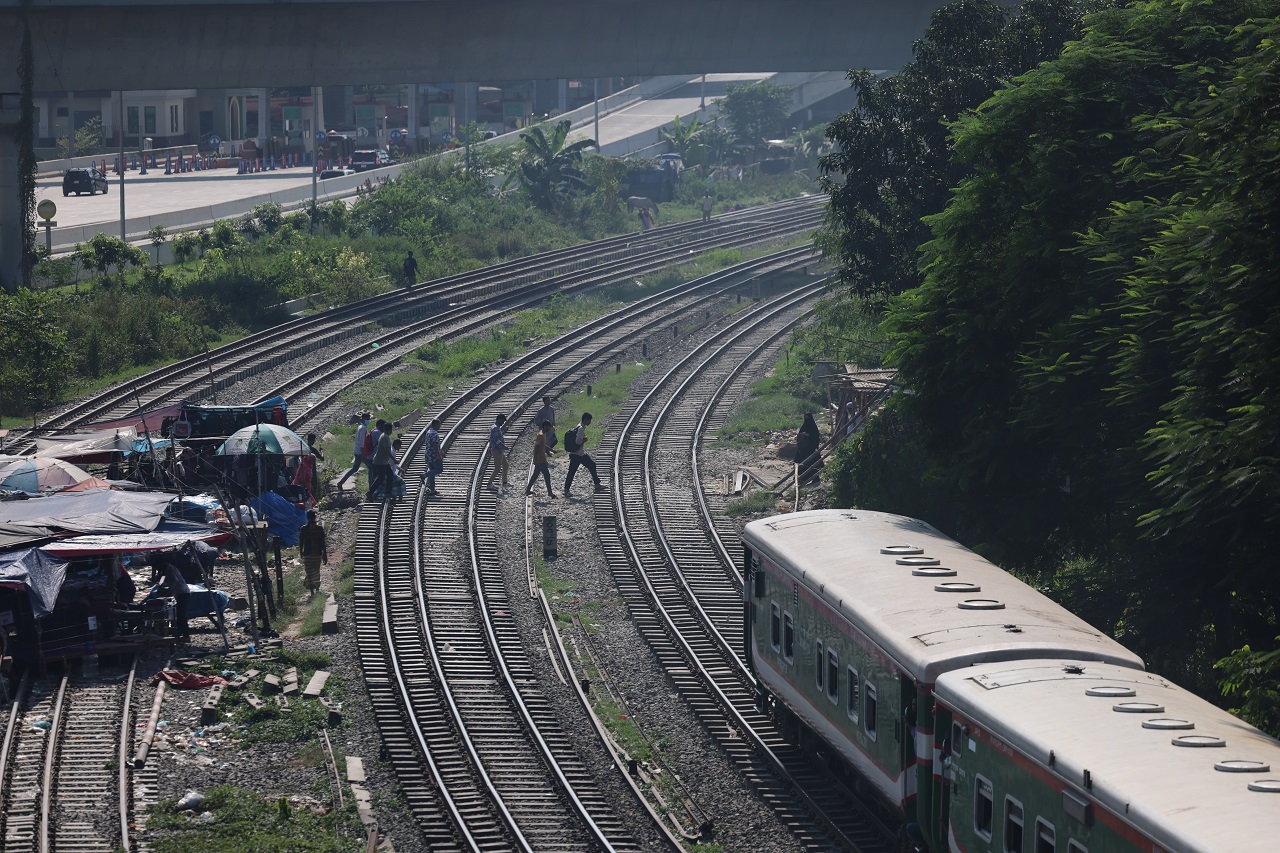
Just beyond the Kuril Flyover, a few hundred metres from the city’s expressway, lies one of Dhaka’s deadliest crossings. Every day, hundreds of people walk across four parallel railway lines with no safety gates, no signals and no one to stop them. Each step is taken with caution and a silent prayer that the next train won’t come too soon.
“Kuril feels like a horror movie,” said one commuter, recalling a near-death encounter. “I looked both ways, twice, maybe three times. Then suddenly, without a horn or warning, a train came rushing at me. The air split open. My body froze. If someone hadn’t pulled me back, I would’ve become another name in the police file.”
This is no ordinary crossing. Two tracks are active, two more under construction. The ground is uneven, layered with sharp stones and loose bricks that wobble beneath every step. Unlike most crossings, Kuril’s rails rise sharply from the ground, forcing pedestrians to climb and leap as if the earth itself resists their passage.
Trains appear without warning, roaring around the bends before a whistle even reaches the ear. Sometimes, one train’s echo hasn’t faded before other screams down a parallel line. And still, people cross because there is no other way.
Life continues, indifferent to danger. Between idle tracks, tea stalls, shirt vendors, and food carts occupy the gravel. Five major roads intersect nearby, one leading to the Purbachal expressway, another to the Kuril Flyover, the rest feeding into Badda and Rampura. Anyone heading toward Farmgate or Gulistan must cross these roads and all four railway lines.

But there is no footbridge. No barricades. No gatekeeper. No warning lights. Police appear only when a VIP convoy passes. Locals rely on instinct and luck. And sometimes, luck runs out.
On October 7, 35-year-old AM Bipul was struck by the Tista Express between markers 307/5 and 307/6, dying instantly. Five months earlier, 22-year-old honours student Isteyak Ahmed Safid was hit by the Sirajganj Express at a nearly identical location. His body bore severe lacerations. On January 9, 50-year-old vehicle helper Sri Tabi Karmakar was struck by the Chattar Commuter train, sustaining catastrophic injuries.
From January to October 2025, railway police recorded 57 deaths across Dhaka. Tejgaon reported the highest toll, 29, followed by Cantonment with 21. While Kuril rarely appears by name in official reports, its fatalities contribute to this grim total.



Osman Goni, who runs a tea stall beside the unused track, has witnessed the human cost firsthand. “At least 20 people have died behind my stall,” he said quietly. “They promised a footbridge within two months. It has been six. No visible outcome we have got.”
Nearby, BRTC ticket seller Rasel Ahmed added, “Every month, four or five people die here. Sometimes it feels like this area is cursed.”
The Officer-in-Charge (OC) of Kamalapur Railway Station, Ferdous Ahmed Biswas, called Kuril a “critical danger zone.” His office has repeatedly filed complaints, sent photographs and requested safety measures, but nothing has changed. “Each death could be prevented,” he said. “But nothing changes. Another life lost, another file closed.”
Trains speed through the crossing at up to 80 kilometres per hour, often from both directions, leaving pedestrians disoriented and without time to react.
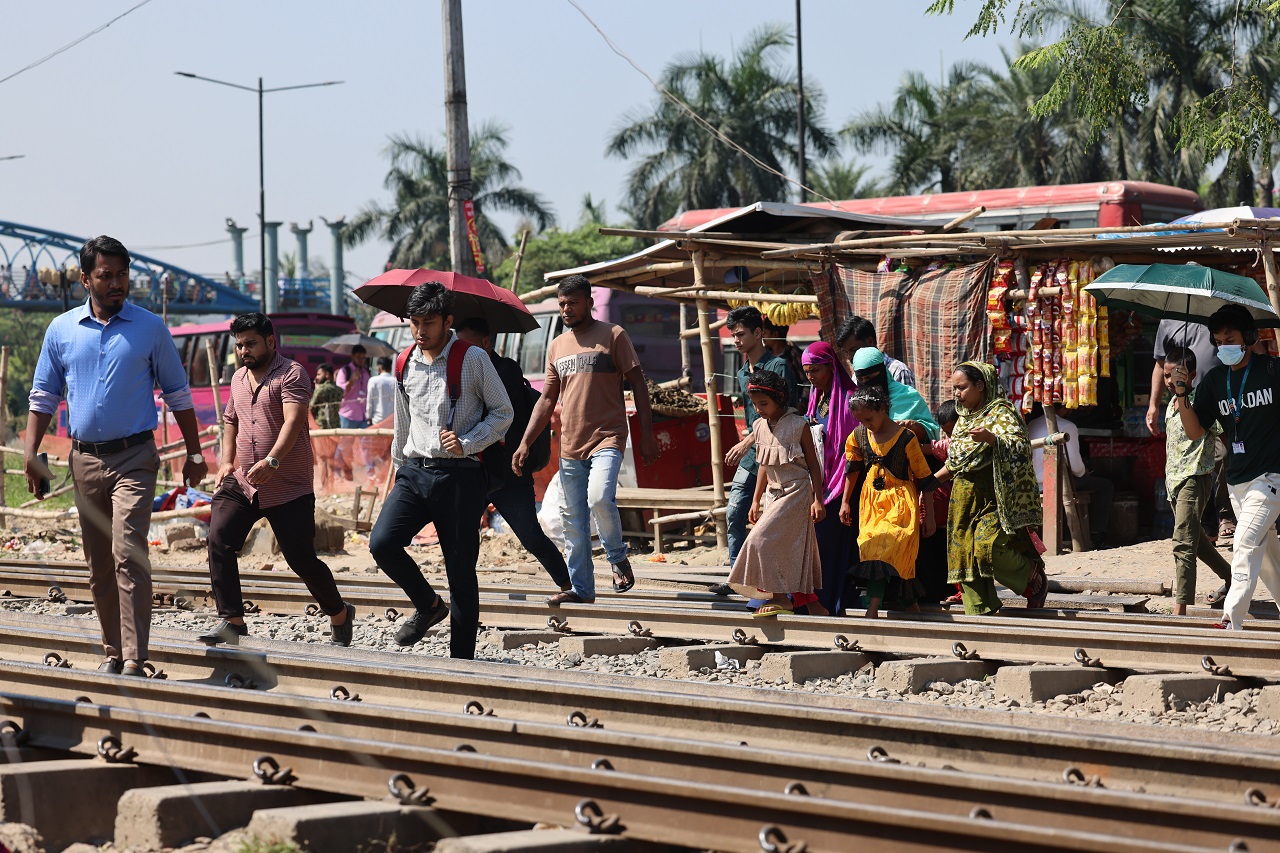
‘‘The layout makes it worse,” said Al Amin Bepari, a garment worker. “There’s a sharp bend on both sides, hiding approaching trains until the last second. You have to leap from brick to brick, hoping you make it across.” He added, almost every month, fate claims another life. It is less a crossing now, more a stage for tragedy.
Md Siraj Zinnat, divisional engineer-1 of Bangladesh Railway, admitted that Kuril has no safety measures. “A wall once built to restrict crossings was broken down by locals, because there are no other options to reach the other side roads. “People are crossing at their own risk,” he said.
“We have posted warnings, but enforcement is difficult. The construction of a footbridge under the Dhaka–Tongi Third Line Fourth Line Project is ongoing. Once completed, the wall will be rebuilt. But there is no confirmed completion date yet,” added the engineer.
Railway Police Superintendent Saifullah Al Mamun said that they have requested a wall and a footbridge for years. “We have been telling them for years, but nothing happens.”
Urban planners say Kuril’s tragedy reflects a deeper failure. “The frequent deaths here portray the authorities’ neglect,” said Md Abdul Wakil, professor of Urban and Regional Planning at Rajshahi University of Engineering and Technology. “The broken wall tells a story of public desperation. When safety is missing, people create shortcuts. If the authorities acted quickly to restore protection, people would not break the wall again. Neglect only feeds danger.”
“Safety is not a favour, it is a duty,” he added. “When deaths keep happening in the same place, it is not public carelessness; it is official negligence.”
Whatever happens, Kuril’s fatal crossing remains unchanged. Vendors pour tea beside rails that have taken lives. The whistle splits the air, a chilling reminder of how close danger is. In every hurried step across the iron tracks is a wager against death and a prayer that today, luck will hold.