





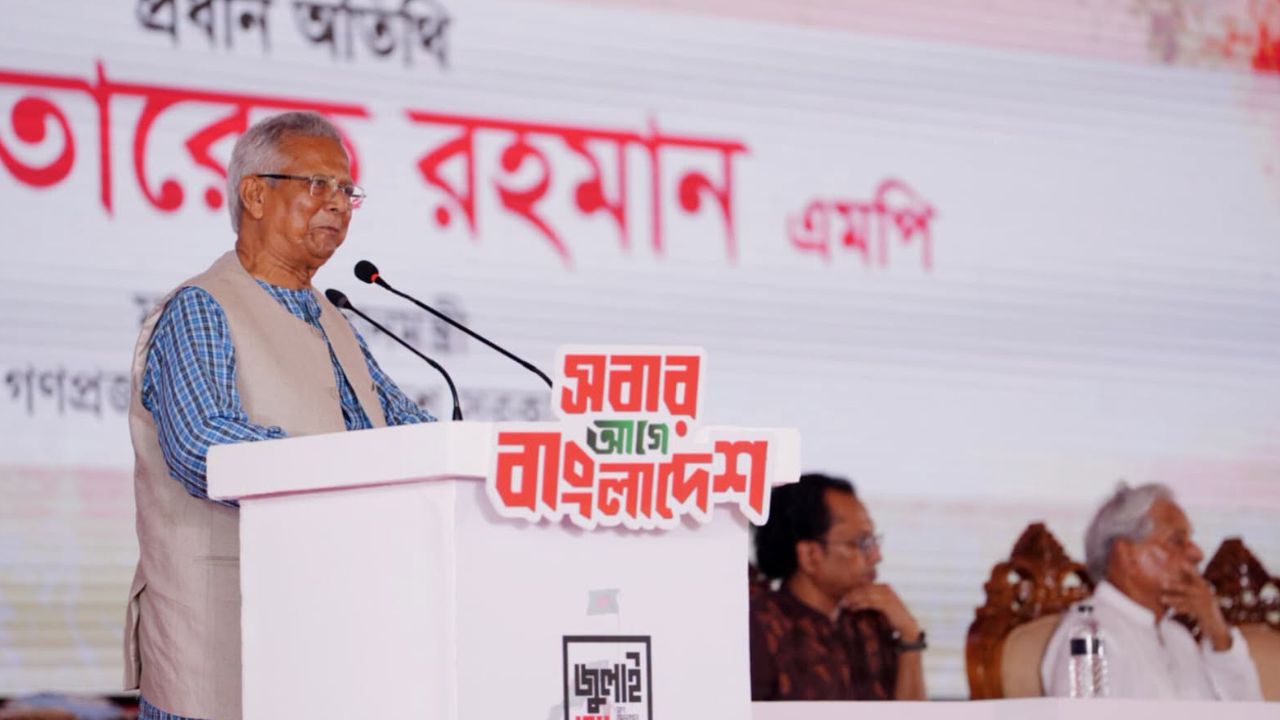
Former interim government chief adviser Muhammad Yunus has described the July Mass Uprising Memorial Museum as a bridge between Bangladesh’s past and future.
The museum has opened “a new chapter” in the country’s history by preserving the spirit of July Uprising and inspiring future generations to build a better Bangladesh, he said.
He made the remarks while speaking as a special guest at a discussion titled “July 36” after the museum’s inauguration Wednesday morning.
Prof Yunus said the institution is different from conventional museums because it documented a defining chapter of Bangladesh’s history almost immediately after the events took place.
“There are many museums around the world that preserve objects from the distant past. This museum is different because it has preserved the memories, documents and artefacts of a historic event almost instantly,” he said.
“This museum stands between the past and the future. It has preserved the past instantly, but it has also created the future. It tells us who we are, what we wanted and what kind of Bangladesh we dreamed of building,” he said.
Yunus said the museum will serve as a guide whenever the nation faces uncertainty.
“If we ever lose our way, we will come here to find our path. If confusion clouds our thinking, we will rediscover our direction here and begin our journey anew,” he said.
He noted that the museum captures the aspirations and sacrifices of ordinary people, especially young protesters who took to the streets hoping to build a new Bangladesh.
Referring to the handwritten farewell letter left by July uprising martyr Shariar Khan Anas, Prof Yunus said it reflected the courage and conviction of an entire generation.
“He was not following a script. His parents tried to stop him, but he felt compelled to join the movement. His letter captured the emotions of a generation,” he said.
The Nobel Laureate called on young Bangladeshis to draw inspiration from the museum and take part in building the country the martyrs had envisioned.
He expressed hope that students from schools, colleges and universities across the country would visit the museum, reflect on the July uprising and record their own dreams for Bangladesh’s future.
“I hope visitors will not simply pass through the galleries and leave. They should consider what kind of Bangladesh they want to build,” Yunus said.
He also imagined the museum becoming a vibrant cultural hub where young people would share their aspirations through literature, music, art and other creative works.
Referring to the symbolic graves displayed on the premises, Yunus said each memorial would narrate the story of a martyr, enabling visitors to grasp the sacrifices made by ordinary citizens.
“These were ordinary sons and daughters from ordinary families. They came out to the streets because they believed Bangladesh deserved a better future,” he said.
He also commended those involved in establishing the museum, saying every exhibit showed painstaking efforts to preserve the nation’s collective memory.
Urging people to visit the museum with their families, he asked them to spend time reflecting on its message.
“We should ask ourselves why these events took place and what responsibilities now rest on our shoulders. Only then will the museum achieve its true purpose,” Yunus said.
Earlier, Prime Minister Tarique Rahman inaugurated the museum and addressed the programme as the chief guest.
Cultural Affairs Minister Nitai Roy Chowdhury, State Minister Ali Newaz Mahmood Khyom, Prime Minister’s Adviser on Information and Cultural Affairs Zahed Ur Rahman and Cultural Affairs Secretary Kaniz Moula also spoke.
Local Government, Rural Development and Co‑operatives Minister Mirza Fakhrul Islam Alamgir, Home Minister Salahuddin Ahmed, Power, Energy and Mineral Resources Minister Iqbal Hassan Mahmood, Liberation War Affairs Minister Ahmed Azam Khan, Prime Minister’s daughter Zaima Rahman, other cabinet members, lawmakers, the chiefs of the three services, diplomats, academics, civil society representatives, families of the July fighters, injured July warriors and senior government officials were present.
Former prime minister Sheikh Hasina fled to India on 5 August 2024 amid a student‑led mass uprising.
Her official residence, Ganobhaban, was later converted by the interim government led by Yunus into the July Mass Uprising Memorial Museum to preserve photographs, documents and artefacts related to the movement.


