
For decades, Jensen Huang was a recognisable figure primarily within the gaming world. Over the past few years, however, as artificial intelligence ballooned into a trillion-dollar ecosystem upon which the broader US (and global) economy increasingly rests, he has become a household name and arguably the most consequential CEO on the planet.
So vital has Nvidia’s co-founder become that his personal life and corporate status have commanded front-page headlines worldwide, drawing the alleged attention of Chinese intelligence and prompting direct intervention from the White House to ensure his reinstatement as CEO.
Yet, beyond the boardroom melodrama lies a deeper question for ordinary citizens: why should the unfathomable fortunes and salacious seductions of a Silicon Valley billionaire matter to everyday people?
And what does one man’s rise and fall, and rise again, reveal about the AI industry?
Who is Jensen Huang?
Born in Taiwan in 1963, Huang spent part of his childhood in Thailand before moving to the United States during the Vietnam War. After earning an electrical engineering degree from Oregon State University and a master’s from Stanford University, he co-founded Nvidia in 1993 alongside Chris Malachowsky and Curtis Priem with $40,000 in seed capital.

Under Huang’s stewardship, Nvidia went public in 1999 and released the GeForce 256, billed as the world’s first graphics processing unit (GPU). His most prescient bet, however, came in 2006 with the launch of CUDA, a software platform that allowed developers to harness GPUs for general-purpose computing. When ChatGPT’s release in late 2022 ignited an unprecedented race for computing power, Nvidia held a near-monopoly on the hardware required to train advanced AI models—propelling Huang’s net worth past $100 billion in 2024.

The (alleged) honeypot
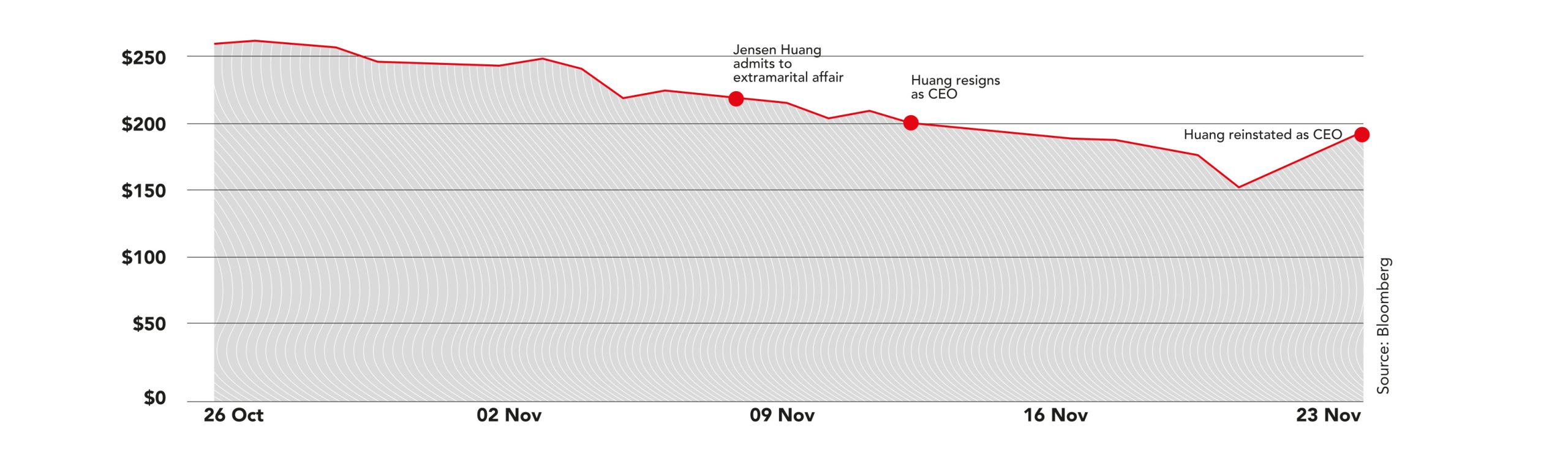
That ascent hit an abrupt wall in late October 2026, when media reports and intelligence leaks revealed that US authorities had investigated Alice Huang (no relation), a former executive at Singapore-based cloud firm Megaspeed. According to US intelligence officials, Alice Huang had been in contact with China’s Ministry of State Security during an extramarital affair with Nvidia’s chief executive—though intelligence assessments reportedly found no proof she was actively tasked with espionage or passed along national security secrets.
Megaspeed had rapidly become a major international buyer of Nvidia hardware, procuring billions of dollars in advanced GPUs amid US suspicions that the firm served as a conduit to circumvent export controls and channel chips to Chinese entities. On November 8, Huang admitted to marital infidelity and pledged cooperation with an independent inquiry. Four days later, following additional reporting of relationships with two Nvidia employee, including a subordinate vice president, Nvidia’s board accepted his resignation.




Beijing dismissed the espionage allegations as “groundless speculation” and slander, while Megaspeed maintained its operations were entirely lawful. Washington nonetheless placed Megaspeed on a national security trade blacklist and tightened restrictions on remote access to restricted American AI hardware.
A Trump-sanctioned U-Turn
Huang’s ouster rattled global financial markets. Amid broader anxieties over AI valuations and regulatory probes, Nvidia’s stock tumbled nearly 23% during the week following his departure, wiping out hundreds of billions of dollars in market value and dragging major indices lower. Nvidia’s top brass flatly told investors on 17 November that the board had “no intention” of reinstating Huang.
Then the White House stepped in. Watching market indices slide, President Donald Trump personally intervened, dispatching senior officials and phoning directly into board deliberations to broker Huang’s return. On 23 November, just 11 days after accepting his departure, Nvidia’s board executed a unanimous U-turn, restoring Huang as president, CEO, and director.


Nvidia shares surged more than 31% in a single session, reclaiming over $900 billion in market capitalisation. Yet the political rescue drew sharp rebukes from governance experts and lawmakers, who questioned the board’s independence and warned of conflicts of interest surrounding market-moving executive intervention.
Circling the drain
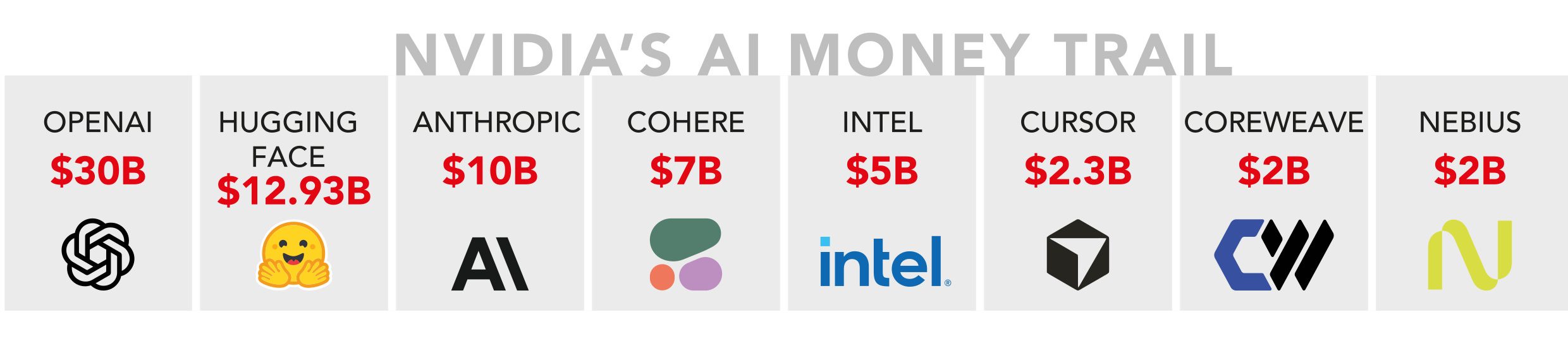
The panic over Huang’s exit underscored a structural vulnerability at the heart of the AI economy. Under Huang, Nvidia functioned not merely as a chipmaker, but as the sector’s central financier, deploying tens of billions in equity stakes and over $100 billion in credit and lease guarantees to cash-hungry AI startups and “neocloud” providers such as CoreWeave and OpenAI.

Critics describe this loop as “circular financing”: Nvidia provides capital to its partners, which the latter in turn uses to buy Nvidia chips, inflating the company’s revenue and valuation. As global AI infrastructure spending accelerates into the trillions, many AI labs continue burning cash with not much to show for it.
The final act
Huang returned to Santa Clara without his trademark leather jacket, striking a contrite tone with staff as Nvidia announced the creation of a National Security and Export Control Oversight Committee and a search for a new Chief Compliance Officer.
However, this story is far from concluded, with Huang’s political reckoning afoot. The reinstated CEO is scheduled for closed-door interviews before House committees, followed by a high-stakes public hearing before the Senate Banking Committee throughout the first week of December.
Jensen Huang’s remarkable rise, fall, and restoration within 11 days encapsulate the strange new logic of the AI era: one man’s reputation now carries more weight than any single company’s fundamentals. When one CEO’s personal conduct can move entire superpowers and their economies, perhaps it is time for ordinary citizens to be paying a bit more attention.