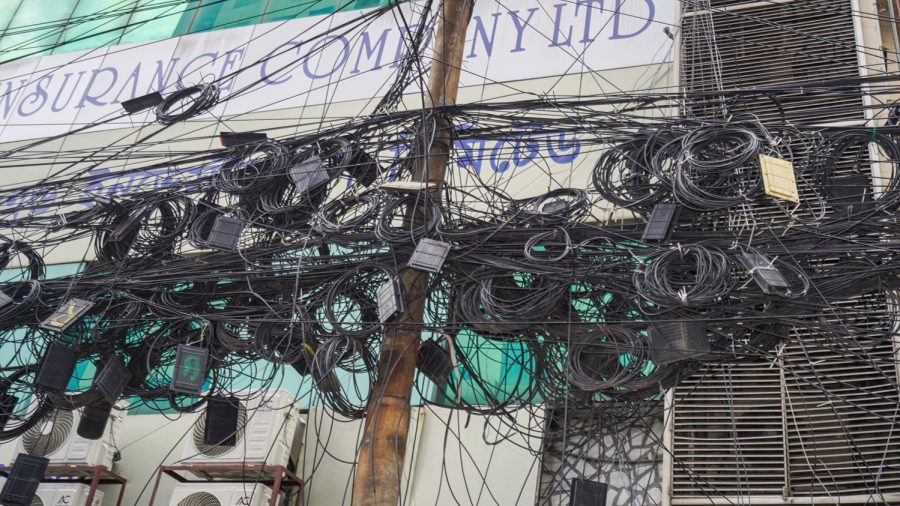

Look at the utility poles in Motijheel, and they resemble giant wire trees. Countless cables descend like roots and branches, connection lines spread out like limbs, and joint boxes hang like fruit. But this strange tree has no gardener: no regular maintenance, no upkeep, no method to the madness.
The same scene repeats at almost every corner of one of the country’s main commercial districts. To meet the demand for internet and cable television, service providers have run their own lines along the same poles. Years of accumulation have created the vast tangle visible today.
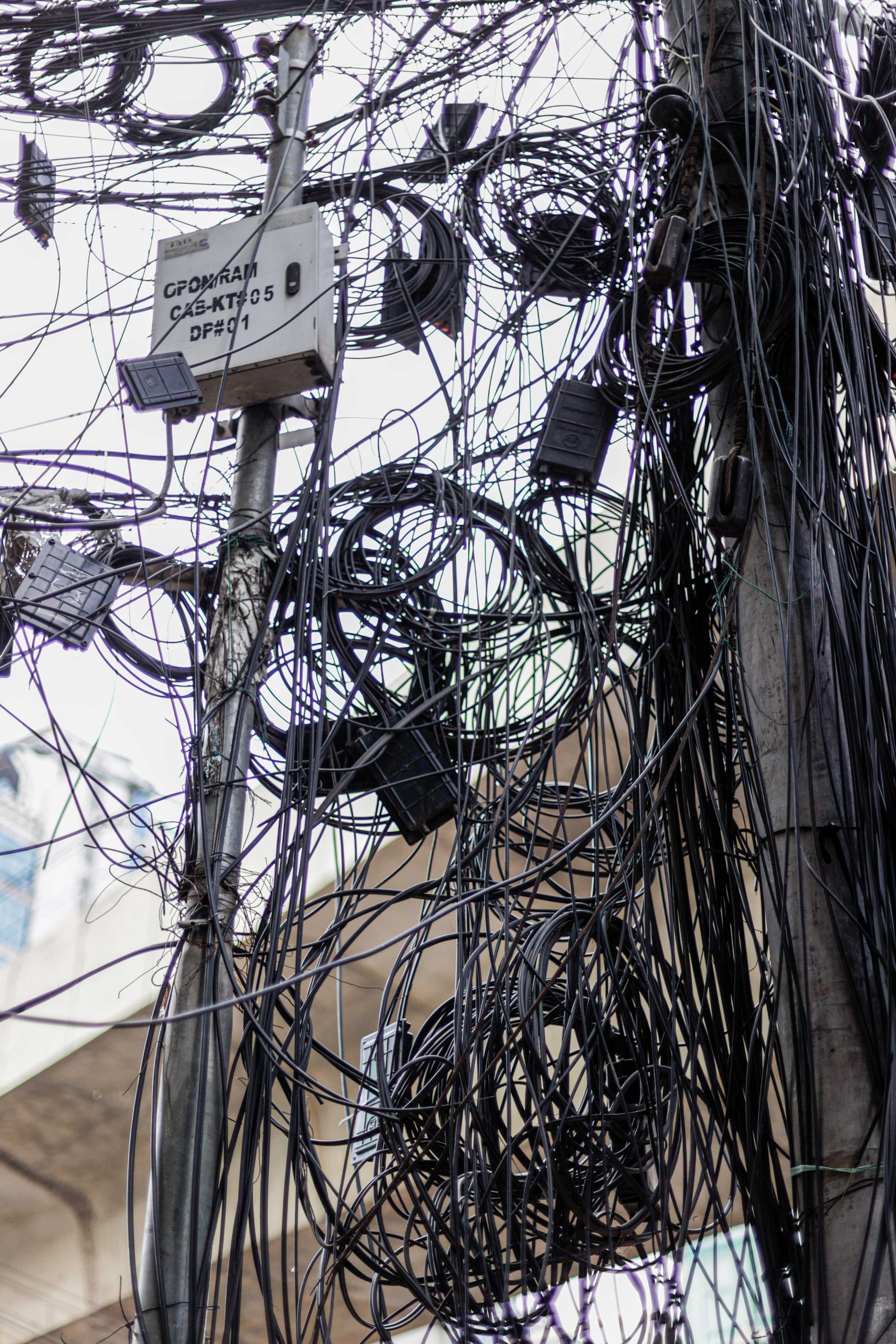
The Bangladesh Telecommunication Regulatory Commission (BTRC) took the initiative nearly 18 years ago to improve the aesthetics of the capital’s roads and eliminate hanging wires. The Nationwide Telecommunication Transmission Network (NTTN) guidelines were created to establish an underground common network, with Fiber@Home and Summit Communications tasked with building the optical fibre infrastructure.
But a vast gap remains between plan and reality. According to BTRC sources, only 20 to 30 per cent of the capital’s hanging wires have been moved underground. The remaining 70 to 80 per cent still hang over the roads, with many ISPs continuing to rely on utility poles for customer connections.

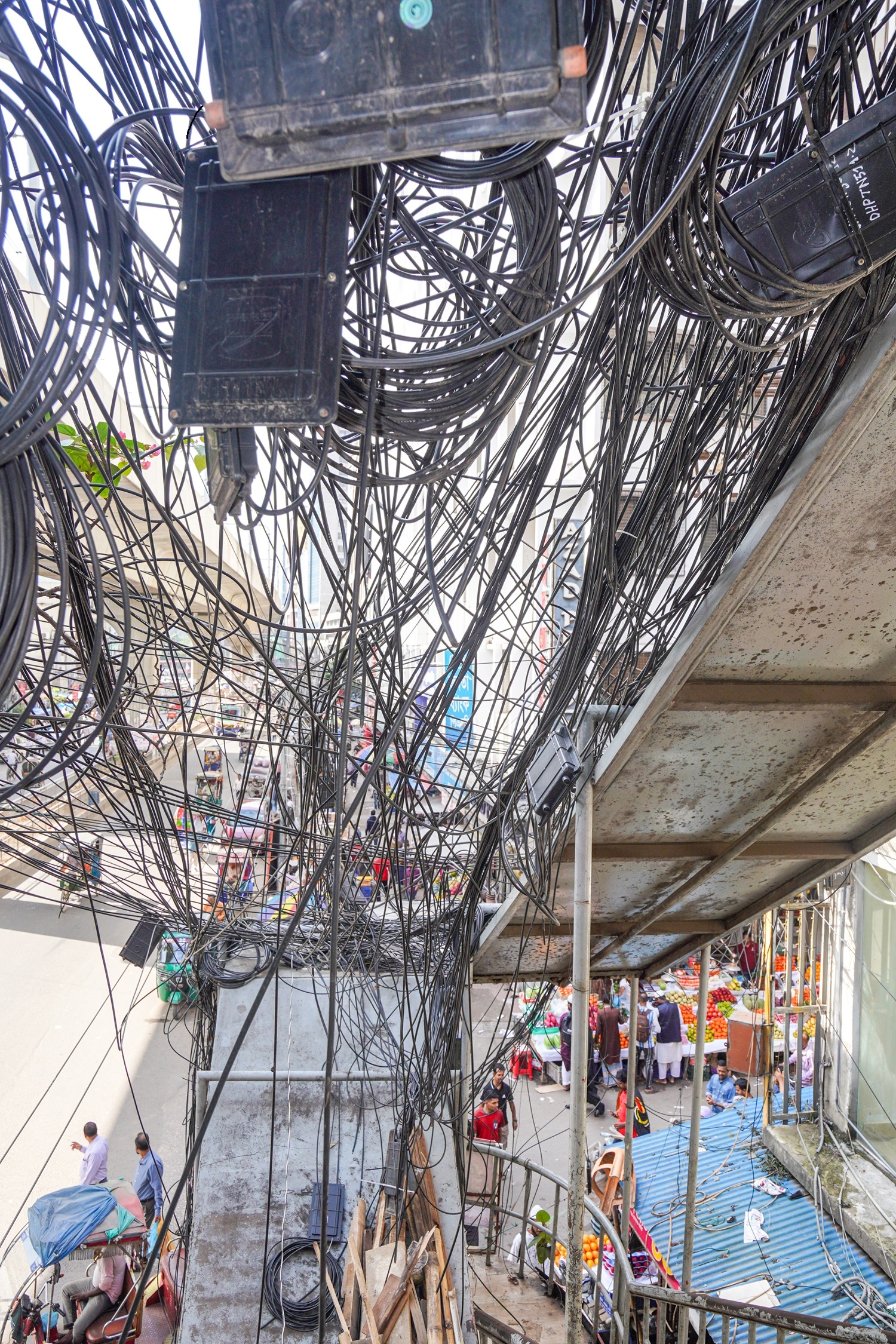
In 2020, when the Dhaka North and South City Corporations moved to remove illegal wires, the Internet Service Providers Association of Bangladesh (ISPAB) and the Cable Operators Association of Bangladesh (COAB) called a strike in protest.
At the time, ISPAB General Secretary Emdadul Haque argued that of the nearly 45 lakh broadband subscribers in Dhaka, more than half are in the DSCC area, and that a shortage of local distribution points forces companies to use utility poles. Fiber@Home and Summit, however, claimed that the infrastructure existed, only the ISPs weren’t using it.




Last month saw DSCC launch another drive in Gulistan, but to little effect, with operations slowing down midway. For every wire removed by the authorities, several dozen others join the tangle of wires every other day.
The issue extends far beyond aesthetics. The Fire Service Department warns that a short circuit in a worn-out cable hanging beside an electric line can spread quickly to nearby buildings, and a fire within a dense tangle of wires can be difficult to control.


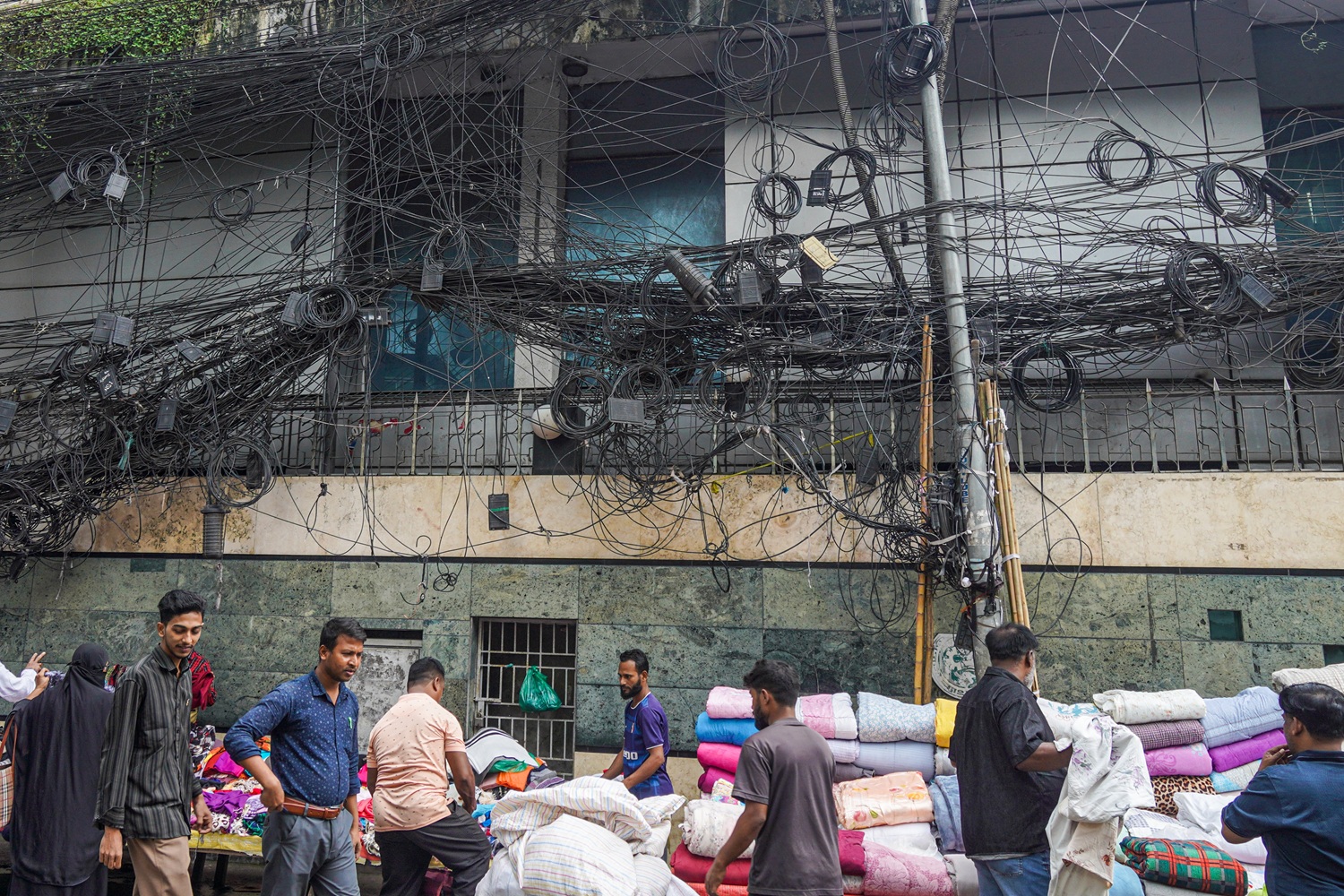
General Secretary of the Bangladesh Institute of Planners Sheikh Muhammad Mehedi Ahsan blames short-sightedness, lack of planning, and weak management by both government and private service providers, adding that these temporary drives are no replacement for an overall plan that provides a lasting solution.
“To eliminate this clutter, a Utility Duct must be established and operated under a comprehensive plan,” he told TIMES.

President of ISPAB MA Hakim offered a solution to reduce the clutter: “If the government permits triple play service – providing voice, data, and ISP facilities through the same cable – the number of wires would be greatly reduced.”
For the people of Dhaka, the web of wires polluting their sky is more than an eyesore. It is a daily reminder of a city that has grown faster than its infrastructure, a plan left half-implemented, and a problem allowed to accumulate for nearly two decades.
And the question is no longer whether the city can afford to wait, for it has waited long enough. But can it afford to remain entangled until this problem runs down to the wire?