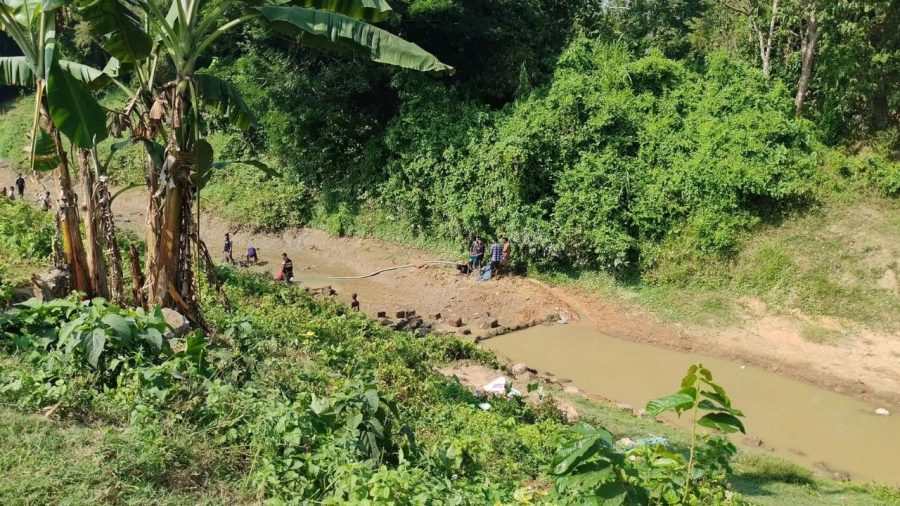

Every Boro season, farmers in Feni pool their own money to build temporary dams to divert water from the Muhuri River into the Kahua. Without this arrangement, they struggle to secure enough water to irrigate their paddy fields.
Yet during the monsoon, water rushing down from the hills causes the Kahua to overflow, flooding farmland, damaging homes and washing away fish from ponds.
The 17-kilometre river, which flows through Parshuram and Fulgazi upazilas, is gradually losing its natural flow. Once a busy waterway, it has developed sandbars and narrowed into a shallow channel in places.
Years of neglect, siltation, waste dumping and infrastructural obstructions have reduced the river’s navigability, damaged agriculture and fisheries, and threatened biodiversity. Boat traffic has virtually ceased.
According to the Feni district administration, the Kahua originates at its junction with the Muhuri River and has an average width of 26 metres, a depth of five metres and a catchment area of 65 square kilometres. Although perennial, its flow drops considerably during the dry season.

Monir Hossain, a resident of Purba Ghaniamora village, said farmers contribute money every year to build a temporary dam and divert water from the Muhuri for Boro cultivation. They would not have to make such arrangements if the river flowed naturally.
Residents alleged that excessive sand extraction from the junction of the two rivers near Kautali village had altered the natural flow. They believe the increased depth of the Muhuri has reduced the flow into the Kahua.
There are also allegations that dams on the Indian side are holding back water. These factors threaten to disrupt Boro cultivation on around 1,000 acres of land in Parshuram and Fulgazi during the dry season.


A visit to the area found that a roughly two-kilometre stretch east of North Kolapara had largely dried up, leaving a narrow channel.
Waste accumulated beneath Khandokia Bridge at Parshuram North Bazar obstructs the flow, while deposits of silt and soil have narrowed the river at several points. Stones lying beneath an abandoned railway bridge in North Kolapara also impede the flow.
Bangladesh Rural Development Board Chairman Abu Taleb Ripon, a resident of South Kolapara, said sections of the river had silted up along its entire course. Waste dumped into the river accumulates as water levels recede, worsening the problem.


He warned that the once-flowing river could disappear altogether unless it was dredged and restored quickly.
Parshuram Upazila Agriculture Officer Mohammad Mizanur Rahman said farmers in Boxmahmud union use the Kahua to irrigate paddy and vegetable fields, diverting water with temporary dams during the dry season.

The Tk1,542.16 crore Muhuri-Kahua flood control and irrigation project approved by the Executive Committee of the National Economic Council (ECNEC) has raised hopes of restoring the river.
The project includes plans to re-excavate 83.50 kilometres of rivers and water bodies, rehabilitate 67.92 kilometres of embankments and protect 11.73 kilometres of riverbanks.
Bangladesh Water Development Board Executive Engineer in Feni Muhammad Monirul Islam said dredging, embankment construction and repairs under the project were expected to restore the Kahua’s natural flow.
Residents urged swift implementation alongside effective measures to prevent encroachment and pollution, curb illegal sand extraction and restore the river’s natural flow.
They also called for a permanent irrigation solution so farmers no longer have to finance temporary dams every Boro season. For communities caught between monsoon flooding and dry-season water shortages, restoring the river is vital to their livelihoods.