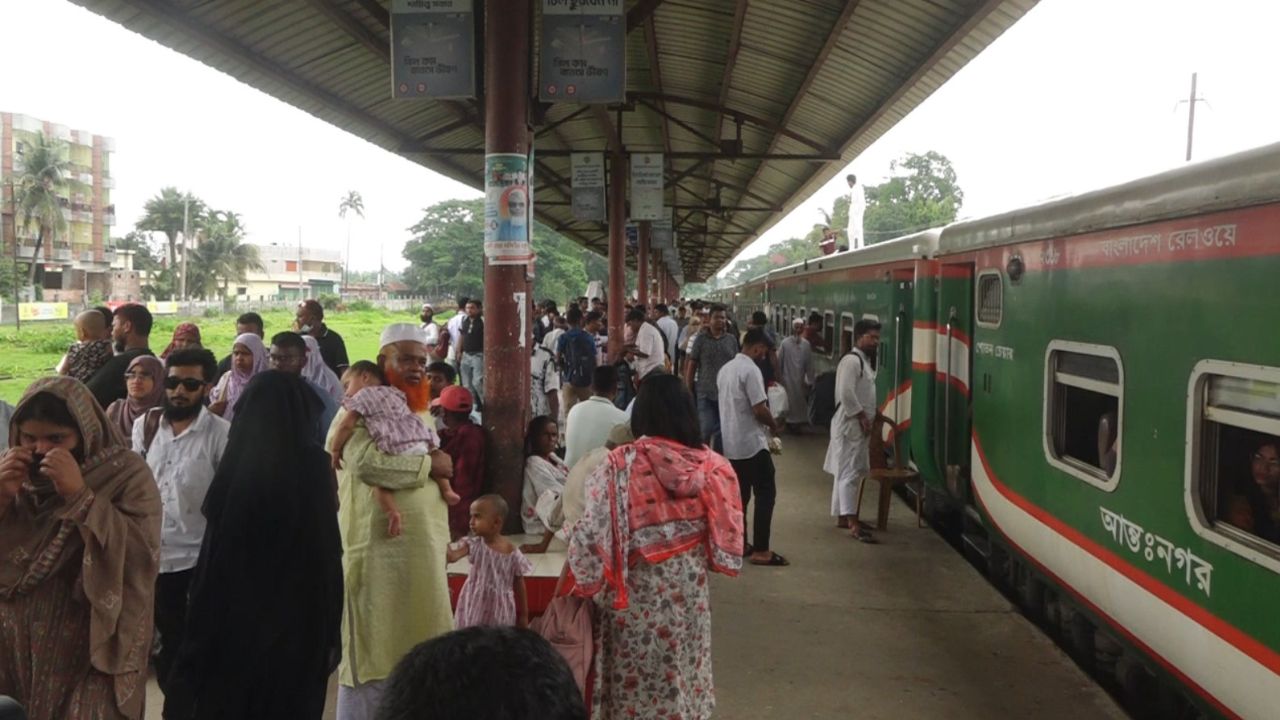

Once hailed as a milestone in rail connectivity for northern Bangladesh, the intercity Jamalpur Express has increasingly become a source of frustration for passengers, who say route changes, inconvenient schedules and limited ticket allocations have turned their dream train into one synonymous with hardship.
Although local residents and civil society groups have repeatedly staged demonstrations demanding restoration of the train’s original route and a more passenger-friendly timetable, Bangladesh Railway has yet to announce any permanent solution.
The Jamalpur Express was inaugurated on 26 January 2020 by then prime minister Sheikh Hasina via video conference from Ganabhaban. Operating on the Dhaka-Tangail-Bangabandhu Bridge East-Sarishabari-Jamalpur route, the train was introduced with imported PT INKA coaches from Indonesia, featuring modern air-brake systems, environmentally friendly bio-toilets, wider doors and dedicated seating for passengers with disabilities.
The 13-coach train has a capacity of 620 passengers, including 110 air-conditioned Snigdha seats and 510 Shovon seats.
The service operated on its original route until 15 April 2023, when it was temporarily diverted because of renovation work at Bangabandhu Bridge East railway station. Since then, it has been running via Mymensingh, Jamalpur and Sarishabari to Bhuapur.
Passengers say the diversion has significantly lengthened the journey, reducing the train’s efficiency as an intercity service.

The train now departs Dhaka at 10am and reaches Bhuapur at around 4:45pm after stopping at numerous stations, effectively consuming an entire working day. On the return journey, it leaves Bhuapur at 5:15pm and arrives at Kamalapur Railway Station around 11:55pm or later.
Regular passenger Shakil said the schedule had become highly impractical.
“The train leaves Dhaka after 10 in the morning and reaches Jamalpur or Sarishabari only in the late afternoon. The entire day is lost in transit,” he said.
“On the return trip we reach Dhaka around midnight or even 1am. Travelling across the city at that hour is not only difficult but also raises security concerns. Many passengers are forced to spend the night at Kamalapur station, while those travelling for official or court work often have to stay an extra night in Dhaka, increasing their expenses.”



Passengers have also complained that insufficient ticket allocations for short-distance stations have encouraged fare evasion.
Atif, another regular commuter, said tickets for nearby destinations were rarely available at station counters.
“Because seats and tickets are so limited, many passengers travel without tickets. As a result, the government is losing a considerable amount of revenue,” he said.
The route change has also disrupted rail connectivity between Jamalpur and Tangail.
Passenger Raihan said the Jamalpur Express had previously been the only intercity train linking the two districts.
“After the route was changed, there has been no direct intercity train to Tangail from our district. Our travel arrangements have become extremely difficult,” he said.
The train currently operates six days a week, remaining off on Sundays. Between Kamalapur and Bhuapur it stops at around 13 stations, including Airport, Joydebpur, Gafargaon, Mymensingh, Piarpur, Jamalpur, Jafarshahi, Sarishabari and Tarakandi.
Passengers argue that the large number of stops over the approximately 235-kilometre route has undermined the speed and character expected of an intercity train.
Over the past several months, residents of Jamalpur and Sarishabari have organised human chains, railway blockades and submitted memoranda demanding restoration of the original Tangail route, increased seat allocations and a more convenient timetable.
Mohammad Yusuf Ali, president of Sarishabari Nagorik Samaj, said the movement would continue until the authorities responded.
“We have been campaigning continuously to restore the train to its original route. Travelling via Tangail reduced journey time and strengthened social and commercial links between the two regions,” he said.
“We want the train to return to its previous route with a passenger-friendly schedule so that commuters, office workers and businesspeople can travel more conveniently.”
Contacted by phone, Dhaka Divisional Railway Manager (DRM) ABM Kamruzzaman said no final decision had yet been taken regarding changes to the route or timetable.
“We are currently trying to ensure the train operates smoothly under the existing schedule. Any future decision regarding the route or timetable will be taken by the higher authorities after considering public interest and other relevant factors,” he said.