Bangladesh Jamaat-e-Islami’s newly announced election manifesto ahead the 13th general election has prompted debate among analysts, with many seeing signs of a calculated shift in political messaging.
The 41-point manifesto, which places special emphasis on the Liberation War, implementation of the July Charter, and women’s rights, appears designed to reposition the party within a rapidly changing political landscape.
The manifesto identifies 26 priority areas and commits to state-level recognition of the ideals and objectives of the Liberation War, pledges to implement the July Charter, and gives unprecedented prominence to women’s rights and security.
Analysts say the document reflects an attempt by Jamaat to broaden its appeal and respond to dominant political demands, though questions remain over how much of it would be implemented in practice.
They note that while manifestos offer insight into a party’s thinking, their true significance becomes clear only when a party gains state power or meaningful influence over governance.
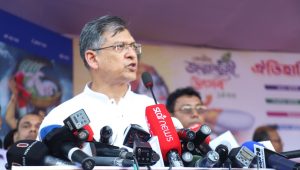
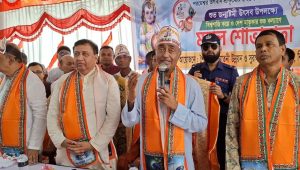
Jamaat Ameer Shafiqur Rahman formally unveiled the manifesto on Wednesday at a five-star hotel in the capital, in the presence of foreign diplomats and prominent members of civil society. Titled “A Safe and Humane Bangladesh”, the document is framed around the slogan “Together Let’s Build Bangladesh”.

The manifesto outlines ten core commitments, divided evenly between five “yes” pledges and five “no” pledges. The affirmative commitments focus on honesty, unity, justice, efficiency and employment, while the rejections target corruption, fascism, hegemony, unemployment and extortion.
In his opening address, Rahman said Jamaat envisioned “a Bangladesh where people’s aspirations are fulfilled”. Drawing historical connections, he said, “Without 1947 there would have been no 1971, and without 1971 there would have been no 2024. Each is linked to the other. This manifesto is not just a party programme; it is a living document and a plan for the nation.”
The manifesto places particular emphasis on youth leadership in state affairs, the abolition of what it calls fascist practices, elections under a proportional representation system, and the establishment of an accountable system of governance. Analysts say these positions align closely with demands currently resonating across Bangladesh’s political sphere.


Professor Sabbir Ahmed of Dhaka University’s Department of Political Science told TIMES of Bangladesh that Jamaat had attempted to introduce noticeable changes. “Overall, Jamaat has tried to bring novelty into this manifesto. There are several strong commitments, particularly regarding women’s security,” he said, adding that implementation would be the decisive factor.
However, he noted that the manifesto does not clearly explain how far the party’s thinking on the Liberation War has evolved compared with the past. He also said the document could have been more explicit on protecting the country’s nine to ten percent minority population and ensuring democratic equality of opportunity in all sectors.
“There is also no clear indication on removing barriers to investment,” he added, while acknowledging that the party had made strategic adjustments on several key issues.
Some analysts believe that while Jamaat has outlined a future political roadmap, its electoral impact and long-term standing will depend on public acceptance and the credibility of its commitments.
Twenty-six priority areas
The manifesto’s 26 priority areas cover a wide range of issues, including the protection of independence and sovereignty, building a justice-based humane state, youth empowerment, women’s security, a drug- and terrorism-free society, a technology-driven smart state, employment generation, banking and financial sector reform, elections under a proportional representation system, prosecution of extrajudicial killings, preservation of the history of the July movement and implementation of the July Charter.
Other priorities include an agricultural revolution, food safety free from adulteration, industrialisation, labour rights, voting rights for expatriates, equal citizenship, universal healthcare, education reform, price stability, major transport reform, affordable housing, the abolition of fascism, expanded social security and the establishment of a welfare state through good governance.
Liberation War and July Charter commitments
Jamaat’s pledge to preserve the “true history” of the Liberation War and present it to students is seen as a significant political signal, given longstanding controversies surrounding the party’s historical position on the war. In the manifesto, Jamaat commits to embedding the war’s ideals — equality, human dignity and social justice — into state life.
At the same time, the party promises rehabilitation, allowances and state-funded medical treatment for those killed or injured in the July movement. Analysts say this is an effort to align the party with recent political struggles and broaden its relevance. The commitment to implementing the July Charter could become a central pillar of Jamaat’s future political strategy.
Focus on women’s rights
One of the most discussed sections of the manifesto is its focus on women’s safety and empowerment. Proposals include a National Women’s Protection Taskforce, safer public transport, expanded day-care facilities, women’s health centres, fast-track tribunals and one-stop crisis centres.
Observers say these pledges move beyond Jamaat’s traditional political image and appear aimed at attracting new voter groups, particularly women in both urban and rural areas. However, questions remain about the feasibility and sincerity of these commitments.
Economy and governance reform
The manifesto also promises reform of the banking and financial sectors, the creation of an investment-friendly environment, expanded employment opportunities and price control measures. Jamaat further pledges accountability for enforced disappearances, killings and extrajudicial executions carried out with state patronage.
Its call for elections under a proportional representation system and support for a strong caretaker government framework are seen by some analysts as efforts to present Jamaat as a reform-oriented political force.
Whether these proposals translate into electoral gains or durable political repositioning, analysts say, will depend less on the document itself and more on how convincingly the party can translate words into action.