

A coordinated social media campaign alleging that “deep state” manipulation cost Jamaat-e-Islami and its allies dozens of seats through “election engineering” has been systematically debunked by Dismislab data analysis.
The narratives, which began circulating on 13 February – the day after the vote – alleged that Jamaat candidates were defeated by fewer than 5,000 votes in 53 different constituencies.
One viral post questioned why Jamaat’s Ameer Shafiqur Rahman accepted the results, claiming that the party would have won 135 seats if not for manipulation by the “deep state” to reduce their count to 70-80.
Data refutes ‘53 seats’ claim
An analysis by Dismislab of seat-based results published by Prothom Alo reveals these figures to be inaccurate. The data shows that only 22 seats across the entire country were decided by margins of fewer than 5,000 votes, not 53.
In these highly competitive races, Jamaat and its allies actually won 11 seats, while the BNP and its allies won nine. One seat each went to an independent candidate and Islami Andolon Bangladesh (IAB).

The specific claims regarding individual candidate margins were also found to be false. In Pirojpur-2, where it was alleged that Shamim Sayeedi – son of Delwar Hossain Sayeedi – lost by only 70 votes, the actual margin was 8,288 votes.
According to the results, the winner, Ahmad Sohel Manjur, received 105,185 votes compared to Sayeedi’s 96,897. Similarly, in Khulna-5, the actual margin was 2,608 votes rather than the 2,000 claimed in viral posts.
Broader competitive landscape
The analysis indicates that narrow margins applied to both major alliances rather than favouring one side. Jamaat or allied candidates won the country’s two closest races: Madaripur-1 (385-vote margin) and Sirajganj-4 (594-vote margin).




Conversely, BNP-supported candidates secured narrow victories in Cox’s Bazar-4, Chattogram-14, and Brahmanbaria-5, with margins of 929, 1,026, and 1,061 votes respectively.
Further examination of the 50 closest races, where margins ranged from 385 to 9,581 votes, showed that Jamaat and its allies won 24 seats, while the BNP and its allies won 22.
Data also indicates that in seats where they were defeated, the average margin of loss for Jamaat alliance candidates (2,990 votes) was actually higher than that of BNP alliance candidates (2,568 votes).
Prominent allied candidates who lost in these 22 narrow-margin seats included Md. Abdul Ahad of the NCP, Omar Faruq of the Liberal Democratic Party, Maulana Mamunul Haque of Bangladesh Khelafat Majlis, and Jamaat’s Secretary General Mia Golam Porwar.
Coordinated digital campaign
Despite the lack of evidence, these claims were amplified across Facebook and Instagram through standalone posts and coordinated comments.
Identical text questioning why the Ameer accepted “election engineering” appeared under reports by the media outlet Amar Desh and on the “Jobians” Facebook page, a forum for Jagannath University students.
One user even claimed that in 57 seats, the margin between Jamaat and BNP candidates was only 70 to 5,000 votes.
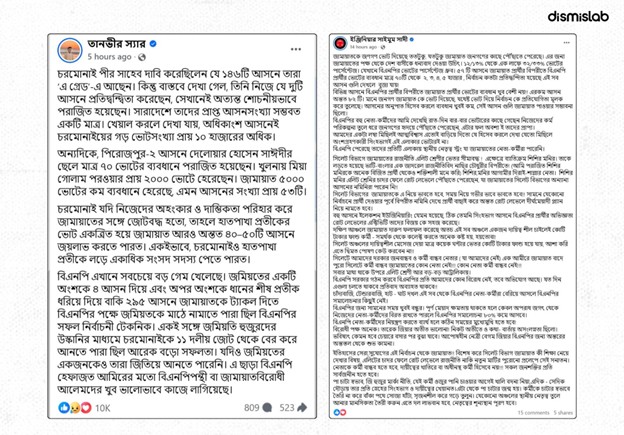
A verified page named “Tanvir Sir” falsely claimed that a coalition with the Pir of Charmonai using the “hand-fan” symbol could have secured an additional 40–50 seats.
Additionally, a well-known parody profile named “journalist Moniruzzaman” used an image of the Jamaat Ameer becoming ill on stage to suggest that the party, with its alleged margins, would have controlled more than 200 upazilas.
Dismislab collected at least a dozen such posts and comments, concluding that the narratives were designed to suggest Jamaat would have won significantly more seats without a “deep state” conspiracy.