

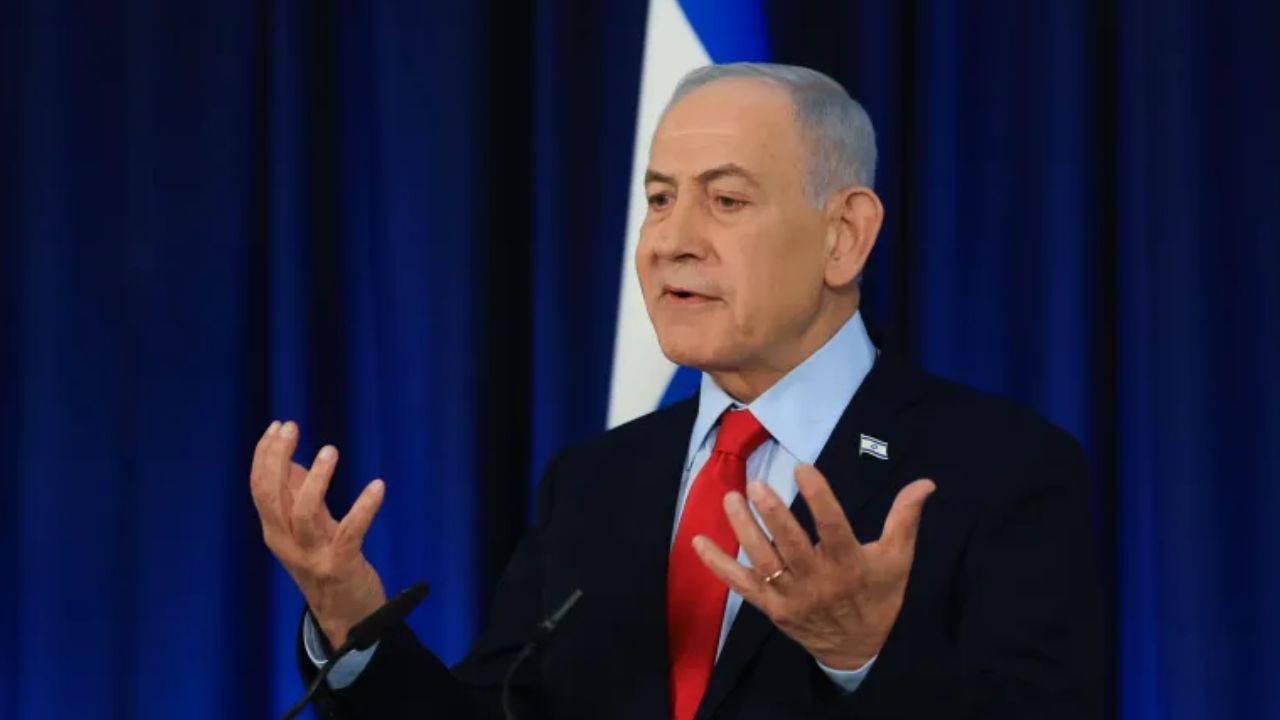



Israeli Prime Minister Benjamin Netanyahu has referred to the United Kingdom as the “Islamic Republic of Britain,” sparking sharp criticism and highlighting growing diplomatic friction between Israel and its long-standing European ally.
Speaking on the Israeli podcast Melech Blitzer Haim, which aired on Thursday, Netanyahu made the sarcastic remark while expressing dissatisfaction with British media coverage of Israel.
He contrasted current reporting with that of British writer Randolph Churchill, whom he commended for “positive” coverage during the 1967 Six-Day War.
“Go find that in Britain today, which you could call the Islamic Republic of Britain,” Netanyahu said, according to an Al Jazeera report quoting translated remarks published by the Israeli press.
Later in the podcast, the Israeli leader appeared to reference a 2022 statement by US politician JD Vance, who had suggested the UK could become the first nuclear-armed “Islamist country.”

“Someone said the first Islamic republic with nuclear weapons will be the Islamic Republic of Britain,” Netanyahu said. “We are making sure there won’t be another one here, in Iran,” he added.
The comments have drawn swift condemnation from political and religious figures in the UK.
The Movement for Progressive Judaism, a British and Irish Jewish organisation, described the remarks as dangerous and divisive.




Co-leads Rabbi Charley Baginsky and Rabbi Josh Lev issued a joint statement saying, “At a time when antisemitism, anti-Muslim hatred and social division are causing real fear across our country, language of this kind is dangerous and irresponsible.”
They added that “Netanyahu does not speak for British Jews. His words do not represent us.”
Gavin Barwell, who served as Downing Street chief of staff to former Prime Minister Theresa May, accused Netanyahu of “blatant Islamophobia”.
Writing on the social media platform X, Mr Barwell expressed hope that “everyone will now shed the pretence some still cling to that this man is any friend of Britain.”
The exchange comes amid a visible strain in relations between Jerusalem and London since the Labour Party won the UK general election in 2024.
Under the premiership of former Labour Prime Minister Keir Starmer, the UK suspended certain arms export licences to Israel, paused discussions on a free trade agreement, and imposed targeted sanctions on far-right Israeli cabinet ministers Itamar Ben-Gvir and Bezalel Smotrich.
Moreover, the UK joined international partners such as France and Canada last year in formally recognising a Palestinian state.
More recently, the current British Prime Minister Andy Burnham offered an apology for his party’s initial response to the conflict in Gaza, admitting that Labour had been too slow in calling for a ceasefire.
Burnham indicated that the UK needs to increase pressure on the Israeli government, saying, “That is why we need to do more, which includes looking at further sanctions on those involved in the violence in Gaza but also looking at measures to ban trading goods with illegal settlements.”
Rodwan Abouharb, an associate professor of international relations at University College London, observed that while Netanyahu’s remarks represent a “new low” in bilateral relations, they also “belies a considerable overlap in policy goals” between London and Jerusalem concerning Iran.
Abouharb suggested the comments were intended primarily for an Israeli audience, aimed at shoring up Netanyahu’s “fractured governing coalition.”