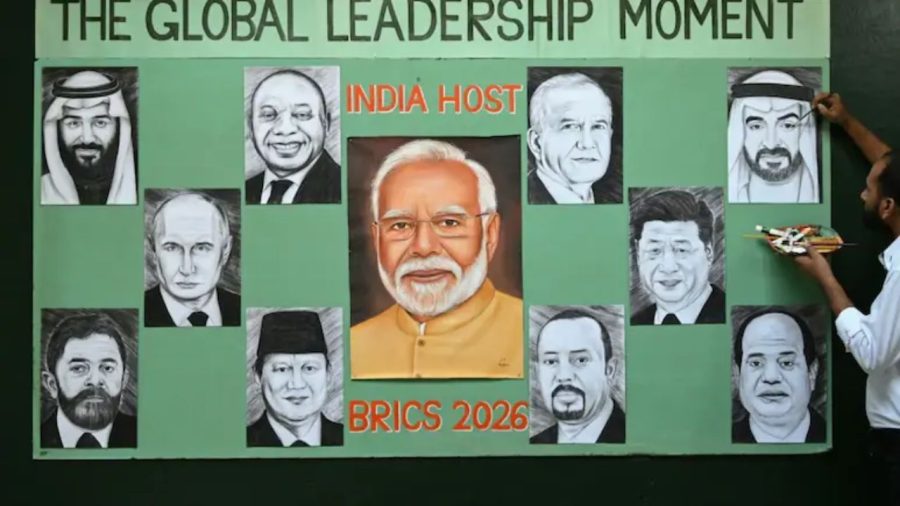

India will host the 18th BRICS Summit in New Delhi on 12-13 September 2026, marking the fourth time it has hosted the annual gathering after 2012, 2016 and 2021.
The summit carries special importance for New Delhi as its next opportunity to host the event will come after a decade, with a new cycle beginning following the induction of members in 2024 and 2025.
India has invested significant diplomatic capital in ensuring a successful summit, with expectations of a consensus-based New Delhi Declaration and concrete outcomes on trade, development cooperation, climate change and alternative payment mechanisms.
But the summit comes at a defining moment for BRICS itself.
The grouping of emerging markets and developing countries (EMDCs) has expanded rapidly, growing from five members to 11 in recent years. The expansion has strengthened its economic and political weight, but it has also made consensus-building far more difficult.
Before the new members could fully integrate into the bloc, BRICS found itself confronted with major geopolitical divisions, including conflicts involving members on opposing sides.
The outcome of the New Delhi summit could therefore determine whether BRICS emerges as a stronger global platform or struggles under the weight of its internal differences.
A difficult geopolitical landscape

The summit is being held at one of the most challenging moments since the first BRICS meeting in Yekaterinburg, Russia, in 2009.
The Russia-Ukraine war, which began in February 2022, has featured prominently in BRICS discussions in recent years. However, managing the issue has been relatively straightforward because Ukraine, the United States and European countries involved in the conflict are not members of the grouping.
The conflict involving Iran, the United States and Israel presents a much more complicated challenge.
Iran, Saudi Arabia and the United Arab Emirates — all BRICS members — have different positions on the crisis. Finding common ground among these countries will test the grouping’s ability to maintain unity on major geopolitical issues.
The BRICS foreign ministers’ meeting in New Delhi in May 2026 failed to produce a joint declaration, highlighting the difficulty of reconciling competing interests over issues such as the US-Iran conflict and Palestine.
However, India’s chairmanship has continued to deliver consensus in economic, social and technical areas despite political disagreements.




From economic bloc to global platform
BRICS was initially created to give major emerging economies a stronger voice in global economic institutions dominated by Western powers.
The grouping later expanded its focus to represent broader Global South interests.
The New Development Bank (NDB) and the Contingent Reserve Arrangement (CRA) were established in 2015 to strengthen financial cooperation among members.
Growing concerns over the use of Western financial systems as geopolitical tools encouraged more countries to seek closer ties with BRICS.
A major expansion was announced at the Johannesburg Summit in 2023, with the UAE, Saudi Arabia, Iran, Egypt and Ethiopia joining in 2024. Indonesia became a member in 2025.
Following the expansion, BRICS members account for nearly half of the world’s population, around 40 per cent of global oil production and about 40 per cent of global GDP in purchasing power parity terms.
The grouping also controls significant reserves of rare earths and critical minerals, giving it potential strategic influence.
However, that influence depends on whether members can act collectively and overcome differences through consensus.
India’s year of diplomacy
India’s BRICS chairmanship has focused on four themes — resilience, innovation, cooperation and sustainability.
Since assuming the chair, New Delhi has organised more than 350 meetings involving foreign ministers, national security advisers, sectoral ministers, Sherpas and government agencies.
Twenty-two ministerial meetings across areas including finance, trade, energy, agriculture, health, education, technology, environment, transport, labour and culture have produced consensus-based declarations and outcome documents.
India has also hosted initiatives such as the first MSMEs Forum, Friendship Cities Conclave, Culture Festival, BRICS Business Council meetings, Think Tanks Council meetings and Academic Forum.
Key areas of cooperation include BRICS Centres of Excellence on agro-ecology, healthy lifestyles, traditional medicine, sustainable development, skill-building, energy storage, startup innovation, global value chains and technology cooperation.
The declaration challenge
The biggest test for India will be securing a consensus declaration that addresses the Iran-US-Israel conflict without alienating any of the directly involved BRICS members.
India has previously demonstrated its ability to bridge deep divisions. At the 2023 G20 Summit in New Delhi, it secured a leaders’ declaration despite widespread doubts over whether an agreement was possible.
That success was achieved with support from key partners, including Brazil, Indonesia and South Africa.
Within BRICS, India maintains strong relations with most members, including Brazil, South Africa, Indonesia, Egypt and Russia. Although ties with China remain complicated, relations have shown signs of gradual improvement.
All BRICS members have a shared interest in ensuring that the expanded grouping remains credible and effective.
Even China, despite strategic competition with India, would not want the BRICS-Plus framework to fail. A successful summit would demonstrate that the bloc can overcome differences and continue to serve as a platform for emerging economies.
For India, delivering a consensus declaration is not merely a diplomatic achievement. It is a test of BRICS’ future relevance.