
At first glance, these statements appear contradictory. Banks say they have liquidity but cannot find credible borrowers. SMEs say they have viable businesses but cannot find supportive banks. After nearly two decades in SME banking, working closely with entrepreneurs, relationship managers, credit risk teams, regulators and development partners, I have come to believe that both statements can be true. The problem is not simply a financing gap. It is a perspective gap.
Every financing discussion involves two parties looking at the same business through very different lenses. The entrepreneur sees opportunity. The banker sees risk. The entrepreneur talks about customers, market demand, innovation and growth. The banker asks about repayment capacity, cash flow, governance, financial records and resilience. Neither side is wrong. In fact, both are doing exactly what they are supposed to do.
Entrepreneurs are expected to dream, take calculated risks and pursue opportunities. Bankers, meanwhile, are entrusted with depositors’ money and have a responsibility to protect the stability of the financial system. The challenge begins when each side assumes that the other should think in the same way.
Most entrepreneurs build businesses through courage, persistence and instinct. Many begin with family savings, borrow from relatives or reinvest every taka they earn back into the business. They know their products. They understand their customers. They know what their market needs and often work harder than anyone else in the organisation.
When they approach a bank, they naturally expect these strengths to speak for themselves. Instead, they are asked for audited financial statements, tax records, banking history, cash-flow projections, ownership documents and governance information. To an entrepreneur, these requirements can sometimes feel like unnecessary bureaucracy. What matters, they may think, “is my business growing”.

But growth alone does not answer the question a bank must ultimately ask: “Can this business repay the loan under different economic conditions?”
Bankers operate under a different responsibility. Every loan represents money entrusted to the bank by depositors. A banker therefore looks for evidence rather than optimism, historical performance rather than promises, documented cash flow rather than verbal assurance and controls rather than assumptions.
To an entrepreneur, this can appear overly cautious. To a banker, it is prudent risk management. This difference in perspective explains why the same meeting can end with two completely different conclusions. The entrepreneur leaves thinking, “The bank did not understand my business.” The banker leaves thinking, “The entrepreneur could not demonstrate repayment capacity.” Interestingly, both may be correct — from their own perspective. One is asking, “Can this business grow?” The other is asking, “Can this business repay?” Growth and repayment are connected, but they are not the same.




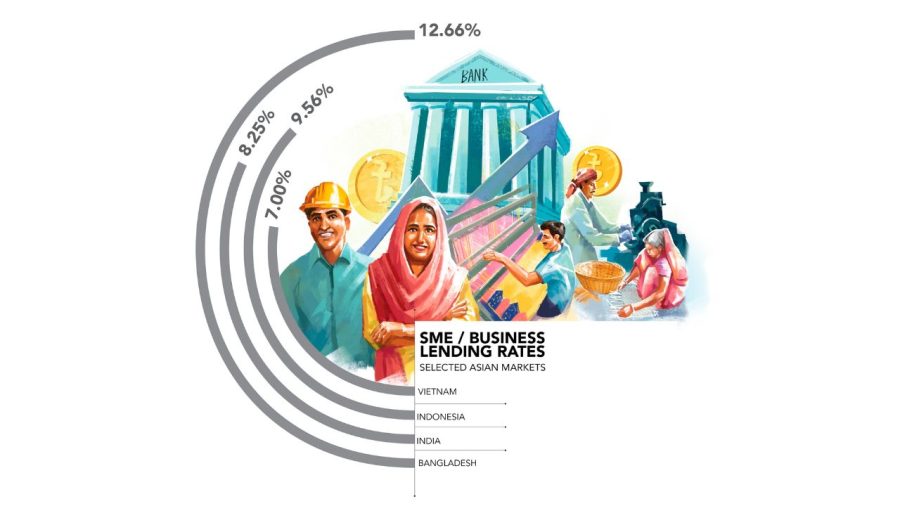
Access to finance is only one part of the SME financing challenge. The other is the cost at which finance is available. Bangladesh Bank’s January 2026 monthly update reports a weighted average interest rate on SME advances of 12.66 per cent in December 2025, with an SME interest-rate spread of 6.32 percentage points — the highest among the major sectors reported. This makes the cost of finance an important part of the competitiveness question for Bangladeshi SMEs.
A cross-country comparison provides useful perspective. Central Bank of India publishes general MSME rates from 8.25 per cent to 9.20 per cent, while Maybank Indonesia’s SME prime lending rate is 9.56 per cent. BIDV Vietnam advertises preferential short-term business rates beginning at 7.0 per cent for qualifying loans. Interest rates reflect inflation, cost of funds, monetary policy, operating expenses, capital requirements, credit risk and expected losses. But it does raise a strategic question: how can Bangladeshi SMEs compete regionally when the cost of bank finance can be materially higher than in comparable Asian markets?
And interest rates are only one part of the equation. The overall financing experience also depends on collateral requirements, documentation, turnaround time, credit information, guarantee mechanisms, digital underwriting and the ability of banks to assess businesses based on actual cash flows rather than only traditional security. This is where the perspective gap becomes particularly important.
The gap becomes even more visible when financing women-led businesses and start-ups. Many women entrepreneurs operate successful enterprises but face additional challenges, including limited ownership of traditional collateral, shorter formal financial histories and fewer established banking relationships.
Start-ups present a different dilemma. Traditional banking relies heavily on historical performance to assess future repayment. Start-ups, by definition, have limited history. Their greatest asset may be future potential. This creates a fundamental mismatch. Innovative businesses can remain outside conventional credit frameworks not because they lack promise, but because their promise is difficult to evaluate using traditional tools. The answer is not to abandon credit discipline. It is to improve the way risk is understood.
Closing the perspective gap
Bridging this gap does not mean asking bankers to abandon prudent risk management. Nor does it mean asking entrepreneurs to become credit analysts. It means helping each side understand the realities of the other. Banks must invest more in understanding business models, industry dynamics, entrepreneurial journeys and the underlying cash flows of businesses. Entrepreneurs, meanwhile, must invest more in governance, financial discipline, transparency and documentation.
Technology can increasingly help bridge this divide. Transaction data, digital payments, account behaviour, supply-chain information, tax records and alternative data can provide banks with a much richer understanding of an SME than a conventional financial statement alone.
The future of SME banking, therefore, may not simply be about approving more loans. It is about becoming better translators. Banks need to translate entrepreneurial ambition into acceptable banking risk. They need to translate credit requirements into practical improvements for businesses. And they need to help entrepreneurs become more bankable while becoming more entrepreneurial themselves in the way they understand customers. When that happens, financing becomes more than a transaction. It becomes a partnership for growth.
Every rejected loan tells two stories. The entrepreneur believes the bank failed to see the opportunity. The banker believes the entrepreneur failed to demonstrate the ability to repay. Perhaps the future of SME banking lies not in choosing one story over the other, but in helping both sides understand each other. Because the biggest gap in SME finance may not be the financing gap itself. It is the perspective gap.
Author is the EVP and Head of SME Banking, Prime Bank, and Adjunct Faculty, East West University. The views expressed in this article are solely those of the author.