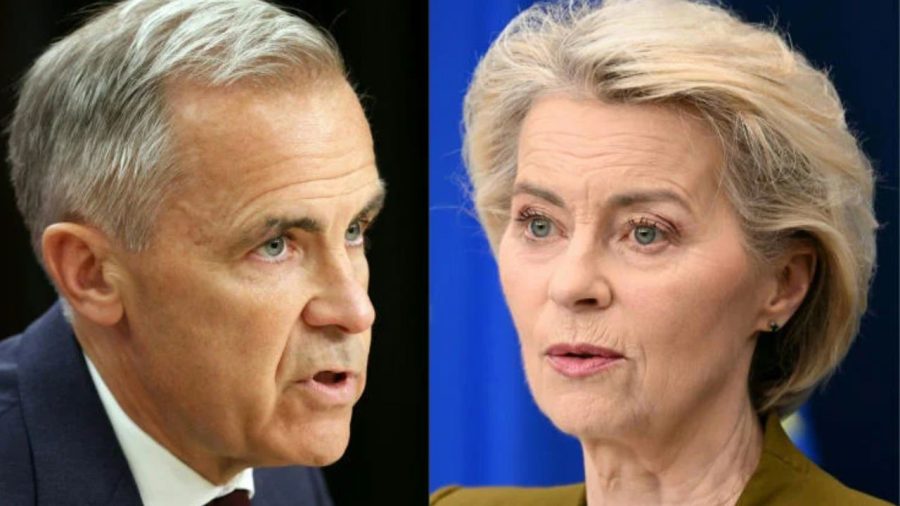

The European Union and Canada are preparing to accelerate cooperation in strategic areas including artificial intelligence, energy and critical minerals as both sides seek to deepen their partnership.
European Commission President Ursula von der Leyen is due to deliver the annual State of the European Union address before the European Parliament in Strasbourg on Wednesday, with Canadian Prime Minister Mark Carney attending as a special guest. Carney will address the European Parliament himself the following day, reports AFP.
The visit comes ahead of the next EU-Canada summit, scheduled for 29-30 October in Montreal. Carney has been pursuing what he calls a “unique alliance” with the 27-member bloc as Canada and the EU seek to diversify their partnerships amid strained relations with the United States and growing economic competition from China.
“The world has been a bit tumultuous in the past little while,” Canada’s ambassador to the EU, Jonathan Wilkinson, told AFP. “It’s an important time for us to reach across and to try to figure out how we can mutually help each other.”

The European Commission has not disclosed specific details of the ongoing discussions. However, a spokesman said the EU’s ambition for cooperation with Canada remains high and that von der Leyen would deliver a “positive and meaningful” message on Wednesday.
EU-Canada cooperation already covers substantial areas. Their bilateral free-trade agreement, the Comprehensive Economic and Trade Agreement (CETA), removed almost all tariffs and has been credited with increasing trade in goods and services by more than 80 per cent since 2016.
Canada also became the first non-EU country to join the bloc’s defence procurement programme this year. Official Canadian figures say Canada joined the EU’s Security Action for Europe (SAFE) initiative in February 2026, becoming its first non-European participant.




However, officials and observers point to scope for further cooperation. Wilkinson said negotiators were focusing on areas with “complementary capabilities and needs” that are “strategically important” to “ensure our sovereignty”. He specifically highlighted energy, artificial intelligence and critical minerals.
Ottawa is seeking to finalise an arrangement that would allow the European Investment Bank (EIB) to finance Canadian critical-minerals projects. The initiative aims to reduce dependence on China for essential raw materials used in products such as batteries.
Wilkinson pointed to recent cooperation as potential models for broader ties, including Canadian liquefied natural gas shipments to Germany and investments by Canadian AI company Cohere in Germany.
“It’s about actually accelerating that work,” he said.
The discussions also cover labour mobility, student exchanges and support for Ukraine. Negotiators are considering ways to ease labour mobility rules and expand student exchanges through the EU’s Erasmus youth mobility programme. Canada is also considering financial participation in the bloc’s 90-billion-euro ($105 billion) loan facility for Ukraine.
Wilkinson said both sides want to move beyond a conventional free-trade relationship and deepen cooperation across a wider range of areas.
Yet the implementation of existing agreements remains a challenge. Ten EU member states, including France, Italy and Poland, have yet to ratify CETA, partly because of opposition from local agricultural producers. As a result, provisions covering investment protection and dispute resolution remain unratified.
The European Parliament’s centrist Renew group has written to EU Trade Commissioner Maros Sefcovic, warning that continued delays “weakens the EU’s credibility as a reliable trading partner” and calling on Brussels to encourage member states to complete the ratification process.
Some EU lawmakers have also called for targeted measures to help small and medium-sized businesses that have yet to make full use of CETA’s benefits.