Local Government, Rural Development and Cooperatives Minister Mirza Fakhrul Islam Alamgir on Saturday said that the future of Bangladesh-India relations largely depends on the renewal or finalisation of the Ganges water-sharing agreement, commonly known as the Farakka Treaty.
He made the remarks while addressing a discussion organised by the BNP marking Historic Farakka Day as the chief guest.
The programme was presided over by BNP Senior Joint Secretary General and Political Adviser to the Prime Minister Advocate Ruhul Kabir Rizvi.
Fakhrul, also BNP Secretary General, said Farakka Day represents a symbol of resistance, recalling the leadership of Maulana Abdul Hamid Khan Bhasani, who, he said, dedicated his life to public welfare movements without compromising with power.
He stated that Maulana Bhasani led a strong movement to protect the livelihoods, biodiversity, and environment of the people of Bangladesh.

The BNP leader added that the Ganges or Padma River is directly linked to the livelihoods of nearly one-third of Bangladesh’s population, while the Farakka Barrage has long posed threats to the country’s ecology and environment.
Referring to BNP founder and former president Ziaur Rahman, Fakhrul said Ziaur Rahman internationalised the issue by mobilising global opinion and raising it on international platforms.




He also alleged that Bangladesh’s water crisis began after then prime minister Sheikh Mujibur Rahman allowed India in 1973 to conduct experimental water diversion through the Farakka Barrage.
Fakhrul further noted that subsequent water-sharing efforts were pursued during the tenure of Ziaur Rahman and later former prime minister Khaleda Zia.
He stressed that a short-term agreement would not be sufficient, arguing that the treaty should be of indefinite duration until replaced by a new arrangement.
“No demand can be achieved without public unity,” he said, adding that Maulana Bhasani had united people on the Farakka issue, which later enabled Ziaur Rahman to reach an agreement.
Fakhrul noted that the current Ganges Water Sharing Treaty is set to expire in December 2026 and warned that failure to renew it or ensure adequate water flow would create serious challenges for Bangladesh.
He also praised what he described as a decision taken by Prime Minister Tarique Rahman to advance the Padma Barrage project, calling it a significant step for protecting large parts of the country.
Fakhrul claimed the government led by Tarique Rahman is a “people’s government” formed through a legitimate democratic process, while alleging that certain groups are spreading propaganda to destabilise the country.
He asserted that Bangladesh would not accept any agreement that compromises national interests, adding that the government would prioritise the country’s welfare in all negotiations.
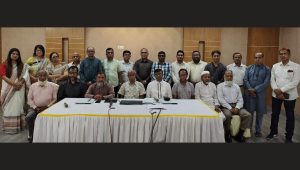
Among the special guests were BNP Chairperson’s Advisory Council member Goyeshwar Chandra Roy, BNP Vice-Chairman Shamsuzzaman Dudu, and Advisory Council members Mizanur Rahman Minu and Ataur Rahman Dhali.
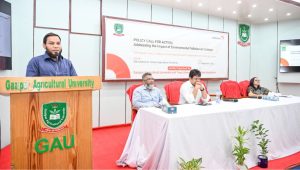
The discussion also featured water resources and climate experts including Emeritus Professor Ainun Nishat, Dhaka University Vice-Chancellor Prof ABM Obaidul Islam, BUET Professor Md Ataur Rahman, and Jahangirnagar University Professor Nahrin Islam Khan.
Vice-Chancellor of Dhaka Central University Prof Md Nurul Islam presented the keynote paper at the event.