

Agent banking in Bangladesh began as a targeted experiment to reach people left outside the formal financial system. Over time, it has grown into one of the most consequential pillars of the country’s financial architecture.
With more than 25 million citizens now brought under formal banking, agent banking is no longer peripheral. It has become central to Bangladesh’s strategy for inclusive and rural-led growth.
Why the model works for banks
For banks, agent banking offers a rare combination of scale, cost efficiency and risk diversification. By relying on local agents instead of building brick-and-mortar branches, banks have been able to penetrate rural and semi-urban markets at a fraction of the traditional cost.
This shift has significantly strengthened deposit mobilisation. Deposits collected through agent banking have reached around Tk477,006 million, driven largely by low-cost CASA growth from outside major cities. These funds have helped banks diversify their liability base while lowering overall funding costs.
Lending through agent channels has also expanded. To date, approximately Tk329,110 million has been disbursed through agent banking, including SME and agriculture-focused loans.
The small-ticket, high-volume nature of these transactions reduces concentration risk and allows banks to spread credit more evenly across regions.
Agent banking has also extended banks’ presence into communities where formal banking services were once absent, reinforcing institutional trust and visibility at the grassroots level.
What it means for customers
For customers, agent banking has translated into access, convenience and security. In many rural areas, it serves as the first point of entry into savings accounts, remittance services, DPS schemes and affordable credit.
A key development has been the growing emphasis on productive rural lending. Lending to specialised agricultural sectors grew by more than 55 per cent during fiscal year 2024-25, reflecting a deliberate shift toward financing income-generating rural activities rather than consumption alone.
Technology has been critical to this transformation. The introduction of e-KYC, biometric verification, NID integration and real-time transaction authorisation has sharply reduced onboarding barriers.

Customers now face lower transaction costs, spend less time travelling and benefit from dealing with familiar local agents, supported by dual-factor authentication, instant SMS alerts and token-based transaction security.
Inclusion first, economics reinforce
Agent banking was initially driven by the financial inclusion mandate of Bangladesh Bank, but economic logic quickly reinforced its appeal. Nearly 85 percent of agent banking customers come from marginal populations, confirming inclusion as the primary driver.
At the same time, low-cost deposit mobilisation and rural micro-lending have made the model commercially viable. Banks such as City Bank have therefore expanded agent banking to meet both social objectives and shareholder expectations.
Is there a one-way flow of funds?
Critics often argue that agent banking drains rural deposits to finance urban lending. The data suggests a more nuanced reality. By December 2024, agent banking deposits stood at Tk419,600 million, rising to Tk471,960 million by September 2025.




Over the same period loans disbursed through agent banking reached Tk240,300 million in 2024 and continued to grow in 2025, even though the overall loan-to-deposit ratio remained modest.
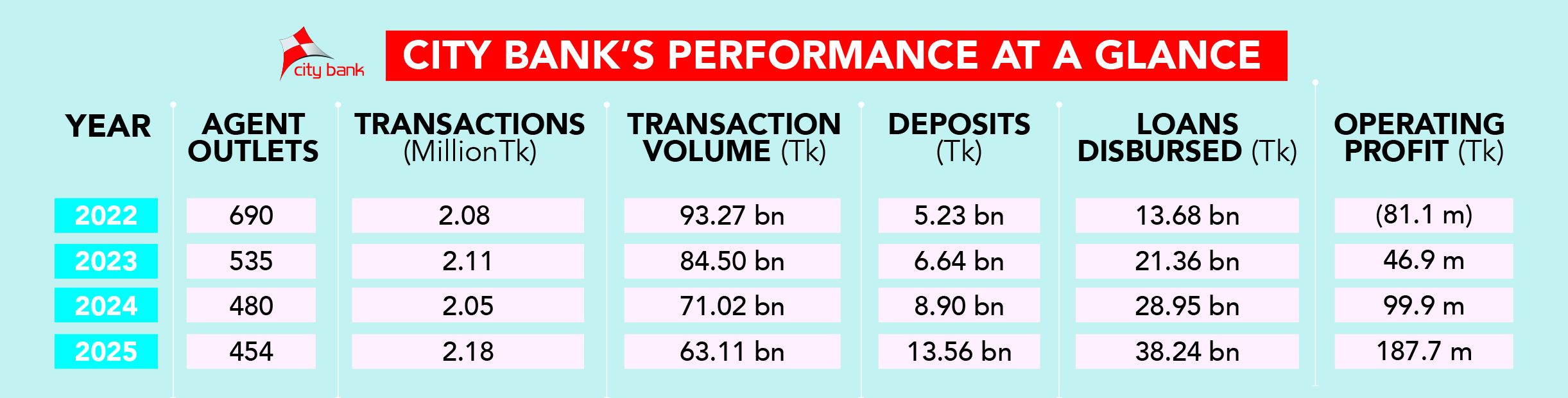
City Bank stands out in this context. It has disbursed more than Tk38,241 million in loans – more than twice the deposits collected through its agent network – ranking second nationwide in agent banking lending and demonstrating active recycling of funds into local economies.
Managing risk at scale
Rapid expansion has brought operational, fraud, compliance and reputational risks. Cash mishandling, forged transactions and agent misconduct remain key concerns across the sector.
City Bank addresses these risks through biometric onboarding, token-based dual authentication, real-time monitoring, frequent audits, mystery shopping and strict agent performance scoring. A zero-tolerance approach allows for swift termination of agents where misconduct is detected.
Notably, City Bank reports no fraud-related customer compensation since 2021, underscoring the effectiveness of its control framework.
Accountability and liability
Under Bangladesh Bank’s Prudential Guidelines, agent banking operates under a strict principal-agent model. Banks bear full legal responsibility for agent misconduct.
Customers with valid transaction proof, such as digital receipts or SMS confirmation, must be compensated by the bank.
Residual risk is managed through mandatory agent security deposits, insurance coverage and legal action under existing penal and digital security laws.
The case for interoperability
As margins tighten, agent profitability has come under pressure. With nearly 200 agent outlets closing in early 2025, the single-bank exclusivity model is increasingly strained, particularly for rural shopkeepers.
Allowing agents to serve multiple banks under strict safeguards is therefore being discussed as a practical step to sustain the ecosystem while maintaining regulatory oversight.
Regulation and the next phase
Bangladesh Bank’s regulatory framework has successfully eliminated ghost accounts through mandatory biometric KYC and strengthened transparency via real-time SMS alerts. Financial inclusion targets have also pushed banks decisively into rural markets.
However, these rules were designed for a slower, branch-extension era. As agent banking becomes faster, more autonomous and technology-driven, supervision must evolve. The planned shift to Risk-Based Supervision (RBS) from 2026 marks a significant step toward aligning regulation with scale.
What reform matters most
Long-term sustainability will depend on moving beyond a deposit-heavy model. Expanding nano-loans and CMSME credit processing through agent outlets can strengthen agent economics. Equally important is reducing liquidity drain by ensuring that a portion of locally mobilised deposits is reinvested within the same communities.
Technology as the growth engine
Today’s agent banking relies on digital onboarding, real-time posting, liquidity dashboards and centralised monitoring. The next phase will be shaped by AI-driven fraud detection, alternative credit scoring, API-based fintech partnerships and agent-assisted digital credit and insurance distribution.
Looking ahead: 2026–2035
Over the next decade, agent banking in Bangladesh is expected to shift decisively from physical expansion to deeper systemic integration. Rather than adding outlets, the focus will move toward linking agent networks seamlessly with digital banks and mobile financial services, allowing customers to move effortlessly between cash-based and digital channels.
Agents are likely to evolve into village-level business hubs, supporting not only banking transactions but also credit access, insurance enrolment and small enterprise services.
Advances in artificial intelligence will enable nano-lending and more accurate identification of CMSME borrowers, expanding credit access without compromising risk standards.
The next phase will also bring a stronger emphasis on inclusion within the agent network itself, with women expected to account for at least 50 per cent of new agents. At the regulatory level, consolidation under risk-based supervision will aim to match oversight intensity with the scale and complexity of agent banking operations.
From an inclusion experiment to a cornerstone of economic policy, agent banking is reshaping how Bangladesh saves, borrows and grows – one village at a time.