The International Monetary Fund (IMF), at a discussion with the industry, has looked into Bangladesh’s readymade garment (RMG) sector situation to assess the country’s macroeconomic stability and examine potential future risks.
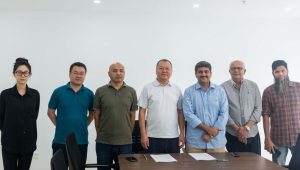
The discussion took place on Wednesday during a meeting between an IMF delegation and Bangladesh Garment Manufacturers and Exporters Association (BGMEA) President Mahmud Hasan Khan at the association’s headquarters in Uttara, according to a press release.
From the IMF side, the delegation comprised Senior Economists Qiaoe Chen, Ruifeng Zhang, and Ayah Said.
The BGMEA team included Senior Vice President Inamul Haq Khan, Vice Presidents Md Rezwan Selim and Vidiya Amrit Khan, and Directors Nafis-Ud-Doula and Dr Rashid Ahamed Hossaini.

According to a BGMEA press release, the meeting aimed to provide the IMF with a detailed understanding of the current state of the RMG industry and its future outlook amid global economic volatility.
Both sides engaged in an extensive discussion on strategic approaches to sustaining industrial growth despite external challenges.
The dialogue focused on issues such as the possible impact of US tariffs on garment exports, the implications of Bangladesh’s upcoming graduation from least developed country (LDC) status, strategies for sustainable industrial growth, product diversification into higher value-added apparel, and the effects of the global economic environment on export competitiveness.




BGMEA leaders highlighted the industry’s critical contribution to the national economy and outlined the sector’s strategic roadmap.
They said the RMG sector is now evolving from a labour-intensive model toward a high-value model driven by innovation, value addition, and technological advancement.
As part of this transformation, BGMEA is focusing on expanding its capacity in man-made fibre (MMF) and technical textile-based apparel production while emphasising skill development for workers to meet global demand.
Both sides also discussed reducing the cost of doing business and enhancing ease of operations.
BGMEA leaders informed the IMF delegation that the current board has already recommended to the government measures such as ensuring uninterrupted power and gas supply, improving port efficiency, simplifying customs and bond procedures, lowering interest rates to a single digit, and expediting key infrastructure projects including the Dhaka–Chattogram Highway.
They also said BGMEA has urged the government to pursue free trade agreements (FTAs) and economic partnership agreements (EPAs) with the European Union (EU), the United Kingdom (UK), Japan, Canada, and other major trading partners to retain tariff advantages after LDC graduation.
The IMF delegation commended the RMG industry’s contribution to Bangladesh’s economic resilience and its pivotal role in the country’s broader development agenda.