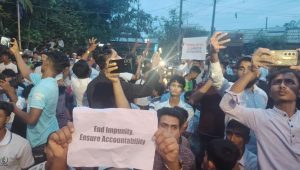
Thousands of Rohingya civilians were killed during 2017 military clearance operations in Myanmar, with evidence indicating that approximately 10,000 died violently, the International Court of Justice has ruled.
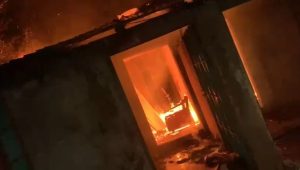
Delivering the summary of the judgment at The Hague, Yuji Iwasawa, president of the court, noted that Myanmar security forces conducted indiscriminate killings, executions of men, widespread sexual violence, and the systematic burning of villages.
The court found that roughly 815,000 Rohingya resided in northern Rakhine state prior to the August 2017 operations, describing this targeted population as clearly significant and substantial under the Genocide Convention.
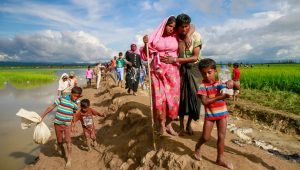
While the tribunal acknowledged earlier attacks on security posts and civilians by Arsa, a Rohingya militant group, it held that Myanmar forces responded with extreme violence against civilians and children, targeting fleeing populations as they escaped to Bangladesh.
Systematic hate speech and birth restrictions
The tribunal established that the Myanmar military systematically disseminated and promoted anti-Rohingya hate speech during the clearance operations.
This coordinated campaign portrayed the Rohingya as sub-human and a violent threat, creating an environment conducive to targeting the group for destruction.
Moreover, the court examined state measures aimed at slowing birth rates within the population, including regional orders imposing special marriage permissions for those labelled as Bengalis and limiting married couples to two children.
The court observed that Myanmar acknowledged the intent of these restrictions was to reduce births. Iwasawa explained that these coercive measures, combined with sexual violence designed to impair procreation, demonstrated clear state intent to prevent the group from reproducing.
State responsibility, court composition
Addressing legal responsibilities, the court president explained that state parties hold obligations under international law to prevent and punish genocide.

The court ruled that a state can be held responsible for actions committed by its organs or entities attributable to it, distinguishing state international obligations from individual criminal liability.
The decision was reached by a panel of 15 elected judges, alongside two ad hoc judges appointed for the case: Navi Pillay, Nobel laureate, chosen by The Gambia, and Claus Kress, judge, selected by Myanmar.
Under court procedures, rulings are determined by majority vote, with the president holding a casting vote in the event of a tie.
Group identity and evidentiary findings
The court formally identified the Rohingya as a distinct protected ethnic group with its own language, art, self-identity, and historical presence in Myanmar spanning generations.
The judgment noted that decades of discriminatory laws progressively eroded their rights, leaving them deeply marginalised and vulnerable.
In evaluating the case, the court highlighted Myanmar’s failure to genuinely investigate the alleged atrocities and its refusal to grant access to evidence or witnesses.


Relying on evidence provided by the parties, including testimony from four witnesses to the August 2017 violence, the court found the accounts presented by The Gambia credible and largely unchallenged during cross-examination.
Plight of refugees and ongoing obstacles
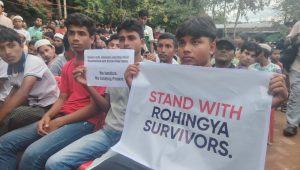
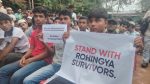
For the displaced population, the verdict represents formal recognition of their long-standing suffering after years of official denial, according to Mohammed Nowkim, a Rohingya refugee driven from Buthidaung in 2017 who now resides in Canada.
More than a million Rohingya remain confined to refugee camps in Cox’s Bazar, Bangladesh, where they are barred from seeking employment as international funding diminishes.
However, major obstacles to repatriation remain, as Rakhine state continues to be torn by armed conflict between the Myanmar military and the insurgent Arakan Army, which controls most of the territory with support from the local Rakhine population.
With many original villages destroyed and strong local hostility, activists acknowledge that a resolution permitting a safe return remains difficult to achieve despite the unprecedented genocide verdict at the world’s highest court.
UN General Assembly adopts resolution
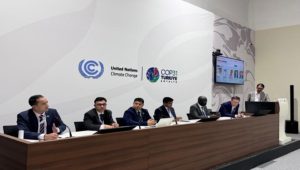
A resolution has been adopted by the United Nations General Assembly calling for adequate funding for humanitarian assistance for the Rohingya, the restoration of their political and voting rights, and the creation of conditions conducive to their voluntary, safe, dignified and sustainable repatriation.
In the vote held on Wednesday, 128 countries voted in favour of the resolution, which was introduced by the Organisation of Islamic Cooperation (OIC) and the European Union (EU). Six countries voted against it, while 33 abstained.
The information was disclosed in a statement received in Dhaka on Thursday.
The resolution emphasised the need to ensure adequate funding for humanitarian assistance for the Rohingya, including under the 2026 Joint Response Plan.
It also called for the restoration of their political and voting rights, as well as the creation of conditions conducive to their voluntary, safe, dignified and sustainable repatriation and reintegration.
Before the resolution was adopted, Bangladesh’s Chargé d’Affaires to the United Nations, Ambassador Sanchita Haque, addressed the General Assembly on behalf of Bangladesh. She underscored the need for urgent action to resolve the protracted Rohingya crisis.

Background of the Rohingya crisis
The Rohingya are a Muslim ethnic minority predominantly living in Myanmar’s Rakhine State. They have faced decades of discrimination and violence in the Buddhist-majority country and are denied citizenship under Myanmar law, leaving them among the world’s largest stateless populations.
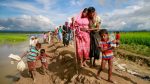
Successive waves of persecution, particularly the military operation in 2017, have driven nearly two million Rohingya from Myanmar.
Thousands continue to flee the country every year, often undertaking dangerous sea journeys aboard overcrowded boats. Last year was among the deadliest in recent years for Rohingya refugees, with nearly 900 dying or going missing at sea.
More than one million displaced Rohingya are currently living in refugee camps in Bangladesh’s Cox’s Bazar. The United Nations has described them as one of the world’s most persecuted minorities.
What the charges against Myanmar
The Gambia has accused Myanmar of violating the Genocide Convention in several ways, including committing genocide, conspiring to commit genocide, failing to prevent genocide and failing to prosecute those suspected of committing such crimes.
The mass exodus of Rohingya began on 25 August 2017, after fighters from the Arakan Rohingya Salvation Army (ARSA) launched attacks on more than 30 police posts in Rakhine State.
Myanmar troops, backed by local Buddhist mobs, subsequently launched what the authorities described as “clearance operations”.
Refugees reported widespread killings of civilians and the burning of entire villages. According to medical charity Médecins Sans Frontières (MSF), at least 6,700 Rohingya, including at least 730 children under the age of five, were killed in the month following the outbreak of violence.
Amnesty International has also accused Myanmar’s military of raping and abusing Rohingya women and girls.
Myanmar has consistently rejected the genocide allegations, maintaining that its military operations targeted militant and insurgent threats.
During hearings at the ICJ in January 2026, Myanmar’s government representative Ko Ko Hlaing argued that the country was not obliged to remain idle in the face of terrorist attacks in northern Rakhine State.
He described the military actions as counter-insurgency or counter-terrorism operations carried out in response to attacks by Rohingya fighters.