


Bangladesh’s own National Loss and Damage Framework for evaluating loss and damage caused by climate change has been presented on the global stage at the international climate conference (COP31) in Antalya, Turkey.
The country’s pioneering initiative earned praise from international climate policymakers at the summit, with a representative from Japan observing that their nation also has valuable lessons to learn from Bangladesh’s experience.
Formulated on the initiative of the department of environment under the ministry of environment, forest and climate change, the “National Loss and Damage Framework” was developed with technical assistance from the Center for Environmental and Geographic Information Services (CEGIS) and financial support from Bangladesh Climate Change Trust.
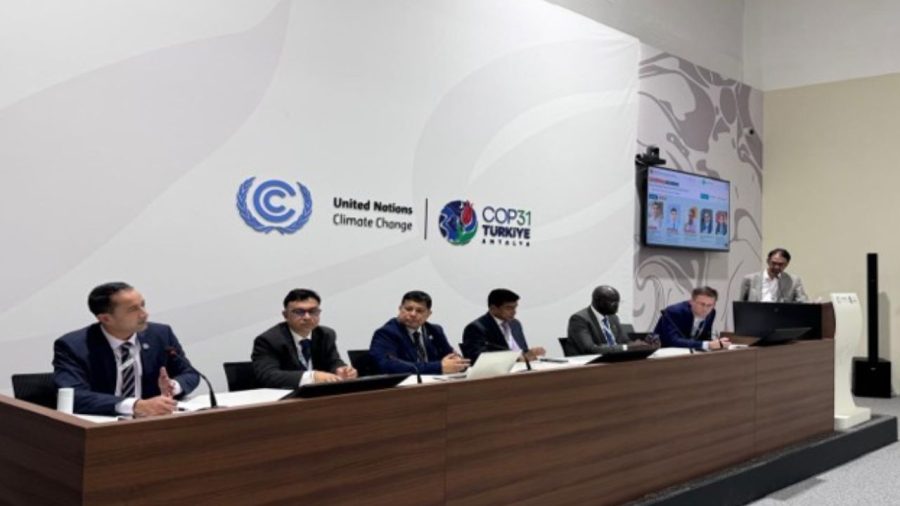
The framework was officially presented during a press conference at COP31, an official side-event of the United Nations Framework Convention on Climate Change (UNFCCC), and dedicated discussions at the Bangladesh Pavilion.
Bangladeshi delegates informed that the nation incurs an annual loss and damage of approximately $3 billion due to climate change impacts.
Although Bangladesh’s National Adaptation Plan identifies 14 types of climate hazards – including cyclones, floods, salinity, and sea-level rise – there has been a persistent deficit in maintaining specific and accurate records of actual losses during disasters.

The newly introduced framework is designed specifically to bridge this recording gap.
Under the framework, 14 types of climate hazards are evaluated across nine thematic areas and 52 sub-areas.
It establishes a system for conducting initial loss and damage assessments within 30 days of a disaster, while creating a clear distinction between repairable or restorable damage and permanently lost assets and opportunities.
Beyond financial figures, the framework prioritises the social and psychological toll of climate change, addressing issues such as disruptions to children’s education, repeated forced relocation of families, and mental health deterioration, while actively engaging local communities in data collection and evaluation.



International delegates commended the initiative on 17 November during an official side-event titled “From National Framework to Global Action: South-South Cooperation in Addressing Loss and Damage,” where Farhad Hossain Azad, state minister for water resources and member of parliament, was present as chief guest.
Speaking at the event, Elisa Calliari, vice-president of the executive committee of the UN Warsaw International Mechanism, described Bangladesh as a pioneer that has shown leadership through conceptual initiatives, diplomatic efforts, and national framework formulation, expressing a strong desire to share Bangladesh’s experience with other countries.
Moreover, Elizabeth Carabine, deputy director of Santiago Network Secretariat, offered cooperation to address existing operational gaps, while Zoha Shawoo, representative of the Loss and Damage Fund, revealed that 176 applications from 119 countries had been submitted to the fund, with around 74 linked to national frameworks.
Shawoo explained that receiving funds does not require specific data or proof of a direct causal link to climate change, allowing support for slow-onset disasters and non-monetary losses.
During the same session, Animesh Kumar, representative of the UN Office for Disaster Risk Reduction, stressed the necessity of aligning disaster and climate loss data while strengthening inter-ministerial data exchange.
Highlighting Nepal’s experience, Manjeet Dhakal, representative from Nepal, noted that his country obtained an initial approval of $20 million from the Loss and Damage Fund following severe floods in August.
Positive discussions continued the next day at the Bangladesh Pavilion during a session titled “From Assessment to Action.”
Laura Schaefer, representative of Germanwatch, hailed Bangladesh as an initiative-taking and leading nation rather than merely a victim of climate disasters, though she pointed out that available fund resources remain inadequate relative to global requirements and called for fair funding from major polluting countries.
Bipasha S Hossain, representative of IUCN Bangladesh, urged viewing nature as the primary line of defence against climate change, citing the vital protective role played by the Sundarbans during Cyclones Sidr, Aila, and Amphan. Sandhya Sameera Savarala, representative of UNDP, observed that loss and damage is highlighted in Bangladesh’s national climate commitments, adding that the new framework will reinforce these efforts.

Addressing the discussions, Farhad Hossain Azad, state minister for water resources, said Bangladesh’s identity revolves around water, meaning climate-induced loss and damage is not a distant matter for his ministry, whose field officers observe its realities daily, while emphasizing that affected communities require grants rather than loans for recovery.
Md Saimum Parvez, special assistant to the prime minister, affirmed the government’s commitment to providing the framework with a formal institutional foundation, stressing that a framework existing only on paper provides no benefit to people unless promised monies from the Loss and Damage Fund are swiftly converted into practical assistance.
Kazi Raonakul Islam, managing director of Bangladesh Climate Change Trust, pointed out that any nation seeking assistance must first understand its own losses, while Md Motalab Hossain Sarkar, executive director of CEGIS, described the framework as an initiative designed around Bangladesh’s specific needs.
Despite receiving international acclaim, the implementation of the framework faces several hurdles, including delays in releasing funds from the Loss and Damage Fund, inadequate financial allocations, and concerns over the sustainability of project-dependent initiatives.
Addressing these challenges requires inter-ministerial data sharing, continuous funding, and securing a permanent institutional base.
Bangladesh has set a target to validate and finalise the national framework by December 2026, with Santiago Network, the executive committee of Warsaw International Mechanism, and the Loss and Damage Fund expressing interest in supporting its implementation.
Ultimately, while Bangladesh previously focused on highlighting what it lost internationally, its COP31 presentation marks a milestone by offering a concrete system to measure and manage those losses, leaving effective implementation as the primary challenge ahead.