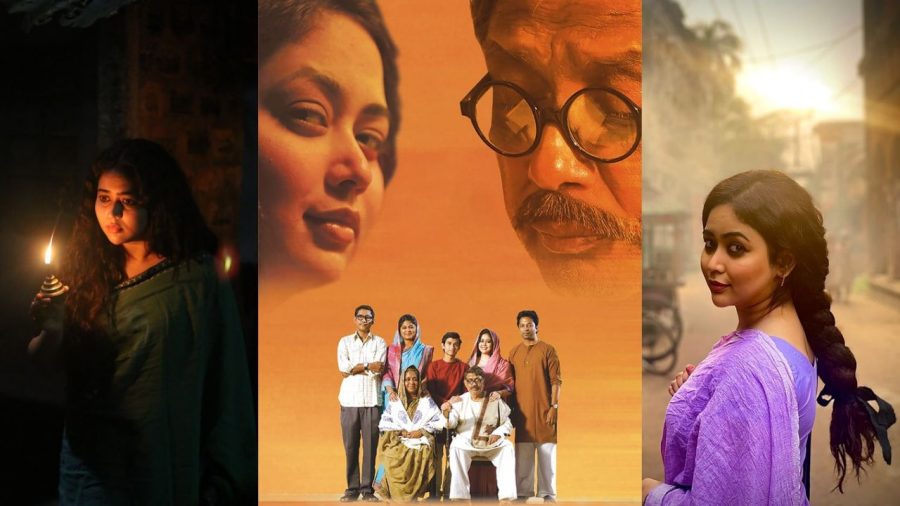



A home can be lost overnight. A familiar land can become foreign, and a journey to safety can turn into a lifelong struggle to belong. When Partition tore through the subcontinent in 1947, countless families were forced to leave behind everything they knew and begin again across newly drawn borders. Selina Hossain’s Japito Jibon brings one such family’s journey to the screen, tracing their passage from Berhampore in India to Dhaka against a backdrop of political upheaval, shifting identities and the Language Movement. Turning this sweeping tale of personal loss and national history into cinema is no small feat. Director Habibul Islam Habib takes on the challenge with evident commitment, crafting an engaging film that has its share of triumphs and missed opportunities.
The story follows Sohrab Ali, an Ayurvedic practitioner whose family falls victim to the Hindu-Muslim riots during Partition. Forced to leave their home, they arrive in Dhaka and begin the struggle to rebuild their lives. Through their experiences, Hossain explores changing society, politics, identity and survival. Jafar, the novel’s central protagonist, represents Bengali roots and identity, while his romance with Anjum forms another strand of the narrative.
Screenwriters Animesh Aich and Ishtiaq Ahmed face the demanding task of compressing this historical and emotional breadth into a cinematic narrative. Their screenplay uses the family’s experiences as an accessible entry point, grounding history in personal relationships and everyday struggles. However, the balance is not always successful. The family drama and romance sometimes overshadow the Language Movement and wider political developments, an imbalance that readers had also questioned in the novel.
Habib, known for television dramas and cultural activism, previously directed Bakhate (1987) and Ratrir Jatri. His experience shows particularly in the film’s treatment of domestic life and period details.

The production design is arguably the film’s greatest strength. Recreating the 1940s and 1950s requires more than period costumes, and Japito Jibon pays attention to the details of everyday existence. Costumes, plates, household objects and even the preparation of medicine help establish a convincing sense of time and place. These carefully recreated surroundings give the film much of its visual character and reflect considerable research and commitment.
However, the visual treatment is less convincing when the story moves towards major historical events. The Language Movement and other political sequences lack the crowd energy, tension and scale their subjects demand. Government-funded productions may face limitations in staging large-scale scenes, but the shortcomings remain noticeable. The history feels bigger than its visual representation.




The performances, meanwhile, give the film its emotional centre. Afzal Hossain and Rokeya Prachy stand out as Sohrab Ali and his wife. Both deliver restrained, convincing performances, finding emotion in expressions, silences and everyday interactions. Afzal’s respect for the novel, which he previously described as extraordinary, comes through in his portrayal of the family patriarch. Prachy brings warmth and strength to his wife. Their chemistry is particularly rewarding, marking their first appearance together on the big screen.
Rawnak Hasan plays the couple’s eldest son, with Mousumi Hamid as his wife. Imtiaz Barshon portrays Jafar, while Ashna Habib Bhabna plays Anjum. Both suit their roles, and Bhabna makes a convincing impression despite limited screen time. The film is also significant as her first project under her father Habib’s direction. Veteran Dolly Zahur and actors playing the household staff strengthen the ensemble. The wider cast includes Azad Abul Kalam, Jayanta Chattopadhyay, Gazi Rakayet, Tanveer Hossain Probal, Kazi Hayat, Pronob Ghosh, Mili Munshi and Khalid Mahbub Turjo.
Music adds another layer to the film. The background score supports the emotional flow without overwhelming the scenes, while the songs fit naturally into the narrative. Momtaz’s ‘Nasib Jetha Nia Chole Ami Setha Jai’, written by Asif Iqbal and composed and directed by Pintu Ghosh, particularly captures the uncertainty and displacement of lives shaped by forces beyond their control.
Ultimately, the film’s biggest weakness is its struggle to balance personal stories with historical significance. The Language Movement deserved greater depth in both the screenplay and visual execution. Some political moments pass without the impact they should carry.

Nevertheless, these limitations do not overshadow the achievement. Literary adaptations remain relatively rare in Bangladeshi cinema, especially those attempting to recreate an entire historical period. Japito Jibon deserves recognition for its ambition, carefully crafted production design, committed performances and evocative music.
It may not capture every dimension of Hossain’s novel with equal force, but it offers a compelling journey into a past shaped by displacement, identity and survival. Its most affecting moments often lie in the smallest details of everyday life. There is much to appreciate, even as certain missed moments leave us wanting more. And that is reason enough to give this sincere cinematic adaptation a chance.
Produced by Impress Telefilm with government funding, ‘Japito Jibon’ will release in 20 cinemas across the country on 20 November.