



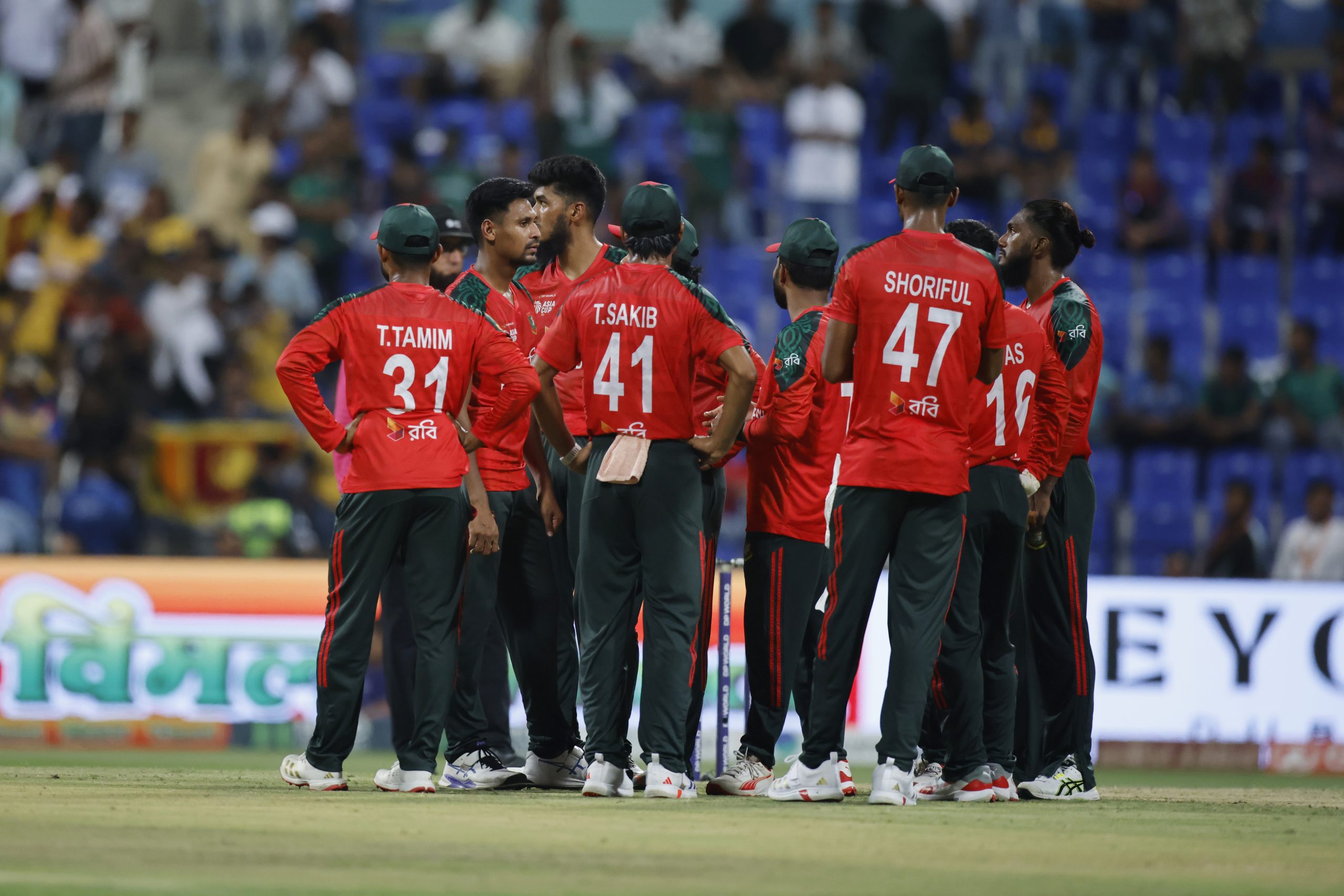

By Jubayer Tanin, from Abu Dhabi
Sri Lanka cruised to a comfortable victory over Bangladesh in the Men’s T20 Asia Cup, chasing down 140 with 32 balls remaining on 13 September at the Sheikh Zayed Stadium.
The stands echoed with chants of “Bangladesh! Bangladesh!” on one side and “Sri Lanka! Sri Lanka!” on the other. The excitement of Sri Lankan supporters, however, seemed to overshadow the cheers of expatriate Bangladeshis. On the field, the story was similar. Winning the toss, Bangladesh were sent in to bat, but after some disciplined bowling, Sri Lanka dominated the chase, leaving Bangladesh struggling.
On a day when the top order failed, Shammim Hossain Patwari and Jaker Ali put together a resilient 86-run partnership, taking Bangladesh to a total of 139 for five. In reply, Pathum Nissanka’s fifty and a composed 46 from Kamil Mishara, who survived on just one run initially, guided Sri Lanka to a six-wicket victory.

Had Bangladesh won this second match of the Asia Cup against Sri Lanka, a place in the Super Four would have been almost certain. Instead, they now face the dilemma of net run rate calculations and will have to rely on results from other matches.
This high-octane T20 match once again proved that chasing a modest 139 is far from straightforward. Despite a month-long skills and fitness camp, and Julian Wood’s power-hitting sessions, Bangladesh capitulated helplessly. Their safe approach in the previous match against Hong Kong allowed them to win, but against the stronger Sri Lankan side, there was neither evidence of smart cricket nor clear intent in the players’ body language. The way Bangladesh lost—32 balls before the innings concluded—could be described as surrender.



Bangladesh started with some promise. In the second over, Mustafizur Rahman created a chance when Kusal Mendis offered a catch to Liton Das, but the experienced batsman failed to capitalise and scored only 3. After Mendis’ departure, Nissanka and Mishara forged a 95-run partnership, which Sri Lanka navigated with ease. Mishara, on just 1 run, attempted a pull off Shoriful Islam and offered a diving chance at mid-on, but Mehedy Hasan couldn’t hold it. Mishara made the most of this reprieve, finishing unbeaten on 46 off 32 balls with four sixes and two fours.
Earlier, Nissanka had scored 50 off 32 balls, his 16th T20I fifty, before falling to a catch in the deep off Mehedy Hasan’s bowling. Bangladesh then claimed their second wicket with the same bowler, and later got Kusal Perera, while Tanzim Hasan removed Dasun Shanaka.
With the top order failing, Shammim Hossain Patwari and Jaker Ali rescued Bangladesh with an unbroken 86-run stand for the fifth wicket. Patwari remained unbeaten on 42 off 34 balls, hitting the only six for Bangladesh, while Ali scored 41* off 34 balls. Apart from this partnership, only Liton Das managed double figures, scoring 28 off 26 balls.
Bangladesh’s top order had already faltered in the first over, with left-arm pacer Tanzeed Tamim bowled after being beaten by a last-ball movement. The next over saw Parvez Imon caught behind, leaving Bangladesh 0 for 2 after the first two overs.
After losing five wickets for 53, Patwari and Jaker briefly steadied the innings. Dasun Shanaka hit three fours in the final over of the powerplay, giving the scoreboard a respectable look. But two overs later, Wanindu Hasaranga induced a reverse sweep from Liton Das, who was caught, and Mehedy Hasan had another batter dismissed LBW.
Tawhid Hridoy, coming in at number four, had all eyes on him. Despite admitting his struggles in recent press conferences, he had the chance to play a responsible innings. Instead, after hitting a cross-batted shot to mid-off for a catch, he was run out the very next ball by an excellent throw from deep square leg. The boundary size in Abu Dhabi made it unlikely to attempt a third run, but the result was still a costly dismissal.
In the end, Bangladesh’s batting collapsed under pressure, leaving Sri Lanka with a comfortable win and showing that without intent and clarity, even a modest total can seem insurmountable.


