


Fahim Hossain of Jashore has been suffering from an ear problem for a long time.
With the necessary treatment and diagnostic facilities unavailable locally, he has had to travel to Dhaka several times on doctors’ advice, spending thousands of taka on transport and other expenses each time. He has also faced difficulties in the capital, including a shortage of hospital beds.
Sohan Mahmud faced a similar ordeal after his brother broke his arm. He took him to Noakhali district hospital but was given a distant treatment date because of a shortage of doctors and a non-functional operation theatre.
“We were forced to hire an ambulance at additional cost and come to the National Institute of Traumatology and Orthopaedic Rehabilitation (Nitor) that night,” he said.
Yet a project to build 500-bed modern hospitals in Jashore, Cox’s Bazar, Pabna and Noakhali was launched in 2018 to provide advanced treatment locally and reduce patients’ dependence on Dhaka.
Scheduled for completion in 2021, the project has achieved only 27 per cent physical progress, seven years after the deadline. A proposal has now been made to extend it until 2028, meaning a three-year project could take nearly a decade to complete. Its cost has also been proposed to increase by Tk555.93 crore.

A similar delay has hit a project to establish comprehensive cancer, cardiac and kidney treatment centres in eight divisional cities. Launched in 2019 for three years, it has already been extended until 2028, delaying the expansion of specialised treatment and efforts to reduce dependence on overseas healthcare.
Another project to modernise diagnostic and imaging facilities at eight divisional medical colleges and hospitals was due for completion by June 2022. A report by Implementation Monitoring and Evaluation Division (IMED) puts its physical progress at 74 per cent, leaving it unfinished nearly a decade after its launch.
66% of allocation unspent
According to IMED data, Tk3,128.41 crore was allocated for 19 projects under the Health Services Division in the fiscal 2025-26. Only Tk974 crore 50 lakh, or 31.15 per cent, was spent.



The Health Education and Family Welfare Division received Tk1,388 crore 88 lakh for 16 projects but spent Tk510 crore, or 36.72 per cent.
Together, the two divisions had Tk4,517 crore 29 lakh for 35 projects but spent only Tk1,484 crore 50 lakh, putting overall ADP implementation at 33.94 per cent. Around 66 per cent of the allocation therefore remained unspent.
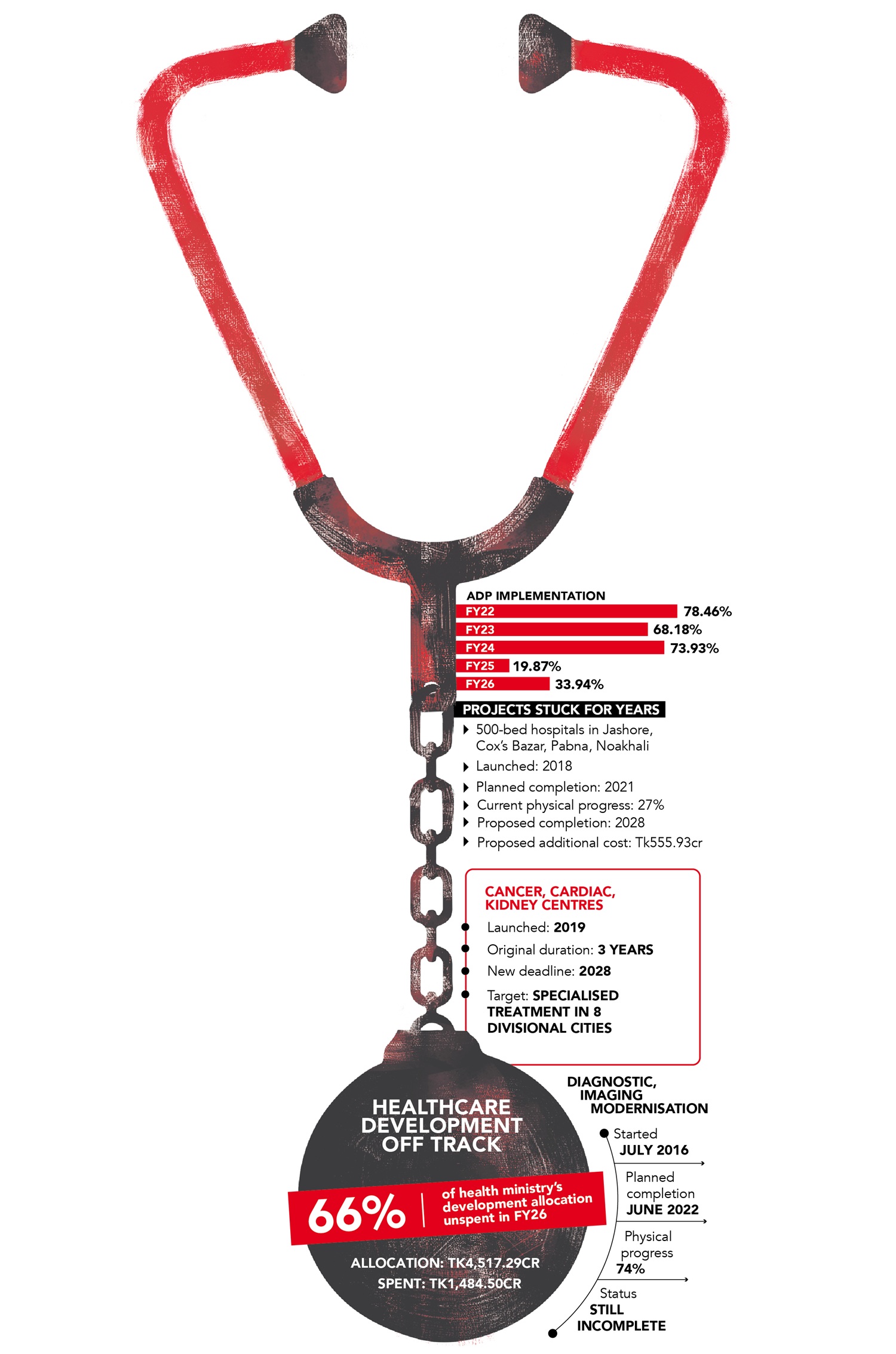
The situation was even worse in 2024-25, when the health ministry’s ADP implementation rate was 19.87 per cent. The rates were 21.69 per cent for the Health Services Division and 15.36 per cent for the Health Education and Family Welfare Division.
Officials attributed the poor performance partly to administrative instability following the 2024 mass uprising and the change of government. Changes in project directors and contractors, including some who fled, disrupted implementation. Election-related activities also affected implementation in the fiscal 2025-26.
Implementation was stronger in earlier years but still below the desired level: 73.93 per cent in FY24, 68.18 per cent in FY23 and 78.46 per cent in FY22.
IMED officials and project directors cited weak institutional capacity, slow-moving contractors, prolonged land acquisition, complications in fund release, inadequate feasibility studies, design changes, procurement problems, retendering, objections, shifting priorities and frequent changes of project directors as major causes of delays.
Former planning ministry and IMED secretary Pradip Ranjan Chakraborty told TIMES that institutional capacity and prolonged land acquisition were major problems. Projects were also sometimes undertaken without ensuring adequate government funding, he said.
“ADP implementation needs to be monitored closely from the outset,” he said, adding that monthly review meetings should identify problems and ensure their quick resolution.
Syed Abdul Hamid, a professor at the Institute of Health Economics at the University of Dhaka, identified three broad problems in health-sector projects: systemic, administrative and cultural.
Healthcare is more complex than many other government services, involving infrastructure, equipment, human resources, procurement, technology and numerous stakeholders, he said. Yet it is often managed under the same administrative framework as other government services.
Project directors are also frequently appointed without matching their qualifications and experience to project requirements. A hospital construction project director, for instance, needs knowledge of construction, equipment, procurement, contractor management and government financial rules, he said.
He added that project directors are sometimes appointed to five-year projects when they have only two years left in service, resulting in mid-project changes and a loss of continuity.
“These problems are not new,” Professor Hamid said, stressing that simply extending project deadlines would not solve them. Systemic reforms in project management and the administrative structure are needed, he said.