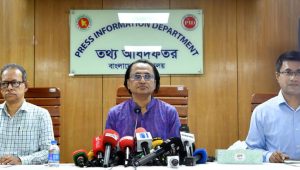
India has yet to respond to Bangladesh’s request to extradite former prime minister Sheikh Hasina, who fled to Delhi following the mass uprising in August last year, Foreign Affairs Adviser Md Touhid Hossain said on Tuesday.
“We have followed the legal aspect that we have and asked them to return her as per the court’s order. Let them look into it. They are yet to reply,” he said while responding to a question at the Ministry of Foreign Affairs.
Bangladesh sent a diplomatic note (note verbale) to India in December last year, along with a set of supporting documents, formally requesting Hasina’s extradition.
Explaining Hasina’s presence in India and its impacts on bilateral relations, Indian Foreign Secretary Vikram Misri recently said this is a “judicial legal process” and it requires “engagement and consultations” between the two governments.

Talking to reporters, Touhid Hossain said Bangladesh maintains a balanced policy in its relations with other countries and that there is no question of avoiding relations with any particular nation.
Commenting on recent remarks by Brent Christensen, nominee for US ambassador to Bangladesh, he said, “We have deep relations with the United States and extensive economic relations with China.”

Hossain also said he believes that future governments will continue to follow this policy.
Brent Christensen on Thursday said if confirmed, he would engage with the Bangladesh government and military to “clearly articulate the risks from Chinese activity, involvement with their military activities in the maritime domain and in their critical infrastructure.”
The foreign adviser said that there is nothing for anyone to worry about regarding Dhaka’s engagement with Beijing, stressing that Bangladesh maintains a balanced approach in its relations with other countries.
“Those who are bigger and stronger than us naturally have greater visibility. But considering our economic and political position, our visibility is not small – we are maintaining our presence everywhere,” he added.
Regarding pre-election assessment missions sent by US-based International Republican Institute, the European Union and the Commonwealth, he said, “We think it’s a good sign,” adding that as the election approaches, more delegations will definitely come to observe.
“We want election observation to take place so that the transparency, freedom and fairness of the election are clearly demonstrated before everyone,” Hossain added.
The interim government plans to hold the 13th parliamentary election in early February next year.