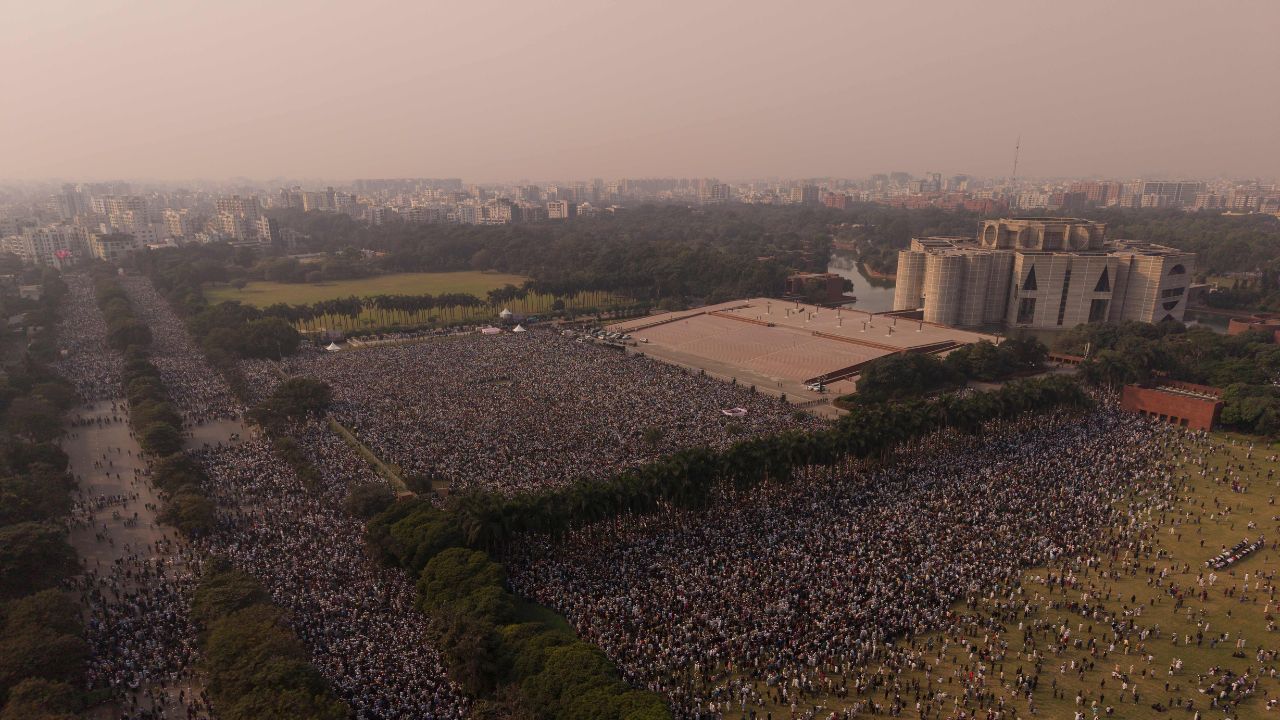



The air in Dhaka was heavy with grief on Saturday as hundreds of thousands of people gathered to bid farewell to Sharif Osman Hadi — a young outspoken leader whose life was cut short by a bullet.
Hadi, spokesperson for Inqilab Moncho and a prominent frontliner of the July Uprising, was laid to rest in the afternoon beside the tomb of National Poet Kazi Nazrul Islam, a resting place reserved for figures regarded as symbols of resistance and national conscience.
From the early hours of the day, Manik Mia Avenue and the surroundings of parliament turned into a sea of mourners. At around 10:30am, security forces opened the gates, allowing people to enter the parliament premises.
Despite tight security, thousands poured in — students, activists, and ordinary citizens from across the country — many carrying the national flag, others holding banners bearing his name.
They chanted slogans heavy with sorrow and quiet anger: “Hadi’s blood will not go in vain.” “We are Hadi.”
The South Plaza of parliament and nearby Manik Mia Avenue echoed with grief. People wept openly, embracing strangers, united by a sense of loss that felt deeply personal. For many, Hadi’s killing was not just the death of a leader, but the silencing of a voice that spoke for them.
“It breaks my heart that even as we stand here for his janaza, his killers haven’t been caught,” said Billal Hossain, who travelled from Narayanganj to attend the funeral. “He spoke for us. Now, we must speak for his justice.”

A hero’s farewell
The funeral prayer was held at 2:00pm at the South Plaza of parliament, attended by Chief Adviser Muhammad Yunus, advisers, and leaders from across the political spectrum, including BNP, Jamaat and NCP. The janaza was led by Hadi’s elder brother, Abu Bakr Siddiq.
Addressing the vast gathering, Yunus paid tribute to the slain leader.
“Sharif Osman Hadi taught us never to bow down,” he said. “We are not here to say goodbye. He remains in our hearts. We promise to fulfil the vision he died for.”
Yet behind the speeches lay raw anguish. Hadi’s brother Siddiq struggled to contain his pain as he spoke of a justice system that had so far failed his family.




Seven days after the targeted attack, he said, the identified killers remained at large. He demanded swift trial and accountability, echoing a frustration shared by thousands present.
That anger was reinforced by Inqilab Moncho Member Secretary Abdullah Al Jaber, who warned on Friday that authorities must inform the public within 24 hours about steps taken in the investigation.
He urged Home Affairs Adviser Jahangir Alam Chowdhury and Chief Adviser’s Special Assistant Khoda Bakhsh Chowdhury to disclose what had been done over the past week.
State mourning and tight security
Hadi’s burial took place on a day of state mourning. The national flag flew at half-mast across government and semi-government offices, educational institutions, and Bangladesh missions abroad.
To manage the massive crowd, the government deployed 20 platoons of Border Guard Bangladesh alongside Police, RAB and Army. Drones were banned, bags were prohibited, and traffic was restricted along Manik Mia Avenue. Roads from Khejurbagan Crossing to the avenue were closed throughout the event.
Despite these measures, the grief-stricken crowd often overwhelmed security personnel, particularly during the final journey of the body.
The final journey
At around 3:00pm, under tight security, the freezing van carrying Hadi’s remains reached the Dhaka University Central Mosque. As the body was lifted from the ambulance, scenes of uncontrollable grief unfolded.
“Hadi bhai, don’t leave us — take us with you!” his colleagues cried, collapsing in tears.
Eyewitnesses said crowds ran alongside the vehicle, repeatedly chanting “Hadi, Hadi”, while law enforcement struggled to keep order amid the emotional surge.
He was buried at approximately 3:30pm on the south side of the tomb of Kazi Nazrul Islam. Dhaka University authorities closed all campus entry points, citing security concerns due to the size of the gathering.
At the graveyard, tears flowed freely as supporters mourned a leader many believed could never be replaced.
A death that sparked defiance
The tragedy began on 12 December — a day after the schedule for the 13th parliamentary election was announced. Hadi, a potential candidate for the Dhaka-8 constituency, was shot in the head by motorcycle-borne assailants in Bijoynagar.
He was first taken to Dhaka Medical College Hospital, later shifted to Evercare Hospital, and then airlifted to Singapore General Hospital. After six days of treatment, he died on the night of 18 December.
His body returned to Dhaka on Friday evening, was taken to the National Institute of Cardiovascular Diseases, and underwent an autopsy at Shaheed Suhrawardy Medical College on Saturday morning.
Justice demanded
Even after the burial, the streets did not fall silent. Protesters regrouped at Shahbagh, while others assembled at Dhaka University’s Teachers-Students Centre. They issued a 24-hour ultimatum to arrest Hadi’s shooters and their associates, warning of stronger actions if their demand was ignored.
As night fell over Dhaka, grief remained etched across the city — mixed with anger, defiance, and an unspoken question that hung in the air.