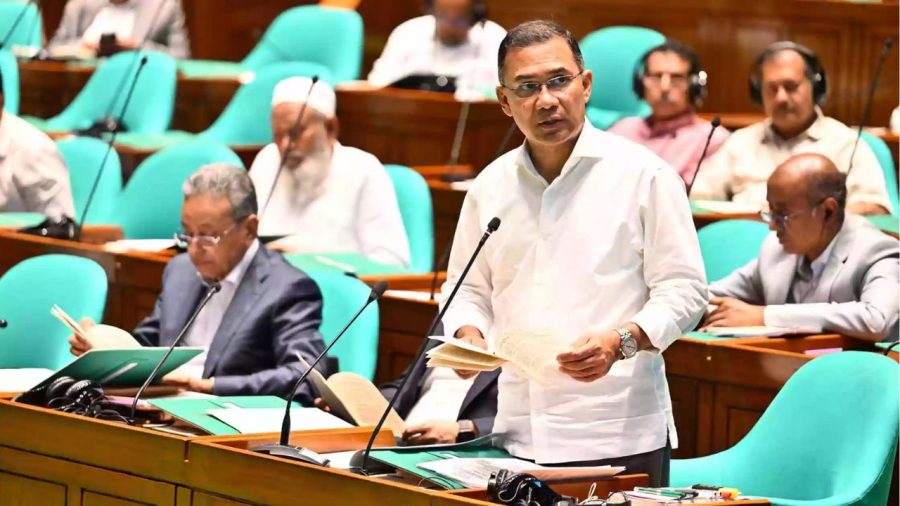

The government has taken a strict stance to curb the repeated extension of deadlines and cost overruns in public development projects, Prime Minister Tarique Rahman told Parliament during a question-and-answer session on Wednesday.
Replying to a query from Comilla-10 lawmaker Md Mobasher Alam Bhuiyan regarding government directives and monitoring plans, Tarique said if a project is not completed within the stipulated timeframe, the causes of delay and budget escalation will be identified.
He mentioned that action will be taken against responsible individuals and institutions according to rules.
Action on project delays
Highlighting that time and cost overruns result from multiple interconnected weaknesses across project formulation, approval, land acquisition, financing, procurement, and management, Tarique mentioned some key factors.
The key factors include weak feasibility studies, improper cost estimation, flawed site selection, delays in land acquisition and utility relocation, slow procurement, delayed appointment of project directors, and a lack of inter-ministerial coordination.

To address these issues, initiatives have been taken to ensure accurate feasibility studies before adopting new projects, complete implementation preparation quickly after approval, update existing guidelines for project formulation, processing, approval, and revision.
He added that to establish monitoring dashboards in relevant ministries and divisions, initiatives need to step up field-level supervision, and strengthen inter-agency coordination for land acquisition and utility relocation.
Moreover, for projects with less than 30 per cent implementation progress, their utility and effectiveness will be reviewed to decide whether to restructure, alter the scope, or continue them.
Electric trains for Dhaka-Chittagong route
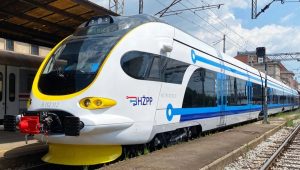
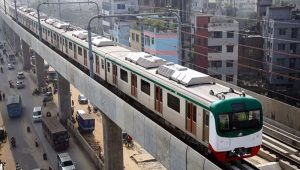
In response to a question from MP Mohammad Enamul Haque (Chittagong-12 constituency) in a session presided over by Speaker Major (Retd) Hafiz Uddin Ahmad, Tarique said the government has taken initiatives to introduce electric trains on Dhaka-Chittagong route.



He added that this initiative is to reduce travel time and distance, construct a direct Dhaka-Comilla cord line, and convert the entire railway line into a dual-gauge double line.
He informed the House that feasibility studies and design work for installing electric traction have been completed, and implementation will begin once necessary funding is secured to increase train speed and cut travel time.
Feasibility and design work for the direct Dhaka-Comilla cord line are currently underway, while feasibility and design work for converting the Tongi-Akhaura and Laksam-Chittagong sections into dual-gauge double lines have been completed.
He also mentioned that with the Laksam-Chittagong project in the approval process and the Development Project Proforma (DPP) for Tongi-Akhaura in its final stages to boost passenger capacity.
20% renewable energy target by 2030
Addressing a written question from MP Md Tajuddin Khan (Meherpur-1 constituency), Tarique announced that Bangladesh has set a target to generate at least 20 per cent of its total electricity from renewable energy sources by 2030.
He also mentioned this will reduce import reliance and ensure energy security.
Under National Renewable Energy Development Strategy (2026-2030), targets include 5,500 MW from rooftop solar, 4,500 MW from land-based solar, and 450 to 550 MW from wind, waste, hydropower, and floating solar technologies, alongside duty and tax benefits for importing equipment such as solar panels, inverters, batteries, and structures.
Effective from 1 September, rooftop solar generation costs with batteries have been fixed at a maximum of Tk8 per unit, with surplus power being purchased at Tk10.50 per unit – incorporating a 20 per cent profit and an 11.25 per cent premium.
This will remain valid until 28 February 2030 for systems installed by 28 February 2027 under policy frameworks such as Renewable Energy Policy-2025, Net Metering Guidelines-2025, National Rooftop Solar Programme, and waste-to-energy guidelines.
Bhola power plant and blue economy hub
Replying to MP Mohammad Nurul Islam (Bhola-4 constituency), Tarique outlined plans to construct a new 400 MW gas-based power plant in Bhola and turn Bhola and its adjacent islands into the “central zone” of the blue economy under the Marine Spatial Planning Zone.
Under the Five-Year Strategic Framework (2026–2031), which prioritises balanced regional development, the government plans to convert 60 million cubic feet of gas daily from Bhola’s Veduaria and Ilisha gas fields into LNG to supply Khulna’s power hub via lighterage operations.
In addition to the proposed 400 MW power plant, the blue economy central zone will give priority to hilsa and fisheries conservation, integrated agricultural development in char areas, protected coastal infrastructure construction, and strengthened maritime security.