


The government plans to develop nearly 10,000 megawatts (MW) of solar power generation capacity over the next two years as part of efforts to ease the energy crisis, reduce dependence on imported fuel and contain industrial production costs.
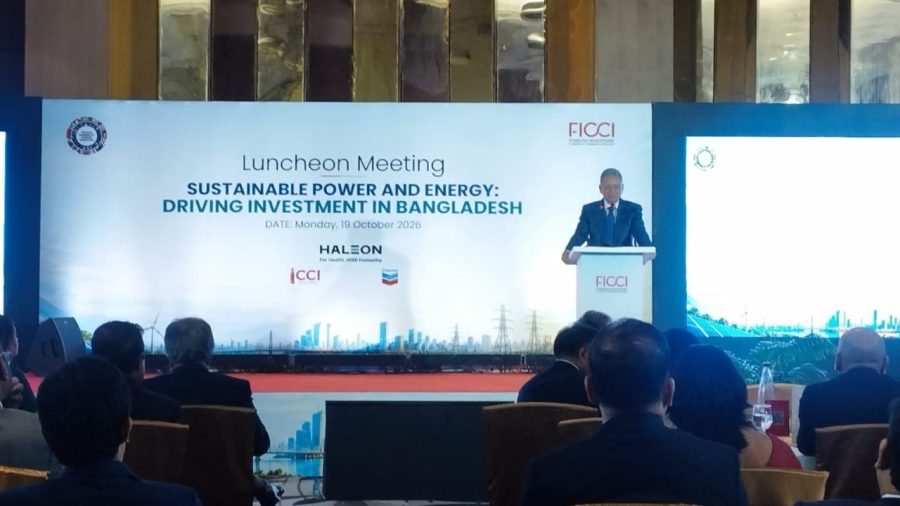
Finance and Planning Minister Amir Khosru Mahmud Chowdhury announced the plan on Monday at a luncheon titled ‘Sustainable Power and Energy: Driving Investment in Bangladesh’, organised by the Foreign Investors’ Chamber of Commerce and Industry (FICCI) in Dhaka.
The minister said the government was prioritising solar power projects, rooftop installations, domestic gas exploration and private investment alongside improvements to energy infrastructure.
Expanding rooftop solar systems at industrial facilities would reduce daytime dependence on grid electricity, lower manufacturers’ energy costs and ease pressure on gas-fired power generation, he said.
Achieving the solar target would require adequate policy support and an investment-friendly environment to attract private capital.
Addressing the country’s persistent gas shortage, Chowdhury said initiatives were underway to drill new wells and increase domestic production.

A proposal for the drilling programme had received approval from the Cabinet Committee on Government Purchase, although some details remained to be finalised.
Higher domestic gas production would help reduce dependence on imported fuel and meet industrial demand, but expanding existing energy infrastructure was equally important, he said.
Acknowledging the severe impact of gas shortages on industrial production, the minister said: “We understand the difficulties faced by businesses, but this issue cannot be resolved overnight”.
He said the government was working to expand liquefied natural gas (LNG) import and supply infrastructure, although developing floating storage and regasification units (FSRUs) and associated facilities would take time.




As a result, completely resolving the gas shortage in the short term would be difficult.
The minister also outlined plans to develop energy infrastructure and terminals centred on Matarbari, stressing the importance of securing financing and ensuring coordination among government agencies for large-scale projects.
Speaking at the event, FICCI President Rupali Haque Chowdhury said volatility in global energy markets had exposed Bangladesh’s vulnerability to imported fuel.
She said rising energy costs, production disruptions and investment uncertainty were among the consequences of that dependence.
Rupali called for greater domestic gas exploration, diversification of LNG import sources and increased investment in renewable energy to ensure reliable and affordable fuel supplies.
Presenting the keynote paper, Institute for Energy Economics and Financial Analysis (IEEFA) Lead Energy Analyst for Bangladesh in South Asia Md Shafiqul Alam highlighted the risks associated with declining domestic gas reserves, growing import dependence and fluctuations in international energy prices.
He recommended reducing gas wastage, expanding rooftop solar capacity, improving industrial energy efficiency and mobilising green financing.
During a panel discussion, Chevron Bangladesh President and Managing Director Shu Xiyong said attracting long-term foreign investment would require stable policies, predictable regulations and faster decision-making.
He also called for stronger cooperation among the government, industries and investors to narrow the gap between energy demand and supply.
Independent University, Bangladesh (IUB) Vice-Chancellor Mohammed Tamim emphasised domestic gas exploration, a balanced energy mix and sharing technical and financial risks with foreign investors.
Centre for Policy Dialogue (CPD) Executive Director Nazneen Ahmed stressed the importance of attracting foreign investment while protecting fiscal stability and keeping energy affordable for industries.
Federation of Bangladesh Chambers of Commerce and Industry (FBCCI) Administrator Fazlul Hoque called for faster adoption of solar energy to ease pressure on industries affected by gas shortages.
Government policymakers, business leaders, chief executives of FICCI member organisations and energy experts attended the event.
Participants emphasised coordinated public-private initiatives to address immediate energy shortages while developing a sustainable, affordable and reliable energy system over the longer term.