




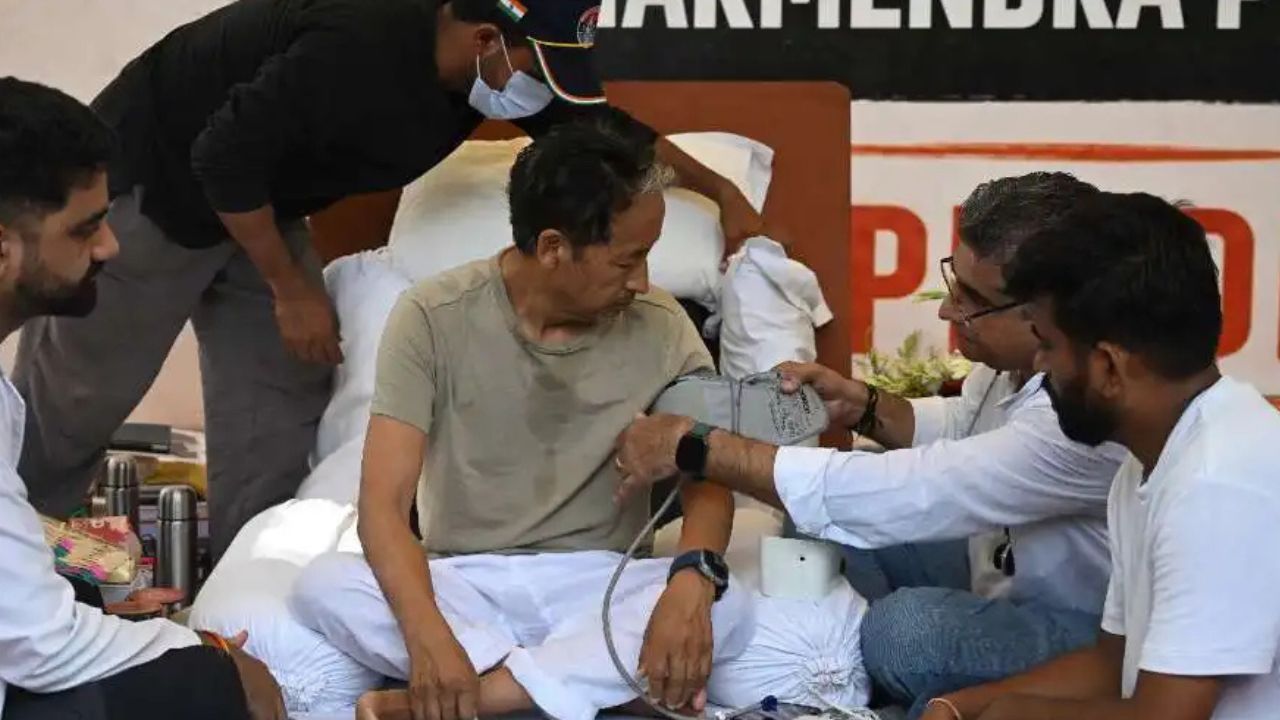
Activist Sonam Wangchuk concluded his 26-day hunger strike on Thursday night at Gurugram’s Medanta Hospital, following a series of formal commitments from the Indian government.
The fast was broken in the presence of Union Health Minister JP Nadda and Minister of State in Prime Minister’s Office Jitendra Singh, reports NDTV.

The resolution followed a high-level four-hour meeting convened by Home Minister Amit Shah, involving Nadda and Singh. Sources indicated that the government decided to adopt a constructive stance toward Wangchuk’s demands while prioritising his medical recovery.

Key assurances
According to the assurances delivered to Wangchuk, the government will introduce a new legislative Bill under the Department of Personnel and Training (DoPT) framework in Parliament next week. The proposal is slated for Cabinet approval on Friday.
The union health minister confirmed that the government would not register legal cases against individuals who protested peacefully at Jantar Mantar or participated in the march to Parliament on 20 July.
Regarding the student movement’s concerns over academic integrity, Nadda said the government has already committed to parliamentary discussions on education reforms and paper leaks.
Significantly, the administration is “positively considering” providing compensation to the families of suicide victims linked to the recent NEET paper leak controversy.
Dialogue with CJP
In a move to facilitate ongoing engagement, the Centre has invited a delegation from the Cockroach Janta Party (CJP) for talks at a neutral venue on Friday.
This development follows the CJP leadership’s refusal to meet at the health minister’s residence or office, insisting instead on a neutral location.
Following the announcement, Prime Minister Narendra Modi expressed his well-wishes for Wangchuk on X, urging him to follow medical advice for a swift recovery.
Upon ending his strike, Wangchuk expressed his intent to return to Ladakh but stated he would first meet with student supporters.
He pledged to encourage the youth to maintain trust in the government’s promises and warned against “anti-social elements” that could derail the peaceful movement. He also emphasised the importance of patient and constructive dialogue as the process moves forward.


