President Mohammed Shahabuddin has told parliament that the fall of a “fascist government” through the July mass uprising marked a historic turning point for the country, in a speech that sharply criticised the former Awami League administration.
The address, delivered on Thursday at the first sitting of the 13th Parliament, outlined the activities of the interim government following last year’s uprising as well as the policies of the newly formed administration.
The speech also drew attention for a striking political contrast: the president who now criticised the Awami League government was himself elected in a parliament overwhelmingly dominated by the same party. He had been nominated for the presidency by former prime minister Sheikh Hasina, who was widely seen as choosing him for his loyalty.
Before the July uprising, Shahabuddin had repeatedly praised the Awami League government and its leadership in public speeches while strongly criticising BNP and its leaders, including Khaleda Zia and BNP chairman Tarique Rahman — now prime minister.
Under the practice, however, the president’s address to parliament is prepared and approved in advance by the cabinet, meaning the speech largely reflects the position of the sitting government rather than the personal views of the president.
‘Historic milestone’
The president said that the student–public mass uprising of July–August 2024 marked a unique milestone in the country’s history, bringing an end to what he described as one and a half decades of fascist rule. He said the sacrifices of thousands of martyrs had paved the way for the beginning of a new democratic Bangladesh free from authoritarian control and subservience.
The ceremonial head of the state said, “The nation’s parliament has begun its journey with representatives elected through a peaceful, free and fair election.”

According to the president, nearly 30,000 people were injured during the uprising, with hundreds left permanently disabled, while more than 500 people lost their eyesight.
The government has issued 1,243 health cards to injured victims to ensure medical treatment, and 137 critically injured individuals have been sent abroad for advanced care.
To preserve the memory of those killed in the uprising, the government has begun constructing memorials in all 64 districts and is also building a July Uprising Memorial Museum in Dhaka.
In the same speech, the president said Bangladesh had been turned into a “champion of corruption” during the tenure of the former Awami League government.
As the president began his address, lawmakers from opposition parties Jamaat and the NCP staged a walkout from the chamber in protest.


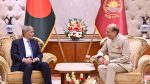

The president continued delivering the speech despite their departure.
The address stated that the current government is working under the principle: “Work for development, build the nation, Bangladesh first.”
The president also praised the role of BNP leaders in the current political transition.
He said the participation of the public in the recent election under the leadership of BNP chairman Tarique Rahman would remain “a bright example in the history of democracy”.
He also acknowledged the contribution of former prime minister Khaleda Zia, saying she had played an uncompromising role in establishing and protecting parliamentary democracy in Bangladesh.
Referring to tensions in the Middle East and their global economic impact, the president presented an overview of Bangladesh’s economic situation.
He said the country’s economy had stabilised compared with the 2023–24 fiscal year.
Inflation fell to 8.58% in January 2026 and is expected to decline further in the coming months, he said.
The president also noted that Bangladesh’s foreign exchange reserves had reached 34.78 billion US dollars as of 19 February 2026.
The government has introduced a family card programme, which the president described as a symbol of women’s empowerment.
He said the administration is implementing several welfare initiatives in agriculture, economic development and poverty reduction.
Among the measures highlighted were expanded social safety programmes, free education for women up to the postgraduate level, and microcredit programmes aimed at improving women’s economic participation.
The government has also launched a nationwide campaign to plant 50 million trees annually.
The president said fighting corruption and maintaining law and order are among the government’s top priorities.
To restore public confidence in the banking sector and address the problem of non-performing loans, the government plans to establish an Economic Reform Commission.
He also announced the formation of a separate commission to reform the capital market, which will investigate irregularities that occurred during the previous administration.
The speech further emphasised plans to restore good governance in the banking sector and strengthen oversight of financial institutions.
For many observers, the address illustrated how dramatically Bangladesh’s political narrative has shifted since the July uprising — and how even the presidency has adapted to the new reality shaped by a changed balance of power.