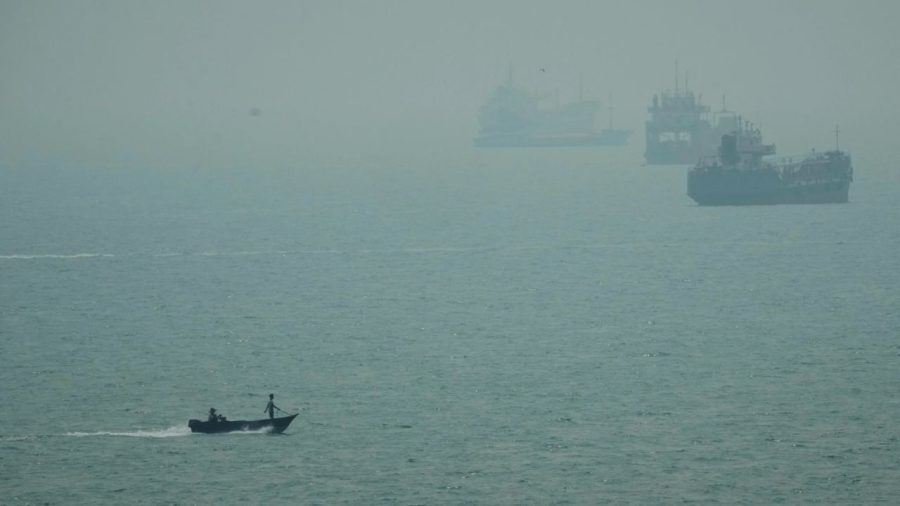

An Iranian cargo ship was struck early Sunday off Qeshm Island in the Strait of Hormuz, killing one person and wounding four, hours before Tehran was due to brief regional countries on its plan to manage shipping through the waterway, Iranian state media reported.
The attack came as Iran-backed Houthi rebels in Yemen took up positions on the Bab el-Mandeb Strait in the Red Sea, adding a fresh threat to global shipping even as attention shifted from Hormuz.
The Houthis say they are targeting only Saudi Arabia, which backs Yemen’s government in its fight against the rebels, but markets remain on edge, and prices of oil, gas and related products have climbed further, according to AP.
The Qeshm governor blamed a “terrorist enemy,” while Britain’s maritime trade watchdog said a vessel was hit by a projectile as it transited the strait, sparking a fire and prompting the evacuation of those on board.

There was no immediate comment from the US military, which has struck Iranian-flagged vessels as part of its blockade of Iranian ports, even as it confronts a new threat from Iranian ballistic missiles fired at its warships.
Qeshm Island, some 22 kilometres (14 miles) from the port city of Bandar Abbas, is central to Iran’s efforts to assert control over the strait, one of the world’s most important oil chokepoints.




Commercial traffic through the Strait of Hormuz remains thin, with attacks continuing on what had been recognised as an international waterway before the United States and Israel launched their war on Iran on February 28. Washington insists sufficient oil is still passing through, with its military helping guide vessels along Oman’s coastline, though at the risk of attack.
Hours before the strike, Iranian President Masoud Pezeshkian struck a defiant tone in a social media post aimed at Washington. “Our people can’t be bullied into submission. Iran won’t surrender,” he wrote.
Monday’s meeting is intended to update foreign ministers from regional countries on efforts by Iran and Oman, which lies on the opposite side of the strait, to manage shipping through it. Bahrain has already said it will not attend, citing the absence of diplomatic relations with Tehran, and it remained unclear which other nations would take part. Iran issued no further statement on Sunday.
Since the early stages of the war, Iran has pushed for vessels to pay fees to transit the strait. It has proposed that inbound traffic to the Persian Gulf pass through Iranian waters, while outbound shipping would pass partly through Iranian waters and partly through Oman’s.
Tehran has, however, insisted that a deal with Oman would not automatically mean the strait reopens to shipping. “The waterway would be opened up on the condition that the US will terminate its blockade,” Pezeshkian told the broadcaster India Today TV on Saturday.
Despite the violence, there was some optimism in the region ahead of the talks, with hopes that Gulf states might use the meeting to present a united response to a conflict they had no role in starting. For months, these countries have endured Iranian attacks that Tehran has said were aimed at US military assets on their territory.
Esfandyar Batmanghelidj, head of the Bourse & Bazaar Foundation, a think tank focused on Iran’s economy, said on social media that Oman was hoping that presenting the agreement with a reasonable degree of regional support would push the Trump administration to accept that the strait’s future would be determined by regional countries.