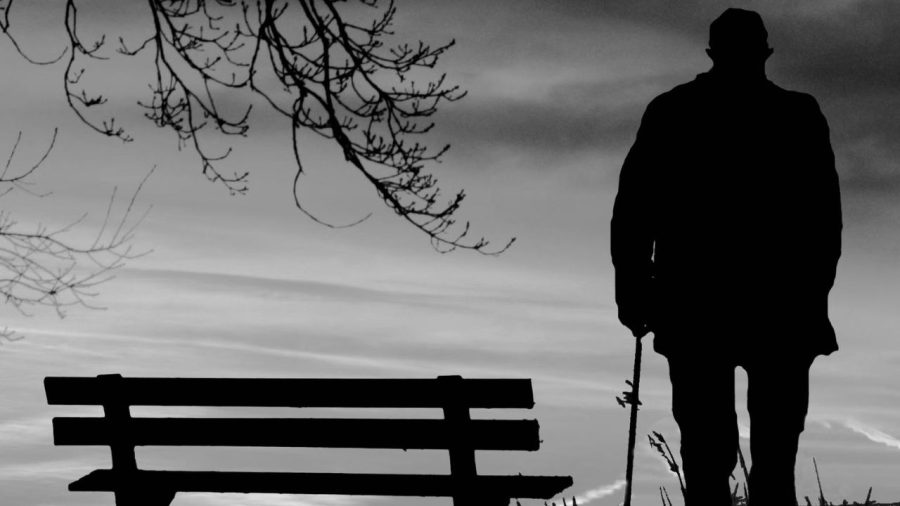



Rahmat Islam sat motionless on a wooden bench on the ground floor of Birdem Hospital in the capital. It was 11am. The 63-year-old, who had been sitting continuously for over two hours, clutched a sheaf of worn prescription papers in his trembling hands.
Driven to Dhaka from Magura after local doctors failed to treat his severe pulmonary condition, the elderly man found himself completely adrift upon arrival. Lacking close relatives in the capital, he reached out to a distant nephew before becoming hopelessly lost within the hospital’s labyrinthine corridors.
“A man promised he would take me to see the specialist, but I have been waiting on this bench for three days,” he told TIMES, his eyes heavy with exhaustion. “I still haven’t seen a doctor.”
Dressed in frayed clothes, Rahmat revealed that his two adult children reside abroad, funded entirely by his life savings. Today, neither calls to enquire after his health.
His plight reflects a bleak reality shared by nearly 18 million elderly people across Bangladesh, where state protections and basic civic courtesies remain severely deficient. The nation’s healthcare system lacks prioritised geriatric services, whilst public transport networks offer no concessionary fares or accessibility measures for senior citizens.
In a society where personal value is often tied to physical labour and earning capacity, those navigating retirement without statutory pensions face immense vulnerability.

Empty declarations and legal gaps
In 2013, the government formally declared citizens aged 60 and above as “senior citizens” under the National Policy on Older Persons. Over a decade later, however, the designation remains little more than a paper policy.
Unlike developed nations, Bangladesh offers no senior health cards, transport subsidies, long-term care frameworks, or integrated welfare packages. State support is largely confined to a paltry old-age allowance and a handful of overcrowded care homes.
In a 2023 report, Claudia Mahler, the United Nations independent expert on the enjoyment of all human rights by older persons, highlighted significant structural gaps in Bangladesh’s legal protections for the elderly and noted severe failures in policy implementation.
UN population projections estimate that the number of Bangladeshis aged 60 and above will reach between 17.5 and 18 million by 2026.




Yet data from the Department of Social Services reveals that under the old-age allowance scheme for the 2025-26 fiscal year, only 62 lakh elderly citizens receive a monthly stipend of Tk750.
A promised increase to Tk1,000 for those over 90 has yet to materialise, leaving roughly 11.4 million elderly individuals entirely without state support.
Though the Parents’ Maintenance Act 2013 mandates that adult children provide food, shelter, healthcare, and care for their parents and grandparents, backed by fines and custodial sentences for non-compliance, enforcement remains rare.
“The core problem is not the absence of legislation, but a decay in societal values and a lack of awareness,” explained Professor Md Nurul Islam of Dhaka University’s Institute of Social Welfare and Research.
“Most parents are deeply reluctant to take legal action against their own children. Consequently, legal mandates alone cannot resolve this crisis,” he said.
A daily battle on the streets
On the city streets, the everyday reality for senior citizens is unforgiving. At 9am at the Merul Badda bus stand, 60-year-old Rahela Sultana was repeatedly jostled aside as she attempted to board a crowded bus.
“What is ‘Older Persons Day’ to someone like me?” she asked bitterly. “I am nearly 60, and all my life I have seen older people treated with contempt.
“I suffer from a severe calcium deficiency and cannot stand for long periods. Every day is a physical fight to get onto a bus, and conductors often look at me with disgust and refuse to let me board.”
In a capital where public transport is notoriously chaotic for healthy commuters, it is virtually impossible for frail, elderly passengers to travel safely.
For those left destitute, institutional care offers little sanctuary. The Department of Social Services operates just eight government-run Shanti Nibash (Peace Homes) across the entire country, with a combined capacity of merely 200 residents.
Societal shifts and flawed pension schemes
Criminologists and sociologists point to urbanisation and changing family dynamics as major drivers of elderly isolation.
“The erosion of the traditional joint family system has severely weakened intergenerational bonds,” Professor Islam noted. “As nuclear families proliferate and urban life grows increasingly transactional, adult children often focus exclusively on their immediate households after marriage, neglecting their aging parents. Furthermore, our education system fails to instil civic morality and familial duty in young people.”
Even recent state initiatives offer cold comfort. The Universal Pension Scheme introduced in 2023 fails to guarantee long-term financial security for surviving dependents.
Under recent amendments, the age cap for a pensioner’s death was raised from 75 to 80 years. However, if a pensioner dies after turning 80, their spouse or nominated beneficiary receives no further payments, despite the state retaining the deceased’s principal deposited capital and funding payouts solely through investment yields.
If a pensioner dies at 79, the surviving spouse receives benefits for just one year.
Without comprehensive legislative reform, accessible infrastructure, and a resurgence of community care, millions of elderly Bangladeshis remain condemned to spending their twilight years in uncertainty, neglect, and silent isolation.