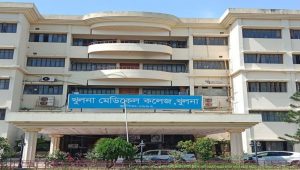
A faulty structural design and the use of substandard bearing pads caused the Dhaka metro rail accident that killed a pedestrian in the capital’s Farmgate area on 26 October, according to the findings of a government probe committee.
Road Transport and Bridges Ministry Adviser Muhammad Fouzul Kabir Khan disclosed the findings while briefing reporters at the Secretariat on Thursday, nearly two months after the incident.
According to the adviser, preliminary findings revealed that the hardness, compression set and neoprene content of the displaced bearing pads did not meet prevailing standards. “Further laboratory tests outside the country are required for confirmation, but it is believed that these deficiencies contributed to the displacement,” he said.
The accident occurred on October 26 when a bearing pad from a metro rail pillar became displaced and fell onto the road in the Farmgate area, killing a pedestrian. The victim was identified as Abul Kalam Azad, 35, a resident of Shariatpur.

The government formed a five-member inquiry committee on the day of the accident, headed by Bridge Division Secretary Mohammad Abdur Rouf. Other members of the committee included ABM Toufique Hasan, a professor of mechanical engineering at Bangladesh University of Engineering and Technology (BUET), Lieutenant Colonel Zahidul Islam, an associate professor of civil engineering at Military Institute of Science and Technology (MIST), Mohammad Abdul Wahab, project director of Line-5 of Dhaka Mass Transit Company Limited (DMTCL) and Asfia Sultana, a deputy secretary of the ministry as the member secretary.
The committee was later expanded to include the Chief Engineer of the Local Government Engineering Department and two additional experts — BUET civil engineering professors Khan Mahmud Amanat and Rakib Ahsan.




The probe found significant design flaws in the alignment near Farmgate metro rail station. The committee observed that circular alignments exist at both ends of the station, but no transition curve was used between the straight and curved sections of the viaduct.
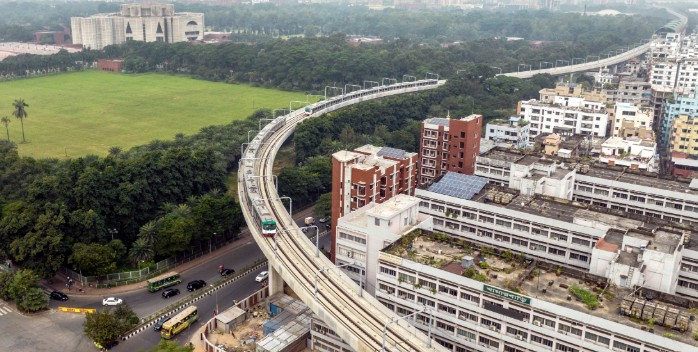
Photo: DMTCL
“The design for the curved alignment was prepared based on modelling of the straight alignment, without separate analysis,” Fouzul Kabir Khan said, citing the report. This, the committee noted, may have generated excessive lateral forces and vibrations.
Vibration measurements taken during train operations showed unusually high vibration levels at Pier No. 430 and Pier No. 433 — the locations associated with the displaced bearing pads — compared to other piers.
The report also noted inconsistencies in track design. While a neoprene rubber mass–spring damper system was installed under rail tracks at the curved alignment and nearby station, a rigid track system was used at the accident site.
The inquiry committee held 10 meetings, reviewed all available data and also examined a previous inquiry into a similar incident that occurred on 18 September, 2024. That earlier probe had failed to conclusively identify the root cause, and the committee noted that neither the contractor nor the consultant conducted detailed engineering analyses despite having sufficient time.
To prevent future accidents, the committee recommended urgent installation of appropriate technical measures at curved alignment sections to stop bearing pads from shifting. It also urged a comprehensive review of the viaduct’s structural and track design through detailed analysis by an independent third-party consultant.
Additionally, the report called for a third-party safety audit of the entire metro rail project, rapid installation of a structural health monitoring system for close observation, strengthening the capacity building of the metro rail authority, and stronger efforts to ensure effective technology transfer from foreign consultants to local experts.