The Faroe Islands are chasing an improbable place in next summer’s World Cup with one Group L qualifier left, having already secured their best-ever points tally in a qualifying campaign. The 18-island archipelago, situated between Iceland and Scotland, have won four of their last five matches, including a 2-1 home victory over second-placed Czech Republic in October.
Ranked 127th out of Fifa’s 211 nations, the Faroes can still qualify for the play-offs if they defeat Group leaders Croatia on Friday and Gibraltar avoid a defeat in Monday’s match against the Czechs. While this combination of results is highly unlikely, 36-year-old central defender Odmar Faero says the team is determined to see how far their recent form can take them.
“The idea is just to keep riding the wave and to hold on and just see how far it carries us,” he said. “We’re soaking this in at the moment and the feeling is that with the results recently, we believe we can go to Croatia and get three points.”

Faero, who has played in Scotland with Keith and Forfar Athletic, is the only Faroese player with 50 European club appearances. His father and grandfather, both named Odmar, also represented the nation, which has a population of just under 55,000.
Despite the optimism, Faero remains realistic about their chances. “I just don’t feel like Gibraltar are going to get any points so it’s a little bit of a lost cause, but we won’t let that affect our performance against Croatia. We would be absolutely gutted if Gibraltar do get a draw and we don’t fulfil our end of the bargain – that would be the worst I could live with.”


The Faroes reached 12 points after their win against the Czechs, thanks to goals from Hanus Sorensen and Martin Agnarsson. Both players are under 25 and represent a new generation for the national team. “They are power players,” Faero said. “They have explosiveness, agility, young naivety, if you can call it that. They basically don’t care who they’re running up against. That’s sometimes what you need.”
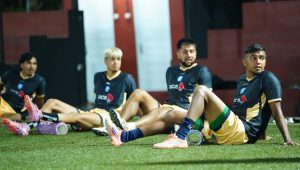
Unlike Sorensen and Agnarsson, who play professionally abroad, Faero combines football with a job at a local furniture store, where he has just won the league again with KI. The team’s part-time status extends across the squad, with players also working in teaching, childcare, and business, including CEO Arni Frederiksberg, who scored against Montenegro.
Faero credits the side’s recent success to having a Faroese coach, only the second in the team’s history. Eyoun Klakstein replaced Swede Hakan Ericson in February, a move that instilled a new sense of identity and expectation. “Psychologically, when you start having the team meetings and the pep talks and the analysis and all these things in our own language, it just gives it a feel that now we are the Faroese national team. Everything is happening in Faroese and we are going to die and bleed for this team. It’s a matter of patriotism and everything we do is the Faroese way,” he said.
Faero explained that the “Faroese way” is rooted in resilience. “We’re 55,000 people stuck on 18 islands in the middle of the Atlantic Ocean. Either you figure it out yourselves, or you die. We have our resources, we have our people, and we just find our way to make it work because there is no other option.”
A victory over Croatia and the right results elsewhere would transform that determination into an extraordinary World Cup qualification.