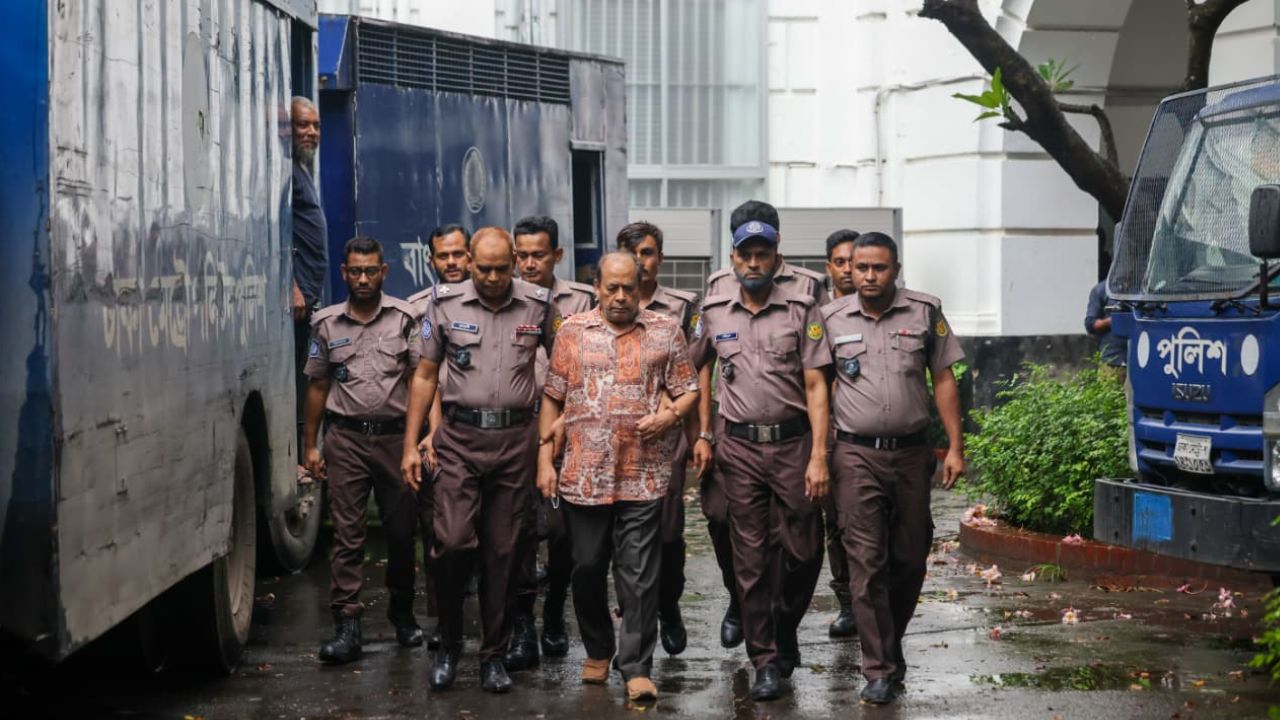

Retired major Mozaffar Hussain, who stands accused of involvement in the assassination of the then president Ziaur Rahman, has been shown arrested in a case concerning crimes against humanity committed during the July 2024 mass uprising.
The International Crimes Tribunal-2 passed the order on Thursday, adding that the accused will remain in army custody. However, the tribunal’s investigation agency has been permitted to take him into custody for two days for interrogation.
Chief Prosecutor Md Aminul Islam represented the state at the tribunal, where he applied to have Mozaffar shown arrested in the case and sought permission for the two-day interrogation.
A period of two months was requested for the submission of the investigation report. The tribunal subsequently fixed 23 September for the submission of the report, on which date the next hearing of the case will be held.
Mozaffar was arrested on the night of 15 July from a residence in Banani, Dhaka, 45 years after the assassination of Ziaur Rahman. He was handed over to the Military Police at Dhaka Cantonment the following day.
There are allegations that Mozaffar was present during the assassination of Ziaur Rahman on May 30, 1981, and information suggests he was tasked with burying the bodies of Zia and two others following the killing at the Chattogram Circuit House.

Following the burial, the army officer was reportedly injured by police gunfire and subsequently fled to India. At that time, a reward had been announced for his capture. Mozaffar was the sixth accused in the case filed by the police at Chattogram’s Kotwali Police Station following the Zia assassination.
The First Information Report (FIR) mentions that he was standing close to the President at the time of the murder. Ultimately, in 2001, the CID submitted a final report to the court, admitting its failure to solve the mystery of the case.
Several sources indicate that Mozaffar later settled in Canada and acquired citizenship there, though he visited Bangladesh at various times. He was even caught by RAB during the 1/11 period in 2007 but managed to slip away by concealing his identity.
Various media outlets are reporting that Mozaffar was identified based on telephone conversations with Lieutenant General (retired) Masud Uddin Chowdhury, a former Jatiya Party lawmaker for the Feni-3 constituency and an influential military officer during the 2007-08 army-backed caretaker government.



Masud was arrested by law enforcement agencies on 23 March this year. Although he was initially placed on remand in cases involving embezzlement and human trafficking, he was later shown arrested in a case involving crimes against humanity in May.
He was also named as an accused in a case involving killings in Feni during the July uprising, which was subsequently brought to the tribunal and in which Mozaffar has been implicated.
Chief Prosecutor Aminul Islam told journalists, “There is no provision in the tribunal to arrest someone in a specific case.
“The prosecution files a ‘misc case’ (miscellaneous case) to interrogate a suspect. He has been arrested and permission for interrogation has been sought through that process. If specific allegations are proven after interrogation, he will face trial.”
Regarding Mozaffar’s arrest, he said, “The investigation officer began work based on information obtained during the interrogation of Masud Uddin Chowdhury while on remand. A lead was found regarding contact with an individual named ‘Jhondu.’
“We later learned that this Jhondu is none other than retired major Mohammad Mozaffar Hussain.”
He further informed that there is evidence of numerous conversations between Masud Uddin Chowdhury and Mozaffar during the time crimes against humanity were being committed during the July movement.
The chief prosecutor said, “We are receiving information that he (Mozaffar) travelled to a neighbouring country many times during the fascist regime. While in hiding in Bangladesh, he had involvements with the government, including Masud Uddin Chowdhury, in crimes against humanity.
He was involved in the implementation of many plans related to the crimes against humanity that occurred during the July Uprising.”
Alleging that Mozaffar enjoyed the patronage of the Awami League government, Aminul said, “Mozaffar travelled freely from one country to another and moved about undisturbed in Bangladesh.
“He maintained contact with various officials of the then Awami League government via telephone.”
Clarifying that the trial for the murder of Ziaur Rahman would be conducted under military law, Aminul said, “We have no connection with that. Our investigation here pertains to crimes against humanity.
“We will examine his involvement in the actions of the Awami League government during its 16-year tenure. In other words, our judicial proceedings are entirely separate.”
He added, “He will remain under the supervision of the army. We will bring him from there for interrogation as per our requirement. Moreover, once the allegations against him are established, his trial will proceed under the existing laws of the tribunal.”