Bangladesh’s budget cannot be people-friendly without prioritising agriculture, experts said on Saturday, arguing that rising energy costs, heavy subsidy allocations and structural neglect of the farm sector are driving up production costs and household inflation.
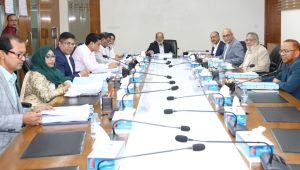
The remarks came at a Ganosamhati Andolon organised dialogue titled “People-Friendly Budget: Thoughts and Expectations” at Dhaka Reporters Unity (DRU), where economists, researchers and civil society representatives said the current fiscal structure increasingly favours energy producers over public welfare spending.
Dhaka University Accounting Associate Professor Moshahida Sultana said rising electricity and fuel prices are increasing pressure on agriculture and livelihoods, while large allocations for power sector capacity charges are crowding out social sector priorities.
She said the budget allocates about Tk27,000 crore in subsidies for Petrobangla and around Tk55,000 crore for power sector capacity payments, adding that total capacity-related costs could exceed Tk100,000 crore amid global uncertainty.
Bangladesh has around 7,700 megawatts of excess generation capacity, requiring continued capacity payments despite underutilisation, she said. The country also spends nearly Tk12,000 crore annually on liquefied natural gas imports while domestic gas exploration remains limited.

“If inflation is being driven by electricity and energy costs, then the budget must address this issue. Otherwise, agricultural production costs will increase and the overall cost of living will rise,” she said, describing the current structure as “producer-friendly rather than people-friendly”.
She added that delays in gas supply and high electricity costs are also limiting investment despite facilitation efforts by the Bangladesh Investment Development Authority.




Centre for Policy Dialogue Agriculture and Social Protection Specialist Shamim Alam Shibli said agriculture remains the “lifeline” of the economy, but remains heavily dependent on rice cultivation, limiting diversification and increasing import dependence.
He said a large share of agricultural subsidy spending goes to fertiliser and seeds, with Bangladesh using about 6.6 million tonnes of fertiliser annually, 70 per cent of which is used for Boro cultivation.
Global fertiliser prices have risen due to geopolitical disruptions, increasing import costs. While farmers currently receive fertiliser at Tk27 per kilogram, the government’s actual cost is about Tk103–Tk105 per kilogram, he said.
“If fertiliser prices increase, production costs will rise and ultimately affect consumers. The government must consider how to stabilise input costs in the budget,” he said, suggesting diversification of import sources including Russia.
On food markets, he said flood damage in the haor region affected around 1 per cent of national production, yet rice prices rose, underscoring the need for stronger market intervention.
He added that affected farmers are receiving Tk7,500 per month for three months, which is insufficient compared to losses, and suggested free fertiliser and seeds for the next cultivation cycle. He described the farmer card initiative as positive but stressed safeguards against politicisation.
LDG Graduation Watch Trade Researcher Barkatullah Maruf said the budget reflects deep structural weaknesses and weak policy coherence, adding that Bangladesh has made inadequate preparation for graduation from Least Developed Country status.
He said macroeconomic statistics used in the transition process have been overstated and added that the country’s debt burden has already reached billions of dollars.
“The main foundation of a country’s budget should be food, meaning agriculture. Yet agriculture is the most neglected sector in Bangladesh’s budget,” he said, adding that farmers continue production despite limited state support.
The session was chaired by Ganosamhati Andolon Chief Coordinator Dewan Abdur Rashid Nilu.