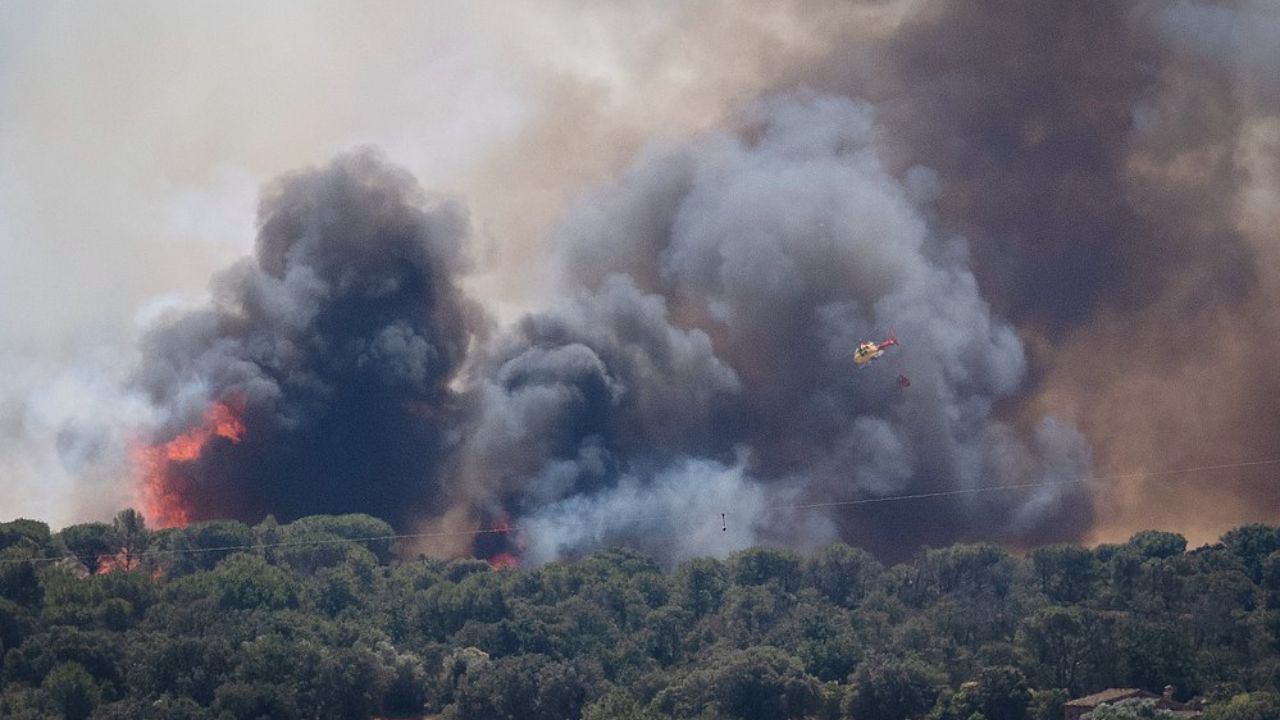



Hundreds of firefighters battled a rapidly spreading wildfire near Spain’s Costa Brava on Friday, while neighbouring Portugal sought international assistance to contain multiple blazes burning across its northern regions.
The fire started near La Bisbal d’Emporda, around 20 kilometres from the Costa Brava coastline, a popular summer tourist destination, reports CGTN.
Strong winds fuelled the flames, prompting Catalan authorities to instruct residents in 10 municipalities, including the seaside resort of Platja d’Aro, to remain indoors. Authorities also evacuated around 150 people, including about 70 children from a holiday camp.
Video released by the Catalan fire service showed helicopters dropping water on flames as thick grey and orange smoke billowed across forested hills. Nearby beachgoers watched water-bombing aircraft flying overhead while smoke spread across the horizon.
More than 200 firefighters, supported by aerial resources, were deployed to tackle the blaze, which had already consumed 1,280 hectares.
Spanish Prime Minister Pedro Sanchez urged the public to “take the utmost caution” as high temperatures are expected to continue over the coming days.

Catalan police said officers had arrested a man on suspicion of causing the fire “while he was using an angle grinder by the roadside.”
Spain remains one of the European countries most exposed to climate change, which scientists say is increasing the intensity, frequency and duration of extreme heat that drives wildfires.
According to the European Forest Fire Information System, wildfires burned nearly 400,000 hectares across Spain last year, the country’s highest annual total on record.
Portugal requests international support
In neighbouring Portugal, the government on Friday activated the European civil protection mechanism and bilateral agreements with Spain and Morocco to secure additional firefighting support.




Portuguese Prime Minister Luis Montenegro said the decision was taken “not because our capacities are already exhausted but because in the current situation, our entire territory is exposed to a very high risk.”
A wildfire burning since Wednesday night in the northern municipality of Vouzela has injured at least nine people, including two seriously. Civil Protection said three firefighters suffered minor injuries, while one civilian sustained severe burns.
The fire has scorched an estimated 10,000 hectares. Around 1,000 firefighters, backed by about 300 vehicles and eight aircraft, continued efforts to contain the blaze on Friday. At the same time, firefighters were also battling four smaller wildfires, each involving at least 100 personnel.
Portugal’s weather agency has placed 12 of the country’s 18 mainland districts under red alert throughout the weekend, with temperatures forecast to reach 44 degrees Celsius in some areas.
The country, which experiences major forest fires almost every summer, continues to bear the scars of the devastating 2017 wildfires that claimed more than 100 lives.
France records hottest June as heatwave deaths surge
France experienced its hottest June since records began in 1947, with temperatures exceeding 40 degrees Celsius in many parts of the country during a prolonged heatwave, the weather service Meteo-France said on Friday.
The country’s average temperature reached 22.7 degrees Celsius, 3.8 degrees above the 1991-2020 seasonal average.
“Unprecedented temperatures, both day and night, affected more than a third of the country” during the heatwave from June 17 to 30, said the Meteo-France, adding that temperatures of 40 degrees Celsius were exceeded at least once over more than 40% of the country.
June 24 and 25 were the hottest days ever recorded in France.
The prolonged heat disrupted daily life, forcing schools to shut and leading to the cancellation of festivals and train services.
Health authorities reported that deaths increased by at least 29.1% during the week beginning June 22, resulting in 2,025 more deaths than the previous week. In the Paris region, the death toll rose by about 62%.
Public Health France reported “a clear rise” in deaths among people aged 45 to 64, while those aged 65 and over accounted for the largest proportion of fatalities.
The agency also said deaths at home nearly doubled within a week, with young people also among those who died.
Scientists said human-caused climate change was “unequivocally” responsible for the intensity of the late-June heatwave across Europe.
The French government has faced criticism from those who argue the country remains poorly prepared for increasingly severe heat. Many homes still lack adequate insulation or cooling systems, forcing residents to rely on survival blankets or chalk-based paint to keep indoor temperatures down.
Elsewhere in Europe, Belgium recorded 1,222 excess deaths between June 18 and 29, representing a 39% increase above normal levels.