


Bangladesh’s energy security challenge is widening as declining domestic gas production, limited LNG infrastructure and rising import dependence leave industries and power plants vulnerable to supply disruptions, prompting calls for faster exploration, private investment and policy reforms.
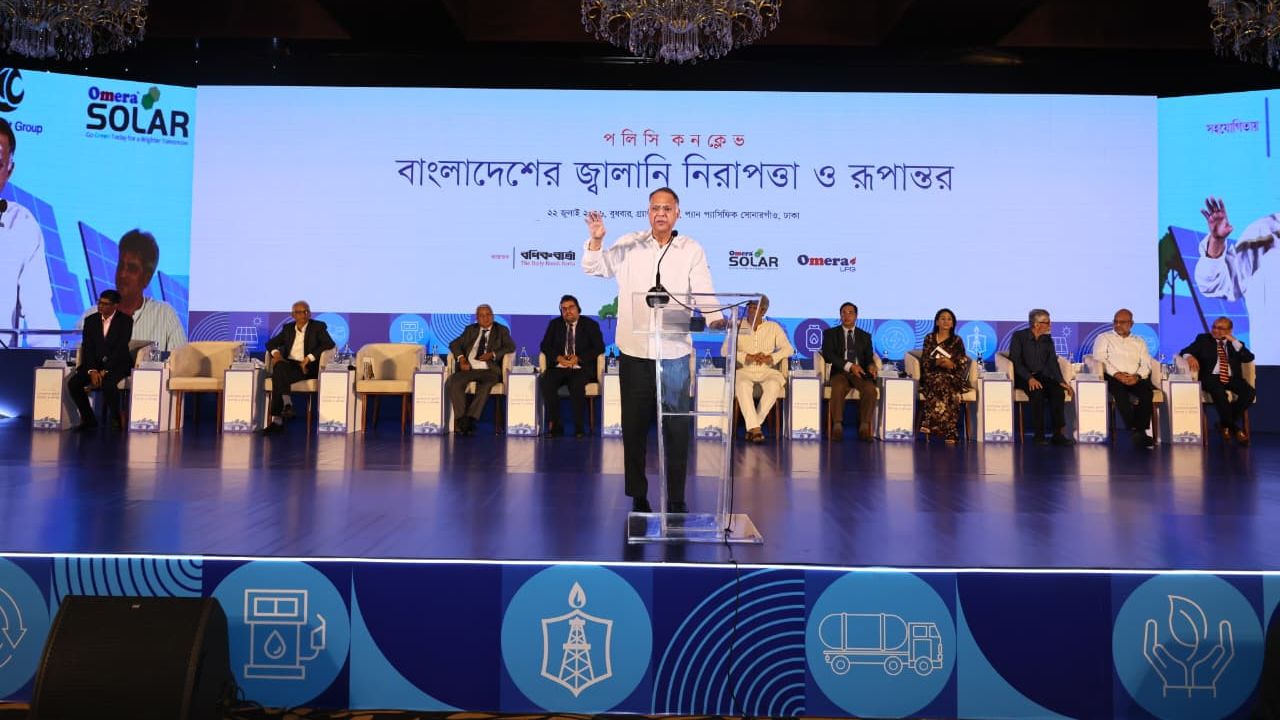
At a policy conclave on “Bangladesh’s Energy Security and Transition” organised by Daily Bonik Barta at the Pan Pacific Sonargaon in Dhaka on Wednesday, policymakers and industry leaders said the country must rebuild its energy strategy around domestic resource development, diversified supply sources and greater private sector participation.
Bangladesh Energy Regulatory Commission (BERC) Chairman Jalal Ahmed said domestic gas production had fallen sharply, increasing dependence on imports.
Local gas supply, which reached around 2,600-2,700 million cubic feet per day in 2016-17, has declined to around 1,700 million cubic feet per day, he said.
Bangladesh also lacks a clear picture of its remaining gas reserves as offshore exploration in the Bay of Bengal remains limited.
While neighbouring countries have reported major discoveries, Bangladesh has not conducted sufficient exploration, he said.
Even after surveys, it could take at least five years to determine whether offshore reserves are commercially viable, Jalal Ahmed added.
Power, Energy and Mineral Resources Minister Iqbal Hasan Mahmud said Bangladesh’s energy problems were partly the result of expanding power generation without securing fuel sources.

“Over the past 17 years, there was no effective planning in the energy sector. We focused on building power plants but did not take enough initiatives for domestic gas exploration and production,” he said.
Bangladesh now has around 28,000 megawatts of generation capacity, but insufficient fuel supply prevents plants from operating efficiently, he said.
The country has not drilled a single gas well in the past 17 years, increasing reliance on imported energy. Bangladesh currently depends on two floating storage and regasification units (FSRUs) at Moheshkhali for LNG imports, leaving the system exposed to disruptions.
A recent shutdown at one LNG terminal reduced gas availability, affecting households, compressed natural gas stations and industries.
“Today LNG supply has been disrupted. Gas pressure has fallen. People in areas including Mymensingh are not receiving gas, and CNG stations are also facing shortages,” Iqbal Hasan Mahmud said.
He said Bangladesh needs more domestic exploration and additional LNG infrastructure so that a disruption at one facility does not create a nationwide supply crisis.



The minister also called for a larger private sector role in electricity distribution, saying the government should focus on generation and bulk supply rather than retail distribution.
“Governments do not need to do everything with public money. Where possible, responsibility should be given to the private sector,” he said, citing private distribution models in major Indian cities.
Business leaders said energy uncertainty was already affecting investment decisions and industrial competitiveness.
East Coast Group Chairman Azam J. Chowdhury said unclear policies, particularly in renewable energy, were creating uncertainty for investors.
“When an investor puts in a large amount of money and waits for an energy connection, ensuring that supply is available is the government’s responsibility,” he said.
World Bank Division Director for Bangladesh and Bhutan Jay Payne said energy security was critical for investment, economic growth, employment and competitiveness.
Although Bangladesh has expanded electricity access, the sector remains vulnerable because of import dependence. Around 30 per cent of gas demand, 95 per cent of oil consumption and 90 per cent of coal demand are met through imports, he said.
Global fuel price volatility, supply chain disruptions, declining domestic gas output and costly power purchase obligations are adding financial pressure to the sector, Payne said.
Industries are also facing higher operating costs because of unreliable supply.
Transcom Group CEO Simeen Rahman said businesses needed consistent supply and quality electricity rather than only access to power.
Frequent disruptions, voltage fluctuations and fuel shortages are increasing costs for generators, raw materials and logistics, while companies often cannot pass those costs to consumers because of global competition, she said.
Renewable energy expansion was identified as another priority, but industry leaders said policy and land constraints were slowing progress.
International Chamber of Commerce Bangladesh President Mahbubur Rahman said rooftop solar alone would not meet industrial demand and urged the government to simplify access to unused public land for large renewable projects.
“If land allocation can be simplified, large renewable energy projects can be implemented quickly,” he said.
He warned that unreliable energy supply could discourage foreign investment as global investors assess the operating environment before entering a market.
Banks are also facing exposure from industrial projects affected by fuel shortages.
Trust Bank Managing Director Ahsan Zaman Chowdhury said around Tk7,000-8,000 crore of the bank’s investment was stuck because of the gas crisis.
Many industrial projects cannot operate at full capacity due to fuel shortages, creating risks for loan repayment and increasing financial pressure on businesses, he said.
Bonik Barta Editor and Publisher Dewan Hanif Mahmud moderated the conclave.
Other speakers included former Power Grid Bangladesh PLC Chairman M Rizwan Khan, Bangladesh University of Engineering and Technology Pro-Vice-Chancellor Abdul Hasib Chowdhury, and Bangladesh Sustainable and Renewable Energy Association President Mostafa Al Mahmud.
Former Infrastructure Development Company Limited Managing Director Alamgir Morshed, Standard Chartered Bangladesh Acting CEO Md Enamul Huque and Omera Renewable Energy Limited CEO Masudur Rahim also spoke at the dialogue.