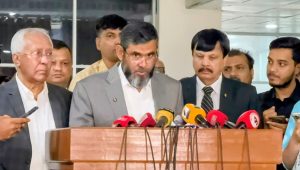
Attorney General Md Asaduzzaman on Monday said the state has kept “as many legal options for controlling journalists as there are stars in the sky”, allowing authorities to use many kinds of punishments – even sedition – when they have no other grounds to act.
He warned that this long-running trend will not change unless the state changes its overall “governing mentality,” simply criticising or amending the Digital Security Act will not fix the problem.
Asaduzzaman made the remarks at the “Bay of Bengal Conversation 2025” organised by the Centre for Governance Studies at a hotel in Dhaka.

He explained that the use of repressive laws against journalists is not new. He said,“The trend started with the 1860 Penal Code, continued through the 1974 Special Powers Act, and later the now-cancelled Section 57 of the ICT Act.”
These laws, he said, gave the state the power to arrest or harass journalists whenever it wanted.



“The use of various ‘black laws’ to harass or punish journalists has continued under different governments,” Asaduzzaman said.
He also mentioned recent cases under the DSA, criticising how cartoonist Ahmed Kabir Kishore and writer Mushtaq Ahmed were targeted under the law.
The Attorney General said that court decisions sometimes added to the suffering, citing example of a 17-year-old girl from the Santal community in Dinajpur who spent more than two years in jail because of a Facebook post before she finally got bail.
He added some online platforms regularly spread propaganda and misinformation and urged journalists to help create a framework that protects both press freedom and citizens.
Rights activist Barrister Sara Hossain and Senior Legal Programme Manager at the Clooney Foundation, Maneka Khanna, were also present at the event.