


From cities to villages, corporate offices to roadside tea stalls in remote areas, election arithmetic now dominates conversations as the 13th parliamentary election brings back a festive mood across the country.
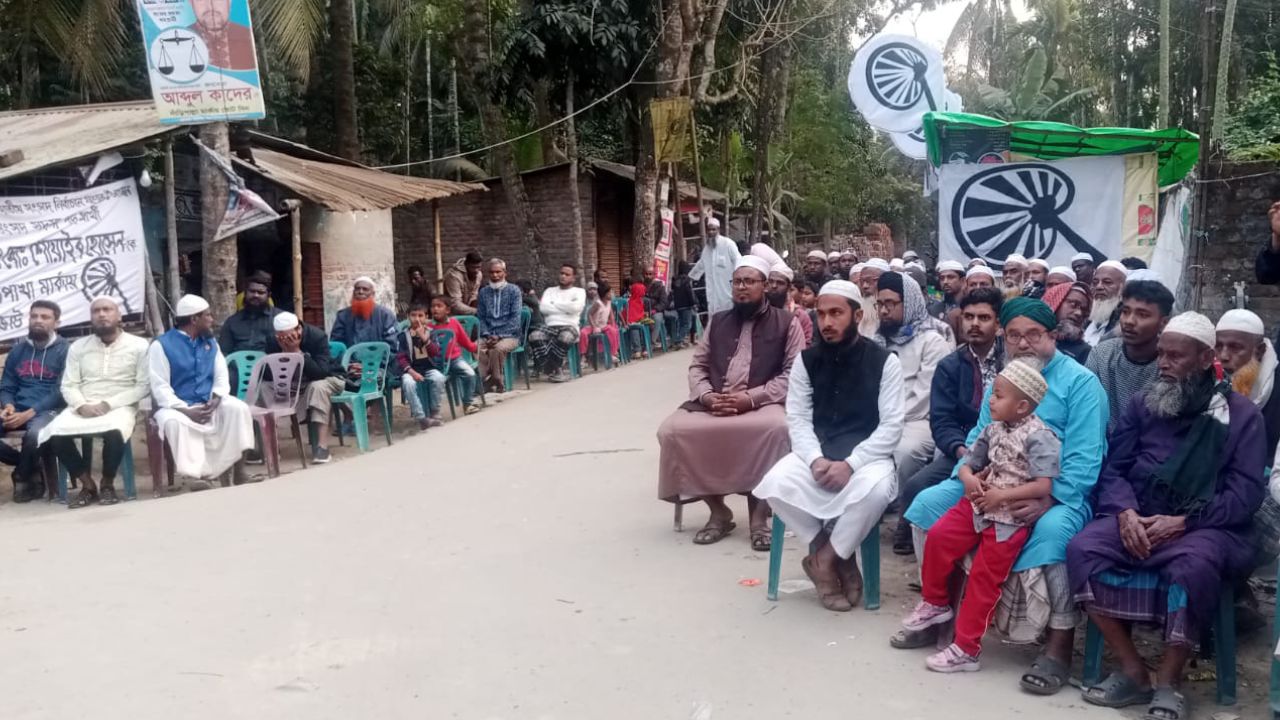
Rural haat-bazaars are echoing with slogans from afternoon until late night, while posters, loudspeaker announcements and door-to-door campaigns have turned villages lively once again.
After a long gap, voters in the countryside said they are eager to cast their ballots in an atmosphere that feels open and participatory, even as farmers and day labourers quietly calculate what the election might mean for their livelihoods.
As winter fades and the sun hangs low in the sky, a small village shop in Sultanpur of Jashore Sadar becomes a hub of political debate.
Some have just returned from harvesting golden crops, others sit down after a day of backbreaking labour, sharing piyaju, beguni and muri-makha while weighing electoral possibilities.
Rafiqul Hossain, a farmer in his fifties, said politics rarely occupied his thoughts beyond agriculture, yet every afternoon he finds himself drawn to the shop discussions.

He said he was denied the chance to vote in several past elections, often being told at polling centres that his vote had already been cast.
“This time we are hearing we will be able to vote, and the mood in the village is very different,” he said, adding that candidates are visiting homes, listening to problems and speaking about solutions.
Rickshaw-puller Bidhan Chandra Adhikari said the festive mood is no longer confined to towns.
“The same excitement you see in the city is now in villages as well, and we are waiting with hope to go and vote,” he said.


Sattar Hossain voiced a more political sentiment, saying voting is his right but that he was deprived of it for years.
“This time there is no boat symbol in the field, and I will vote for the symbol of my choice,” he said.
He added that candidates carrying symbols such as the scales, sheaf of paddy, sickle and hand fan have visited villagers, listened to local problems and spoken of development if elected.
“No one stopped us from voting,” he said, adding that villagers plan to go to polling centres together.
Young voter Samiul Kabir Alvi, a BSc engineering student at a private university in Dhaka, struck a note of caution.
He said rural voters have been deceived many times before, with promises made before elections but forgotten afterwards.
Back home on vacation, he said he was struck by the scale of campaigning and the behaviour of candidates and supporters.
“I took part in the mass uprising of 2024 because we wanted change without discrimination,” he said.
Returning to his village before the election, he noticed supporters of different parties campaigning together without threats or intimidation.
He recalled hearing from his father that elections once felt like festivals, something he never experienced in recent years.
“Now I see many similarities with what my father described,” he said, expressing hope that on 12 February he will be able to vote with his family for the candidate of his choice.
Candidates, meanwhile, are extending their campaigns deep into rural areas.
In Jashore-3 (Sadar), candidate Anindya Islam Amit launched his campaign from Arabpur Union and has since been travelling village to village.
Across Jashore’s six constituencies, other contenders are following a similar path, knocking on doors of working-class households, promising development and appealing for change as the election momentum spreads through the countryside.