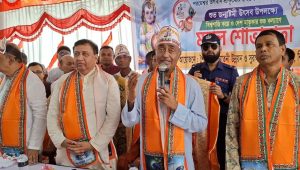


For the first time in history, with the majority of seats in the DUCSU elections going to Islami Chhatra Shibir, a new equation has emerged in campus leadership.
The Bangladesh Ganatantrik Chhatra Sangsad (BGCS) panel, backed by the National Citizen Party (NCP), was considered one of the main contenders. Many thought that this new force could emerge as an alternative to traditional politics.
However, after the results were announced, a different picture emerged. Contrary to expectations, the BGCS-backed “Boisommo Birodhi Chhatra Sangshad” panel failed spectacularly. As a result, a sudden silence has descended upon their leadership.
Since the July uprising, BGCS had been vocal across various campuses in the country, demanding student union elections. Even before the DUCSU elections, they were quite fiery, repeatedly calling for fair and impartial elections.
On the Dhaka University campus, the “Boisommo Birodhi Chhatra Sangshad” panel sought to present a clear outline regarding political settlements, the nature of student politics, and the structure of teacher politics.
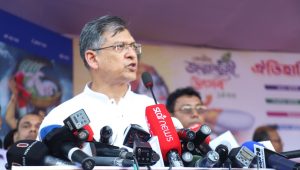
When the announcement came on September 2nd that the DUCSU elections were being postponed, the VP candidate of the Boisommo Birodhi panel, Abdul Kader, said, “One of the key aspirations of the 2024 Uprising was neutral student union elections in educational institutions.
Today, we see conspiracies to destroy that aspiration. But students will resist this rigging through a ballot revolution.” In his speech, words like “ballot revolution,” “fair vote,” and “protecting the achievements of the uprising” were emphasized.

Meanwhile, during the campaign, GS candidate Abu Baker Majumdar alleged that the Election Commission was failing to ensure even the minimum level of order.
Biased behaviour?
On September 9th, election day, events took a different turn. From the morning, BGCS-backed candidates began accusing the administration of biased behavior.
At Shamsunnahar Hall, students were prevented from entering, ballots were allegedly pre-filled, and rival candidates were present inside polling centers, all of which fueled their press conferences with complaints.


In an emergency press conference on election day, Baker alleged, “Red-flagging, entry control, and campaign rules — none of these were followed. Chhatra Dal is blaming Shibir, and Shibir is blaming Chhatra Dal.
But in reality, both sides are involved in a power struggle.” He also highlighted issues regarding voter list preparation, relaxation of age limits, and intimidation of families at their homes.
Inevitable defeat
However, none of these allegations ultimately changed the election outcome. On the morning of September 10th, it was announced that the Bangladesh Islami Chhatra Shibir-backed “Sommilito Shikkharthi Jote” had won 23 out of 28 central positions.
In contrast, the BGCS-backed panel did not win a single seat.
VP candidate Abdul Kader received only 1,103 votes, and GS candidate Abu Baker Majumdar 2,131. Both placed fifth. Though they managed to secure second place in a few secretary posts, their overall collapse in the polls was inevitable.
In this result, while some blamed the role of the administration and electoral irregularities, the issue of the party’s internal divisions also surfaced.
Multiple BGCS student leaders contested for the same positions, causing vote splitting; lack of coordination in campaigning; mutual mistrust; and factional divisions. These issues prevented BGCS from delivering a unified message to students.
This was evident when five leaders from the same organization contested for the AGS post.
On this matter, Ariful Islam Adeeb, Senior Joint Convener of the NCP, told TIMES of Bangladesh, “Reaching 40,000 students at Dhaka University is not easy at all. Since Shibir is a strong organization here, they were able to reach students easily with structural preparation.
A lot also depends on the individual capability of the candidate.” He added, “We saw coordination among other panels. But in our case, despite being from the same organization, the candidates participated separately and contested against each other.”
Meanwhile, NCP leaders are also blaming the negative image and organizational weakness.
Arif Sohel, former member secretary of the Anti-Discrimination Students Movement and now joint member secretary of the NCP, said, “If BGCS had performed well in DUCSU, it would have had a positive impact on NCP politics as well.”
However, he also believed that after the uprising, some activities of the Anti-Discrimination Students Movement leaders had created a negative impact.
As a result, after the elections, BGCS’s disappointing position on campus has become clear. Leaders who had been holding daily press conferences and making fiery declarations suddenly vanished after the results were announced.
Neither their presence on campus nor any public program is visible. No formal reaction has come from the organization either. Instead, deep frustration has spread within the group.
Even within the NCP, discussions have arisen about whether to maintain BGCS’s current structure at the university or dissolve the organization entirely and move in a new direction.