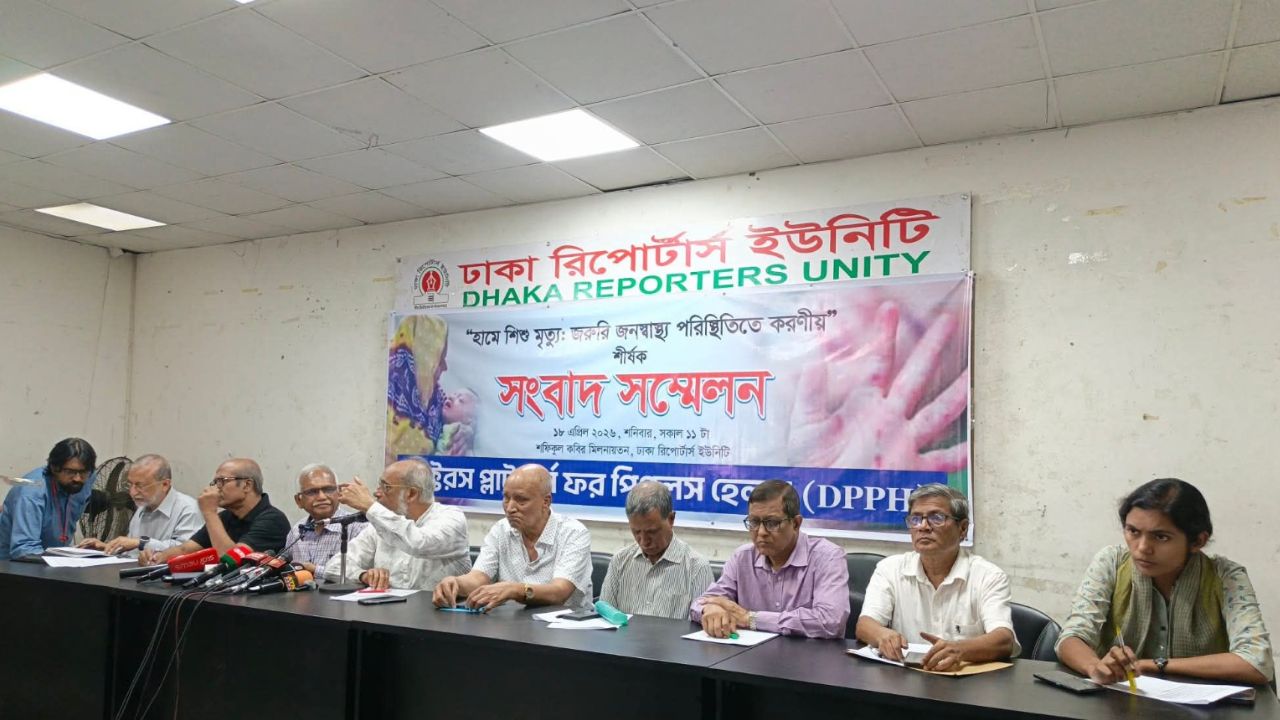

Doctors Platform for People’s Health (DPPH) has urged the government to declare the ongoing measles outbreak a ‘pandemic’ and demanded immediate coordinated measures to address the crisis.
The organisation stated that the current situation is not only a grave public health emergency but also exposes the vulnerabilities and vaccination gaps within the national healthcare system.
These demands were raised during a press conference titled ‘Measles Child Deaths: Actions in Emergency Public Health Situations’ held at the Dhaka Reporters Unity (DRU) auditorium in Segunbagicha on Saturday. T
he event began with a moment of remembrance for the children who have lost their lives to the disease, expressing sympathy for their families.
Data presented at the conference revealed that 206 children died from measles or measles-like symptoms between 15 March and 16 April. Currently, more than 3,000 children are undergoing treatment in various hospitals across the country.

Public health expert Dr Mushtaq Hussain, who presented the keynote paper, noted that the spread of the disease has reached a stage where it qualifies as a public health emergency due to the unusual rate of infection and mortality.
He remarked that while the government is taking necessary steps such as cancelling doctors’ leave, ensuring continuous service, and recruiting additional medical staff it has stopped short of an official ‘pandemic’ declaration.



“It will take approximately one to one-and-a-half months for the upward trend of measles to decline. However, if effective measures are not taken now, the situation will turn even more horrific,” Dr Hussain warned.
Abu Mohammad Zakir Hussain, former director of the Institute of Epidemiology, Disease Control and Research (IEDCR), highlighted that measles spreads faster than COVID-19.
He pointed out a worrying spike in the mortality rate, which has risen from the previous three deaths per thousand infections to ten per thousand. He urged the government to investigate the reasons behind this increased lethality with serious analysis.
He further noted that the measles vaccine takes two to three weeks to become effective, meaning immediate vaccination does not provide instant protection during an active outbreak.
Prof Dr Rashid-e-Mahbub, DPPH Convener and former President of the Bangladesh Medical Association (BMA), presided over the event, noting that marginalised children are the most affected by the current crisis. Paediatrician Prof Dr Kazi Rakibul Islam added that there has been a lack of effective initiatives to prevent post-measles complications, such as night blindness, in addition to the vaccination gaps.
To tackle the crisis, DPPH placed a series of urgent demands, including the launch of a nationwide mass vaccination campaign with priority given to slums, remote regions and marginalised populations. It also called for strengthening healthcare services from upazila to central levels and establishing dedicated ‘Measles Corners’ in all hospitals.
The platform further stressed the need to ensure uninterrupted supplies of essential medicines and Vitamin A, decentralise medical services to reach vulnerable populations, and roll out robust public awareness campaigns to counter vaccine misinformation.
Among its policy recommendations, DPPH urged an increase in the national health budget, improvements in vaccine supply chains, and the development of domestic capacity for vaccine production. It also called for the immediate operationalisation of children’s hospitals constructed in six divisions.
Other speakers, including Prof Dr Shakil Akhtar, Prof. Dr Harun-or-Rashid, Prof. Dr M H Faruquee, Dr Manisha Chakraborty and Dr Faizul Hakim Lala, described the situation as a stark warning. They appealed to parents, community leaders and the media to work collectively to prevent further deaths from what remains a preventable disease.