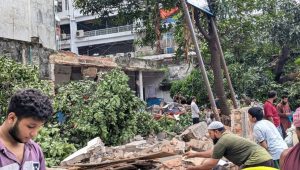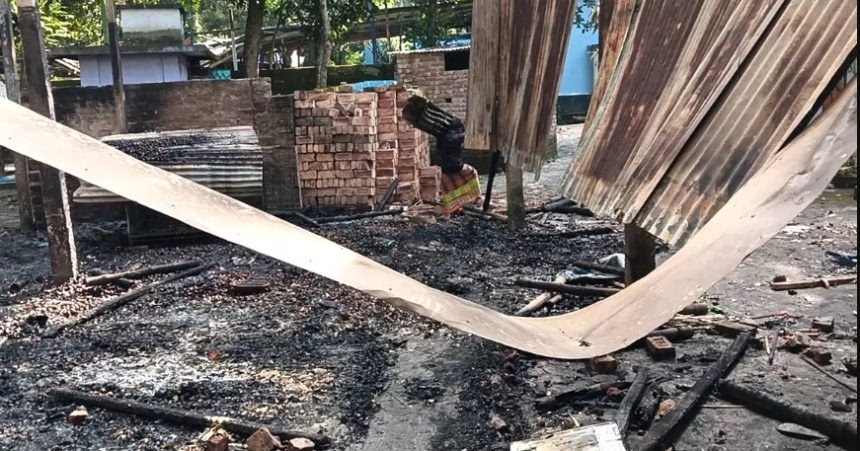

The flames that consumed the Nural Pagla shrine in Rajbari last Friday left more than charred bricks and ash. They ignited a searing question: why does Bangladesh’s interim government crack down swiftly on political unrest but falter when violent mobs torch the country’s spiritual heartlands?
For months, Chief Adviser Muhammad Yunus’s administration has deployed force with speed and severity against political protests.
In July, law enforcers used baton charges, tear gas, and mass arrests after supporters of the Awami League – whose political activities remain banned – clashed with them following an attack on a convoy of National Citizen Party (NCP) central leaders in Gopalganj. Officials defended the crackdown as necessary to maintain order.
But when violence targets sacred landmarks, the response has been halting, inconsistent, and at times indifferent. Since last year’s mass uprising, 44 shrine-related attacks have been reported. Just 23 arrests have followed.
Analysts say the contrast reveals a deeper crisis of governance. “Dr Yunus has failed to establish effective coordination and rapid response mechanisms,” said Sabbir Ahmed, a political science professor at Dhaka University.
Police, he added, remain demoralised after the uprising and are unable to act decisively. The government’s approach to law enforcement, he argued, is “highly selective and primarily driven by political interests.”

That vacuum has emboldened hard-line groups, particularly self-styled “Towhidi Janata” networks that blend theology with street muscle. They have repeatedly tested the state by attacking shrines, journalists, and law enforcers.
By contrast, students of the Bangladesh University of Engineering and Technology (BUET) faced swift police repression in late August while calling for academic reforms.
Barrister Jyotirmoy Barua argues that the government’s inaction is itself a legal offence, since failing to perform a required duty carries consequences. He said the state’s silence after shrine attacks and desecrations, often limited to issuing press notes, contrasts sharply with its proactive response in other situations.




This pattern of selective action, he warned, is deeply alarming before the election and suggests that future violence will again be met with either excessive force or dangerous inaction.
Law enforcers caught off-guard
Law enforcement officials concede their limits. Rajbari’s police superintendent Mohammad Kamrul Islam described how Friday’s assembly of 4,000 to 5,000 people spiralled out of control.
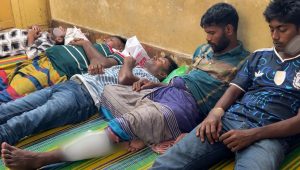
He said a faction of attendees, many from outside districts, pelted officers with stones pried from nearby railway tracks. Twelve policemen, including an additional superintendent of police, were injured.
More than 200 security personnel had been deployed, including police, the Rapid Action Battalion, and the army. Yet, in the chaos, officers were busy evacuating their wounded. That left space for attackers to remove a coffin from the shrine, parade it through the streets, and burn it.
“That may have happened while we were reorganising,” Kamrul Islam admitted. Reinforcements eventually arrived, and by 4:15 pm, the situation was under control.
Election security adds another layer of fragility
Election security adds another layer of fragility. Police morale is low, trust in the force has eroded since its partisan role in 2018, and manpower is stretched thin. The government recently amended the Representation of the People Order to allow deployment of the army, navy, and air force at polling stations – a step Dr Ahmed calls “positive, but not sufficient.”
He warned that politically motivated police recruitment, now underway for 4,000 new positions, could deepen bias. “That would be another disaster,” he said.
Dissent crushed, intolerance indulged
The interim government has defended its heavy-handed actions against political unrest as necessary to maintain stability before elections. But critics see a troubling pattern: dissent is crushed, while intolerance is indulged.
“Societies get fractured when dissent is punished but extremism is tolerated,” said a senior journalist in Dhaka, requesting anonymity.
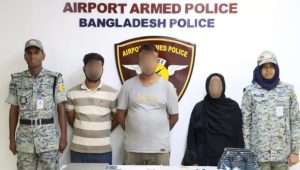
Even after the shrine attack, the state’s response was reactive, not preventive. Days later, police arrested five members of Chhatra League, the student wing of the Awami League, after CCTV and mobile phone footage linked them to the violence. Additional Police Superintendent Mohammad Sharif Al Rajib of Rajbari confirmed the arrests.
However, the question lingers: why were officers from three different security agencies unable to prevent the attack, despite being stationed at the scene?
For many, the arrests came too late. Each unpunished or belatedly punished assault deepens minorities’ sense of abandonment and undermines the secular ideals on which Bangladesh was founded.
Critics have expressed concerns that, alarmingly, there has been no international pressure urging the government towards consistent law enforcement. In its absence, shrines may continue to burn, communities will fracture, and radical forces will gain ground – while the Chief Adviser offers little more than emotional statements in response.