
What began with only 68 students has, over more than two decades, grown into a thriving academic community of more than 25,000. Daffodil International University, better known as DIU, has expanded not only in size but also in ambition, transforming itself from a conventional degree-awarding institution into what it describes as a complete educational ecosystem.
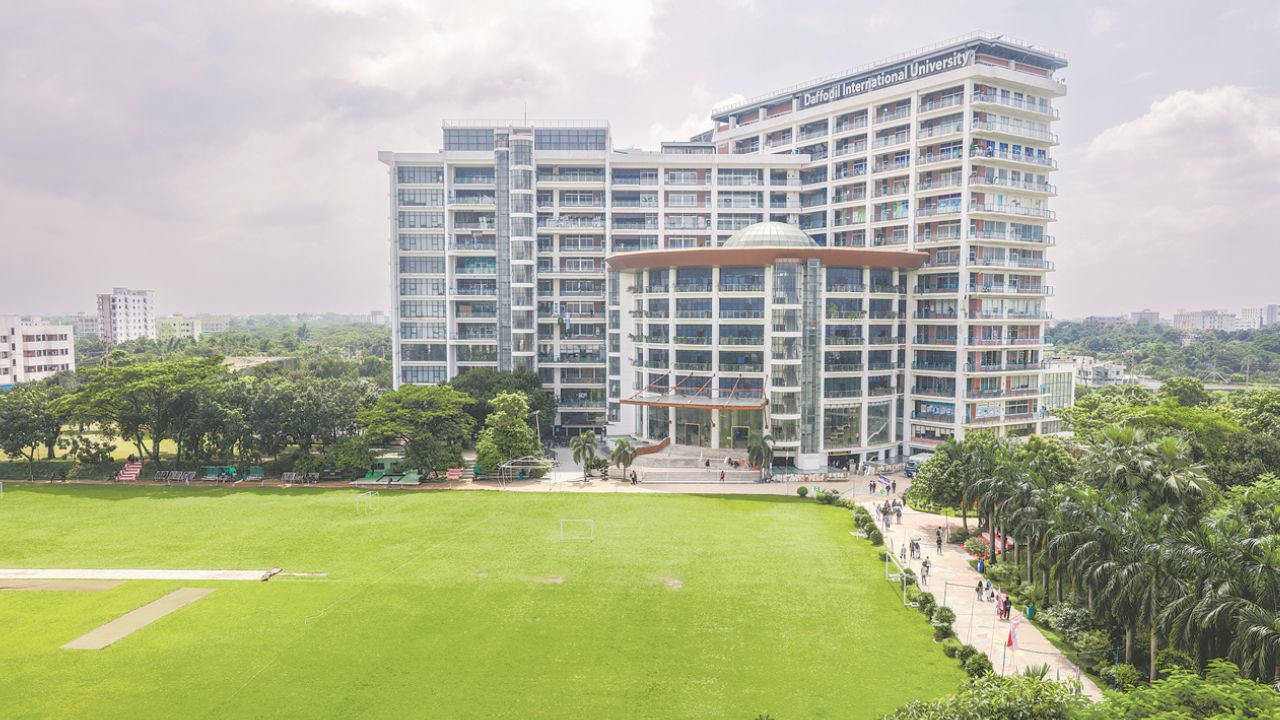
That transformation is visible across its green campus in Birulia, Savar.
Modern academic buildings stand beside research laboratories, residence halls, sports grounds, experimental farms and ponds. Students move between classrooms, laboratories, clubs and co-curricular activities, while a large transport network connects the campus with different parts of the capital.
Founded in 2002 with just two faculties, DIU now operates more than 30 departments under seven faculties. Its academic community includes more than 1300 full-time, part-time and visiting teachers from Bangladesh and abroad. The university has also become a major destination for international students.
DIU’s growth, however, is not defined by enrollment alone. Its expansion has been shaped by an effort to provide accommodation, technology, research opportunities, practical training and student support within one institutional framework.
Among private universities in Bangladesh, DIU has one of the largest residential arrangements. Around 7,000 students can live in five residence halls – three for male students and two for female students. The halls provide security, internet connectivity, food services and an environment intended to support academic life.
Across the campus, laboratories support research in science, agriculture, engineering and emerging technologies. Large playing fields and green spaces promote physical and mental wellbeing, while clubs encourage leadership, teamwork and communication.
This combination of academic and non-academic facilities has helped DIU position itself as more than a place where students attend lectures and sit examinations. Its broader aim is to extend learning through research, technology and practical experience.

The university has also gained recognition. In the QS World Sustainability Rankings 2026, DIU ranked first among Bangladeshi universities. It also secured joint first place among Bangladeshi institutions in the Times Higher Education World University Rankings 2026.
First private university to teach fisheries
One of DIU’s newest initiatives reflects the growing importance of Bangladesh’s blue economy.
The university recently launched a Department of Fisheries, becoming the first and only private university in the country to offer such a programme. The aim is to develop skilled professionals for fisheries, aquaculture, food security and the sustainable use of marine and inland water resources.
In the ‘tri-semester’ system, students have been admitted to only one of the three first-year semesters in this department. Admissions are currently underway for the Fall session. After the publication of HSC examination results, admissions through the Spring session will complete the cycle of the three first-year semesters.
According to the university’s waiver policy, students may receive up to 100 per cent waiver based on eligibility.
Head of the Fisheries Department Professor Dr Khandaker Anisul Huq told TIMES, “This department has been established keeping food security and sustainable development in mind. The course curriculum has been designed with emphasis on hands-on practical education and in-depth research alongside theoretical learning.”



He further said, “To ensure modern facilities for developing students of the new Fisheries Department into skilled and industry-ready professionals, smart classrooms and modern laboratories have been prepared. At the same time, a proposal has been approved to establish an experimental pond and fish hatchery on at least 10 acres of land as soon as possible.”
Professor Dr Huq also said linkages have been established with various government and private organisations and industries for internships and joint research activities with the department.
Regarding this, University Grants Commission (UGC) member Professor Mohammad Anwar Hossen said, “The UGC grants approval for opening new departments after considering several issues. Faculty strength, laboratory facilities and tuition fees are very important. Daffodil is a good university. Its campus is beautiful and modern. The UGC approved the opening of the Fisheries Department after being informed about all aspects.”
State-of-the-art agricultural research laboratory
Agricultural research is another area where DIU combines classroom learning with field experience.
Professor Dr MA Rahim, head of the Department of Agricultural Science and recipient of the Independence Award 2026, said the university had developed advanced research facilities.
“Our university laboratories are so modern that such facilities are not available even at many public universities,” he told TIMES.
According to Prof Rahim, researchers in DIU’s laboratories have developed and registered four new varieties of jackfruit. Work on improved varieties of Burmese grape, pineapple and papaya is also nearing completion. “Every research project is being conducted through the students,” Prof Rahim said. “Teachers work to ensure that students learn everything through practical experience.”
The university also connects agricultural education with disaster response. After floods, it distributes seeds developed at DIU, as well as disaster-tolerant and fast-growing rice and vegetable varieties, among affected farmers.
This year, preparations are under way to distribute at least 1,000 packets of vegetable seeds and 40 million rice seedlings among flood-affected farmers from Cumilla to Chattogram. “Students gain experience of the soil and crops in disaster-prone areas, while affected people also receive support,” Prof Rahim said.
Protection beyond the classroom
DIU has introduced an insurance policy to provide financial protection for students and their families.
Students enter the scheme as soon as they enroll. If a student dies in an accident, financial assistance is provided to the family. Support is also available if a parent or guardian dies during the period of study, helping the student continue his or her education.
So far, under this insurance facility, a total of more than Tk15 crore has been provided as financial assistance to families through claim settlements, which has served as important support during moments of grief or crisis.
One student, one laptop
Technology is another central part of DIU’s educational model. Under its “One Student, One Laptop” initiative, every student receives a laptop at admission. With internet connectivity across the campus, students can use the devices for coursework, research, presentations and other academic activities. So far 80,000 laptops have been distributed by the university.
The university also organizes mock recruitment tests and internships to prepare students for employment. Club activities, including debating, cultural programmes, entrepreneurship and volunteering, help develop confidence, social awareness and communication skills.
Courses for a changing economy
DIU continues to introduce academic programmes in response to changes in technology, business and society.
The expansion of real estate beyond Dhaka led to the establishment of a Department of Real Estate. The programme covers land transactions and construction as well as finance and market management.
The university has also launched programmes in Innovation and Entrepreneurship, Robotics and Mechatronics, Physical Education and Sports, Environmental Science and Disaster Management, Nutrition and Food Engineering, and Public Health.
These departments offer undergraduate and postgraduate courses designed to meet emerging professional needs. DIU is also working to establish a Department of Artificial Intelligence, reflecting the growing use of AI across education, business, healthcare and engineering.
From campus to smart city
DIU began its journey in Dhanmondi before relocating to Birulia in Savar. Its permanent campus now covers around 30 acres. The university says the development of roads, buildings and other infrastructure has influenced surrounding communities. Improved connectivity and growing economic activity have changed the lives of many people living nearby.
The wider area has gradually become known as Daffodil Smart City, reflecting DIU’s ambition to connect education with technology, research, sustainability, employment and community development.
From 68 students to more than 25,000, the university’s journey has been one of rapid expansion. Its challenge now is to ensure that growth continues to be matched by quality, innovation and meaningful opportunities.
The campus already offers a clear picture of the direction it has chosen: an institution where education is not confined to a classroom, syllabus or certificate, but is built around the wider experience of learning, living, researching and preparing for the future.