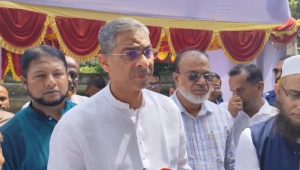
Jatiya Sangsad Deputy Speaker Barrister Kayser Kamal has called for the formation of a “Special Task Force” to identify and resolve the long-standing problems of the haor region.
Speaking as the chief guest at a seminar on Sunday at the Shafiqul Kabir Auditorium of Dhaka Reporters Unity, the deputy speaker added that no effective measures have been taken for the haor region since independence.
He said although the people of the haor make significant contributions to the country’s food security and economy, they have faced decades of neglect and discrimination.
The seminar, titled “Disasters of Haor: Relevance of the Book ‘Chashabhushar Santan’ and Way Forward,” was organised by the Netrokona Journalist Forum-Dhaka. Presided over by the organisation’s president, Rafiq Muhammad, the keynote paper was presented by novelist and journalist Muhammad Mofazzal.

Bureaucratic Hurdles and Systematic Oppression Barrister Kayser Kamal expressed concern over the decision-making process regarding the haor, noting that steps are often taken without consulting the victims or local Members of Parliament due to bureaucratic complexities.
He emphasised that there is no alternative to long-term, sustainable, and integrated initiatives to protect the lives and livelihoods of the haor people.
Sharing his personal experience as someone born and raised in the haor, the Deputy Speaker lamented that discussions only arise when disasters strike, while research-based planning and realistic initiatives for permanent solutions remain absent.




He highlighted the mismanagement of fishery resources, where influential individuals occupy assets through lease systems, depriving genuine fishermen. Furthermore, he noted that farmers are suffering because the natural flow of water is being blocked by large pits in the canals.
He also pointed out a form of “systematic oppression” where farmers are forced to provide 43kg of paddy for a maund, even though the hoarders only pay for the standard 40kg. He expressed hope that by working together under the prime minister’s leadership, a more humane Bangladesh can be built for future generations.
Critique of development projects
Dr Anwarul Huq, lawmaker and president of Netrokona District BNP, spoke as a special guest, mentioning that any damage to haor crops due to early floods has a negative impact on the national economy.
He strongly criticised the Haor Department, alleging that billions of taka have been wasted on road repairs and that “looting” has occurred in the name of development without benefiting the residents.
Economist Professor Anu Muhammad argued that development serving individual interests at the expense of the collective is not beneficial to the state. He identified unplanned dams, wrong agricultural policies, and inadequate drainage as the primary causes of the crisis.
He called for river dredging, maintaining natural water flows, and involving local farmers in the supervision of dam construction.
Calls for a separate ministry
Lyricist and thinker Shahidullah Farayeji said while the country has seen various party-led governments over the last 55 years, it has yet to see a “people’s government” that truly respects the producers and farmers.
Other speakers at the seminar, including journalists Faruk Ahmed Talukdar, Masud Karim, Rajan Bhattacharya, and Bahram Khan, as well as affected farmer Kayes Azad Ashrafee, demanded the formation of a separate ministry for haor affairs.
They also stressed the importance of science-based water management, biodiversity conservation, and the preparation of accurate lists of victims.