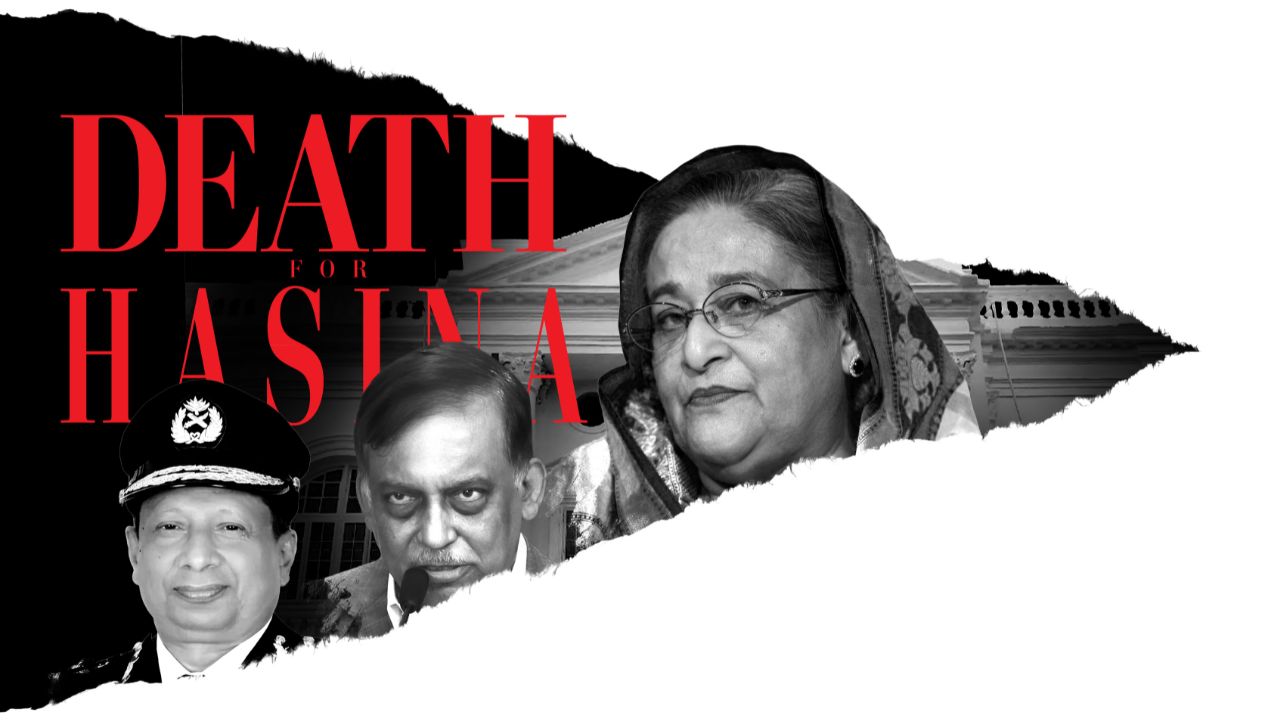

In a consequential judgment, a special Dhaka tribunal on Monday awarded capital punishment to deposed prime minister Sheikh Hasina in absentia, holding her responsible for ordering a brutal crackdown on a student-led uprising last year.
Hasina, who ruled the country for fifteen and a half consecutive years and dealt with political opposition with an iron hand, is the first former head of government in Bangladesh to have a death sentence hanging over her head.
A three-member International Crimes Tribunal (ICT)-1, led by Justice Md Golam Mortuza Mozumder, pronounced the verdict against Hasina and former home minister Asaduzzaman Khan Kamal in a jam-packed courtroom that included families of victims, holding them guilty on several charges under the doctrine of superior command responsibility.
Awami League, which activities have been banned, immediately rejected the verdict, terming it a politically motivated one.
The tribunal also found former Inspector General of Police Chowdhury Abdullah Al-Mamun guilty and awarded a lenient sentence of five-year imprisonment due to his role of uncovering the truth through cooperation with the investigators as state approver.
While pronouncing the verdict, the tribunal observed that Hasina had the authority over Kamal and Mamun and it was her responsibility to stop the atrocities carried out nationwide.
Similarly, Kamal held superior command responsibility over Mamun and other senior security officials. But in all the cases, they not only failed but also incited and abetted the commission of the crimes, it observed.
Hasina in 2010 set up the tribunal to prosecute local collaborators of Pakistani forces after an earlier attempt was called off following the assassination of Bangladesh founding president Bangabandhu Sheikh Mujibur Rahman. Now, she has been sentenced by the same court after 15 years on charge of crimes against humanity.
The then top leadership of the Jamaat-e-Islami party, which opposed creation of Bangladesh and few BNP leaders were either executed or jailed as per the verdict of this special tribunal. The parties termed those cases politically motivated.

The landmark verdict against Hasina and Kamal featured 453 pages with six portions. Judge Md Mohitul Haque Enam Chowdhury read his portion until 1:10pm while Justice Md Shafiul Alam Mahmood continued the middle section until 1:56pm.
The tribunal chairman then read out the sentencing portion, concluding the delivery at about 2:45pm.
The defendants in this case faced five charges related to instigating, provoking, and directing the killing of 1,400 people in suppressing the July movement, “superior command responsibility,” and “joint criminal enterprise.”
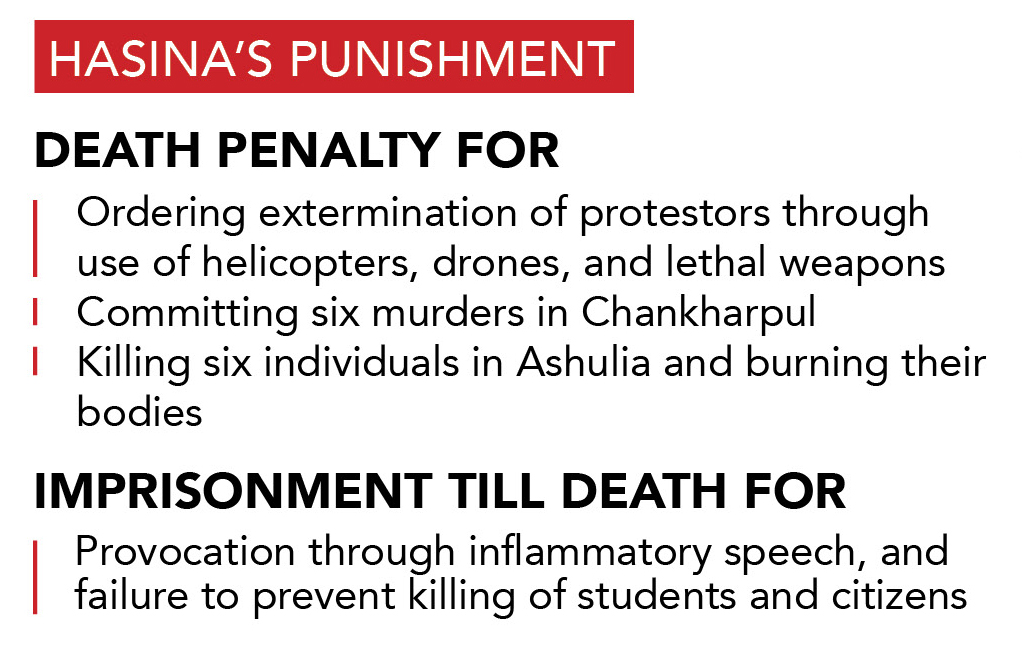
On the first charge—incitement, provocation, assistance, involvement, and failure to prevent the killing of students and citizens through “inciteful” speech—Sheikh Hasina was sentenced to life imprisonment.
On the second charge “ordering extermination” of protestors through the use of helicopters, drones, and lethal weapons, on the fourth charge, six murders in Chankharpul, and on the fifth charge, killing six people in Ashulia and burning their bodies, the court found Sheikh Hasina guilty. These three charges together resulted in a death sentence.
On the fourth charge (six murders in Chankharpul) and the fifth charge (six murders and burning of bodies in Ashulia), former home minister Asaduzzaman Khan Kamal and former IGP Abdullah Al-Mamun were also found guilty. Kamal received the maximum punishment.



Mamun, having cooperated by providing information as a state witness, received a reduced sentence of five years in prison.
Along with the maximum sentences for Hasina and Kamal, the court also ordered the confiscation of all their property in favour of the state.
The government was also instructed to arrange compensation for the families of those killed and for the injured during the July movement.
In the morning, Mamun was brought to court for the verdict. After the verdict, he was taken back to prison.
After failing to control the student movement, initiated over the quota reforms in government job, which later turned into a one-point demand for the resignation of the Awami League government, Hasina fled to India by a helicopter on 5 August last year.
After the fall, dozens of cases were filed against her in various courts and police stations across the country. Numerous AL leaders and activists were accused in those cases. Amid this, the interim government initiated the trial of the July killings at the ICT.
The fall of Hasina through mass uprising drew global attention. As a result, on the day of her verdict, international media outlets, along with the whole of Bangladesh, kept their eyes on the tribunal.
For the first time in Bangladesh’s history, the proceedings for announcing the verdict in this case were broadcast live from the court.
Announcing the sentences, Tribunal Chairman said that under Section 20(3) of the International Crimes (Tribunals) Act of 1973, the sentences would be carried out in accordance with prevailing custom.
According to Bangladeshi custom, a civilian court’s death sentence is carried out by hanging the convict until death.
The defendants will have the opportunity to appeal this verdict. However, because Hasina and Kamal are fugitives, they must surrender to the tribunal and file an appeal within one month if they wish to appeal.
Hasina issued a statement from India, calling the verdict politically motivated and accusing the interim administration led by Muhammad Yunus of orchestrating a campaign of vengeance.
The families of those killed in the July movement and the injured expressed joy in front of the tribunal and hailed the verdict.
In an immediate reaction Chief Prosecutor Mohammad Tajul Islam said they believe this verdict is not any kind of revenge for the past rather it is the nation’s pledge and a step toward the establishment of justice.
“This verdict proves that no matter how big or powerful a criminal is, they are not above the law. And Bangladesh is a state where even the most powerful offender must face accountability and receive the punishment they deserve,” he said.
The prosecutor said if this verdict brings even a small measure of relief to the families of the 1,400 vibrant young people who gave their lives to end this dictatorship, that alone is the achievement of the prosecution.
Claiming that the verdict meets “international standards,” Tajul said the quality of evidence shown here, the type of testimony presented in this court, these would meet the standards of any court in the world.
“And anywhere in the world, if this evidence were presented, all the defendants punished today would have received these same sentences,” he said.
Expressing satisfaction, Attorney General Md Asaduzzaman said, “In honouring our obligations to the martyrs, the country, the people, democracy, the constitution, the rule of law, and future generations, this verdict is historic. It will bring peace, and it will stand as a milestone in Bangladesh’s justice and rule-of-law landscape.”
In response to a question, he said, “The issue of banning Awami League was not part of the case. So, the tribunal made no comment on it. Sheikh Hasina and Asaduzzaman Khan Kamal have been ordered to forfeit all their property in Bangladesh.”
When asked how the verdict would be implemented, he replied, “Implementation will follow the legal path, in accordance with the law. The government will not adopt any unlawful or illegitimate path.”
Since fugitive Hasina did not appear at the hearings, she did not get the opportunity to personally defend herself in the case.
In interviews with various international media, she denied ordering the July killings. Her state-appointed lawyer, Md Amir Hossain, also claimed she was innocent during the tribunal proceedings.
In an immediate reaction after the verdict, Amir said, “The verdict did not go in my favour, it went against me. I am aggrieved. I am holding my pain within. I am deeply hurt by the death sentences.”